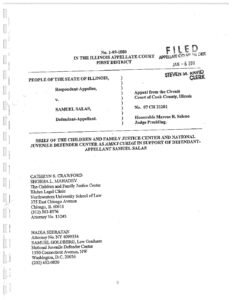
The Children and Family Justice Center and The Gault Center Amicus Brief, Illinois v. Salas
This amicus brief by Juvenile Law Center and The Gault Center argues Illinois automatic transfer law does not comply with recent research and findings on adolescent development as recognized by the Supreme Court jurisprudence in Roper and Graham. Further, amici argue the state’s automatic transfer statute violates the proportionality clause of Article I, Section 11 of the Illinois Constitution since it does not consider individual youthfulness, mental culpability, or amenability to rehabilitation. Additionally, amici argue the transfer statute contravenes the history, purpose, and specialized function of the juvenile court and subjects children to unnecessarily punitive and dangerous adult criminal courts and facilities.
From the Summary of the Argument in the Brief: “Five years ago, in a watershed decision ending the application of the death penalty to children under the age of 18, the United States Supreme Court merged scientific research on adolescent brain development with constitutional principles to find that children were “categorically less culpable than adults.” Roper v. Simmons, 543 U.S. 551, 567 (2005) (quoting Atkins v. Virginia, 536 U.S. 304,316 (2002)). This past year, the Supreme Court conducted a similar analysis in Graham v. Florida, holding that a child under the age of 18 who did not commit a homicide could not be sentenced to life imprisol1II1:ent without the possibility of parole. Graham v. Florida, 130 S. Ct. 2011
(U.S. 2010). The Graham and Roper courts relied upon scientific research to carve out a separate jurisprudence with respect to children, differentiating them from adults based on their lessened culpability and greater amenability to rehabilitation. Implicit in these decisions is the recognition that the underlying science is not dependent upon the nature of the actions taken by a minor. In other words, a child’s right to be treated as a child cannot be forfeited solely based on the crime charged.
Illinois’ automatic transfer statute, which excludes a child who is over the age of 15 from the jurisdiction of the juvenile court without any individualized assessment or consideration of that child’s youth-particularly his lessened culpability and amenability to rehabilitation-cannot be squared with the emerging scientific research that served as the basis of the Supreme Court’s opinions in Roper and Graham or by the reasoning of those decisions. Moreover, the automatic transfer statute violates the Illinois Constitution’s proportionate penalties clause. Whereas a child convicted of murder in juvenile court faces a maximum sentence of incarceration until he is 21 years old, a minor prosecuted for the same offense in adult court faces a minimum of 20 years of incarceration; with mandatory sentencing enhancement statutes such as the ones applied in Samuel’s case, the minimum sentence increases to 45 years. The automatic transfer of a child and subsequent imposition of a mandatory sentence without any consideration of ”the seriousness of the offense” (culpability) or the child’s ability to be “restored to useful citizenship” (amenability to rehabilitation) is accordingly unconstitutional. ILL. CONST. art. I, § 11
Illinois’ automatic transfer statute also contravenes the history, purpose and specialized function of the juvenile court, the latter of which is consistent with the logic and science in the Roper and Graham decisions. While the purpose of the juvenile court has changed over time and has admittedly conformed to legislative policies that address more punitive objectives, it has maintained its corrective and rehabilitative purpose, striving to hold a child accountable for his actions while also recognizing his potential to change. In addition, treating a 16-year-old as an adult in criminal court is contrary to national norms, laws and court decisions that recognize 18 years old as the age defining adulthood in a variety of contexts. Because juvenile court is the most appropriate place in which to try Samuel Salas, amici support appellant’s request that this Court vacate his conviction and sentence and remand this matter for a new trial under the Juvenile Court Act. Alternatively, amici respectfully suggest that this Court vacate Samuel’s conviction and sentence and remand the matter for an individualized determination as to whether he should be prosecuted in juvenile or adult court.”