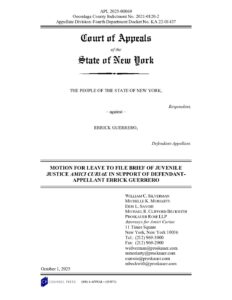
Juvenile Justice Amici Amicus Brief, New York v. Guerrero
This amicus brief from over 26 juvenile justice amici, including the Gault Center, , argues 1) the spirit and text of New York’s passage of landmark Raise the Age Law rejects the attitudes that underlay the Juvenile Offender Act of 1978, 2) New York’s Raise the Age Law and its legislative history demands a youth subject to adult prosecution only in “extremely rare and exceptional cases”, 3) before courts determine a young person is not amendable to services, they are required to make an individualized inquiry into their needs and whether those needs have been addressed, and 4) adopting a broad definition of “extraordinary circumstances” negatively impacts public safety and widens racial disparities.
From the Introduction of the Brief:
“Raise the Age carves out especially serious felonies—cases involving allegations of significant physical injury, a sexual offense, or display of a deadly weapon—from removal. CPL § 722.20(4). However, for cases that do not include any of these elements, a prosecutor must demonstrate “extraordinary circumstances” to prevent removal to family court. “Extraordinary” means what it says—unusual and extremely rare. Consistent with Raise the Age’s legislative history and intent, this requires a showing of “highly unusual and heinous facts” and “strong proof that the young person is not amenable or would not benefit in any way from the heightened services in the family court.” People v. J.J., 2022 WL 842078, at *2 (Ulster Cnty. Ct. Mar. 15, 2022) (quoting N.Y. Assembly Debate of 2017, at 39. This individualized inquiry must be grounded in principles of adolescent development and evidence-based best practices in juvenile justice, and must incorporate consideration of mitigating circumstances even when the required showing is made.
No such showing was made here. The lower courts disregarded both the express language of the statute and the legislative intent behind Raise the Age, applying a broad interpretation of “extraordinary” to prevent removal of Mr. Guerrero’s serious but not exceptional robbery and burglary charges. They failed to engage in the required individualized inquiry; did not evaluate whether Mr. Guerrero’s actions were “heinous and highly unusual,” much less make such a finding; prematurely and incorrectly weighed mitigating circumstances; and improperly considered confidential family court records in finding extraordinary circumstances. Upholding the Appellate Division’s decision in this case would eviscerate Raise the Age’s protections. Far from serving New York’s youth and their communities, such an interpretation would force many of the youth Raise the Age sought to protect into adult criminal court and perpetuate the very harms Raise the Age sought to address.”