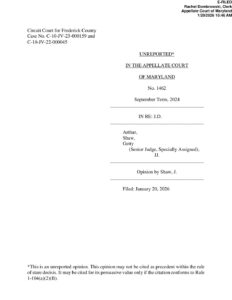
In re J.D., 2026 Md. App. LEXIS 57 (Md. App. Ct. 2026)
In re J.D., the Appellate Court of Maryland vacated the circuit court’s imposition of a suspended commitment to the Department of Juvenile Services because this dispositional option is not authorized by the Maryland Rules or the Juvenile Causes Act.
The court offered the following language in support:
“In our review of the Juvenile Causes Act, we found the statute to be clear and unambiguous. It plainly provides for three types of disposition: probation, commitment or court ordered home services. The statute does not reference or include language conferring upon the juvenile court, the ability to stay a commitment or to grant a temporary disposition. The subsections of the statute that the State argues allow the court to impose a suspended commitment or temporary disposition are distinct and do not provide that a juvenile court can mix and match dispositions or delay the imposition of a commitment. We note that “[as] a court of limited jurisdiction, the juvenile court may exercise only those powers granted to it by statute.” In re Ryan W., 434 Md. 577, 602, 76 A.3d 1049 (2013) (citing In re Franklin P., 366 Md. 306, 334, 783 A.2d 673 (2001). As explained in In re W.Y. and In re S.F., a juvenile court does not have the authority to act outside of the boundaries of the statute, even if the court determines that such requirements further the child’s rehabilitative goals. In re W.Y., 228 Md. App. 596, 611, 142 A.3d 602(2016); In re S.F., 477 Md. 296, 326, 269 A.3d 324 (2022).
In sum, the plain meaning of section 3-8A-19(d) of the Maryland Courts and Judicial Proceedings Article is clear and unambiguous. It permits three dispositions: probation, commitment, or services in the home for the child and family. Here, the court erred in imposing a disposition not authorized by law.”