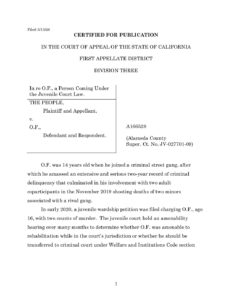
People v. O.F. 2026 LEXIS 149 (CA. 2026)
The California Court of Appeals First District reversed and remanded a trial court’s order transferring O.F. to adult court, finding that the trial court must make specific findings on a young person’s amenability to rehabilitation and must meet the heightened burden of proof.
The court reasoned in part, “The recent amendments to section 707 have led to a “renewed focus on rehabilitation” of delinquent minors. (S.S., supra, 89 Cal.App.5th at p. 1287.) “ ‘[C]ognitive science has proven that children and youth who commit crimes are very capable of change.’ ” (O.G. v. Superior Court (2021) 11 Cal.5th 82, 92.) “Rehabilitation is the way forward, and that includes giving juveniles who have made a mistake the opportunity to create a new future as they prepare to reenter our society as adults.” (S.S., at pp. 1285-1286.) Thus, a minor’s amenability to rehabilitation is the central and “dispositive” question in proceedings under section 707 (S.S., at p. 1286), and the juvenile court’s analysis of the section 707 criteria must be “focused through the lens of amenability to rehabilitation” (S.S., at p. 1288). The heightened standard of proof applies throughout this analysis (see rule 5.770(b)), reinforcing the important policy of maintaining youth offenders in the juvenile court system when the evidence of their resistance to rehabilitation is less than clear and convincing.
Section 707 and rule 5.770 do not define the term “amenable to rehabilitation.” Given this omission, “we look to the plain language” of the phrase “as understood by the ordinary person, which would typically be a dictionary definition.” (People v. Johnson (2020) 50 Cal.App.5th 620, 633.) Amenability is defined as “having or showing willingness to agree or to accept something that is wanted or asked for,” while rehabilitation is defined as “the process of restoring someone (such as a criminal) to a useful and constructive place in society.”5 Thus, the ultimate question presented in this case is whether clear and convincing evidence supports the juvenile court’s conclusion that O.F., while under the court’s jurisdiction, is not willing to accept treatment that would restore him to a constructive place in society.
On this score, we observe the record contains abundant and uncontroverted evidence of O.F.’s willingness to engage in the services and therapeutic interventions available to him in juvenile hall. Every witness at the amenability hearing who personally knew O.F., including Probation Officers Yeh and Bradley, praised his efforts and remarked positively about his consistent engagement and participation in treatment at juvenile hall, as well as his potential for growth, reflection, and maturity. O.F. showed a strong rapport with clinicians and developed prosocial relationships. He developed an aptitude for poetry, became committed to his academic progress, and is well on his way to earning a college degree. All witnesses agreed that O.F. has “gone above and beyond” what other youths in juvenile hall achieved. And critically, O.F. maintained this behavior steadily during his more than two years in juvenile hall prior to the transfer decision. No witness suggested O.F. lacked sincerity or commitment to his rehabilitation.
. . .
To summarize, we conclude that on the record before us, the juvenile court erred in finding the second criterion weighed in favor of transfer. As to the first, third, fourth, and fifth criteria, we instruct the court on remand: (1) to conduct a new analysis that gives weight to all the factors relevant to these criteria (§ 707, subd. (a)(3)(A)(ii), (C)(ii), (D)(ii), (E)(ii)), with a view towards O.F.’s amenability to rehabilitation; (2) to reassess whether the first, third, fourth, and fifth criteria weigh in favor or against transfer, with a view towards O.F.’s amenability to rehabilitation; and (3) to reassess the global question of whether O.F. is amenable to rehabilitation while under the jurisdiction of the court. On remand, the juvenile court remains free to accept new evidence relevant to whether O.F.is amenable to rehabilitation.”