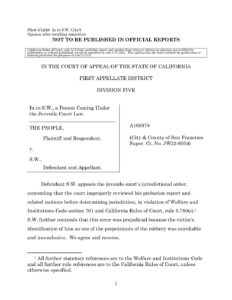
In re S.W. 2026 LEXIS 1699 (CA. 2026)
The California Court of Appeals, First District, found that the trial court improperly reviewed S.W.’s probation report and related motions, which included evidence of the alleged victim’s identification of S.W. as one of the perpetrators of the robbery, before determining jurisdiction, was error, and reversed the case.
The court reasoned in part, “Turning to the merits, we hold that the juvenile court’s review of probation reports and related documents in the court file prejudiced S.W. because the evidence presented at the jurisdictional hearing was close and did not conclusively establish that S.W. was involved in the robbery.
If the jurisdictional facts presented at the hearing are “far from conclusive,” the juvenile court’s review of the probation report prior to determining jurisdiction constitutes prejudicial error. (Gladys R., supra, 1 Cal.3d at p. 862.) Thus, if the “determination of jurisdiction” is made by “closely balanced evidence,” reversal is proper. (In re James B. (2003) 109 Cal.App.4th 862, 875.)
At the jurisdictional hearing, the parties stipulated that S.W. was arrested outside of a parking garage four and a half hours after the robbery and that Marcus C.’s watch was found in a car matching the description that Marcus C. had given to the police. But the stipulation did not describe the car’s location in relation to where S.W. was arrested or any other facts connecting S.W. to the car or watch. And there was no evidence at the hearing connecting S.W. to the car or watch. Indeed, the only evidence of this connection came from the probation report and other related documents in the court file that the court should not have reviewed or considered.
Instead, to establish S.W.’s guilt, the prosecution primarily relied on Marcus C.’s in-court identification of S.W. as the one who had pistol whipped him. But there were several issues with Marcus C.’s testimony that cast doubt on the reliability of his identification of S.W.
. . .
Based on these issues and the factors, such as limited exposure, distractions, and the presence of guns, identified by S.W.’s expert as casting doubt on Marcus C.’s identification of S.W. as one of his attackers, we conclude that the evidence of S.W’s guilt was “far from conclusive.” (Gladys R., supra, 1 Cal.3d at p. 862.) We therefore find prejudicial error. (Ibid.)”