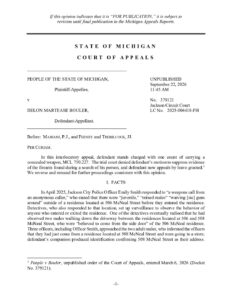
People v. Bouler, 2026 Mich. App. LEXIS 8007 (Mich. Ct. App. 2026)
The 1st District Court of Appeals in Michigan reversed a trial court’s denial of a youth’s motion to suppress, finding that the police lacked reasonable suspicion to conduct a search because there was no basis to believe that the youth was armed.
The court stated in relevant part:
Officers responded to “a weapons call from an anonymous caller,” who stated that there were “juvenile” “mixed males” “waiving guns around” outside of a residence located at 506 McNeal Street before they entered the residence. Officer Smith candidly conceded that she could see that neither defendant nor his companion were juveniles, and that concession is supported by the body-camera footage. Additionally, although Officer Smith was not asked to clarify whether defendant and his companion were of mixed race, the body-camera footage reveals that the men were both black males, with nothing suggesting mixed-race ancestry. Moreover, when the men identified themselves, they indicated that they had come from 508 McNeal Street, not 506 McNeal Street.
Accordingly, the information that the officers had before they conducted their search, which is the measuring factor for the reasonableness of their suspicion, did not provide the officers with an objectively reasonable particularized suspicion that defendant was “engaged in, or about to be engaged in, criminal activity.” Prude, 513 Mich at 387. The fact that defendant was later found to have a gun on his person does not suggest that the officers, before the frisk, had a reasonable basis for suspecting defendant of engaging in unlawful conduct. See Florida v JL, 529 US 266, 271; 120 S Ct 1375; 146 L Ed 2d 254 (2000); see also Prude, 513 Mich at 387.