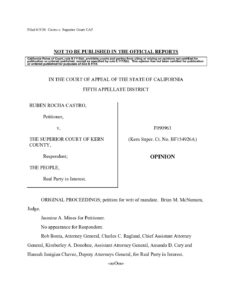
Castro v. Superior Court of Kern, 2026 Cal. App. Unpub. LEXIS 2761 (Cal. Ct. App. 2026)
The California 5th District Court of Appeal held that the defense was entitled to discovery related to racial disparities in plea deals to voluntary manslaughter, finding that defense’s statistical evidence showing that Latine individuals in Kern County were more likely to be charged with murder and receive longer sentences than white individuals satisfied the “plausible factual foundation” required under the California Racial Justice Act.
The court stated in relevant part:
In support of his discovery request, Castro presented statistical evidence purportedly showing the following for Kern County: (1) Hispanic people were more likely to be charged with murder than other races; (2) Hispanic people are more frequently convicted of murder than defendants of other races; and (3) Hispanic people were punished more severely for murder than defendants of other races. He also submitted a “Publicly Accessible Data Sets” report for 2017 showing arrests in Kern County for 2017 consisted of 42 percent Hispanic people, 39 percent White people, 13 percent Black people, and 6 percent other race. The People concede Castro’s statistical evidence meets the low threshold of a plausible factual foundation for discovery under the RJA. We agree.
. . . .
To be sure, the strength of the evidence against a defendant is a reasonable factor for a prosecutor to consider in deciding whether to offer a plea deal. But studies have found plea bargaining can exacerbate racial disparities in the criminal justice system. (CRCP Report, supra, at p. 57.)18 This does not reflect explicit bias on the prosecutor’s part but rather implicit bias. Even if a district attorney’s office did not intentionally discriminate in exercising its charging discretion through plea bargaining, the defendant “does not need to prove intentional discrimination” to show a violation of the RJA. (§ 745, subd. (c)(2).) This is because the RJA “was enacted to address much more than purposeful discrimination based on race. Indeed, the primary motivation for the legislation was the failure of the judicial system to afford meaningful relief to victims of unintentional but implicit bias.
. . . .
The intent of the Legislature is not to punish this type of bias, but rather to remedy the harm to the defendant’s case and to the integrity of the judicial system.