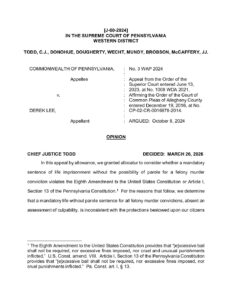
Commonwealth v. Lee, 2026 Pa. LEXIS 553 (Pa. 2026)
The Supreme Court of Pennsylvania ended the use of mandatory life without parole for felony murder cases based on the state constitution’s prohibition against cruel punishment. Finding that Pennsylvania’s constitutional safeguards against cruel punishment offers greater protections than the 8th Amendment of the U.S. Constitution, the Court reasoned that the blanket imposition of mandatory life without parole absent an individual consideration of culpability heightens the risk of disproportionate punishment. The Court also noted that the practice of sentencing an individual to mandatory life without parole for felony murder cases where intent is essentially immaterial does not meet the goals of rehabilitation, deterrence, retribution, or incapacitation (i.e., the traditional penological justifications for criminal punishment). Accordingly, the Court finds that the Pennsylvania state constitution prohibits mandatory life without parole for felony murder cases and holds that there must be an individualized determination at sentencing. This decision reflects the opportunity to challenge mandatory sentences for felony murder cases based on heightened state constitutional principles. In addition, the Antiracism and Community Lawyering Practicum at Boston University School of Law, Fred T. Korematsu Center for Law and Equality, and the NAACP Legal Defense and Educational Fund submitted an amicus brief on this case highlighting several racial justice arguments that defenders may also reference to build effective challenges to felony murder cases from a racial justice lens.