Community-Based Alternatives to Youth Incarceration
This report from the RAND Corporation highlights needs that various delinquency system practitioners and policy experts identified to support the closure of juvenile facilities and improvement of alternatives to incarceration.
From the Executive Summary:
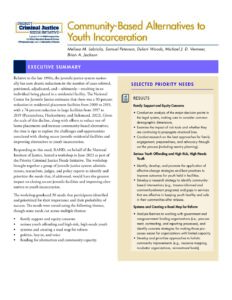
Relative to the late 1990s, the juvenile justice system nation ally has seen drastic reductions in the number of cases referred, petitioned, adjudicated, and—ultimately—resulting in an individual being placed in a residential facility. The National Center for Juvenile Justice estimates that there was a 50-percent reduction in residential placement facilities from 2000 to 2019, with a 74-percent reduction in large facilities from 1997 to 2019 (Puzzanchera, Hockenberry, and Sickmund, 2022). Given the scale of this decline, along with efforts to reduce out-of home placements and increase community-based alternatives, the time is ripe to explore the challenges and opportunities associated with closing secure juvenile residential facilities and improving alternatives to youth incarceration.
Responding to this need, RAND, on behalf of the National Institute of Justice, hosted a workshop in June 2023 as part of the Priority Criminal Justice Needs Initiative. The workshop brought together a group of juvenile justice system administrators, researchers, judges, and policy experts to identify and prioritize the needs that, if addressed, would have the greatest impact on closing secure juvenile facilities and improving alter natives to youth incarceration.
The workshop produced 30 needs that participants identified and prioritized for their importance and their probability of success. The needs were sorted using the following themes, though some needs cut across multiple themes:
- family support and equity concerns;
- serious youth offending and high-risk, high-needs youth;
- systems and creating a road map for reform;
- politics, buy-in, and voice;
- and funding for alternatives and community capacity.