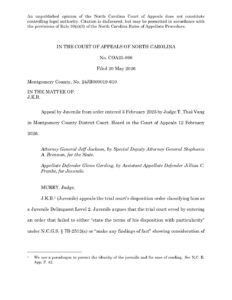
In re J.K.B., 2026 N.C. App. LEXIS 399 (N.C. Ct. App. 2026)
The North Carolina Court of Appeals vacated a disposition order, finding that the failure to specify the length of probation violated state statute. The court stated in relevant part:
In juvenile-delinquency proceedings, the trial court’s dispositional order must “be in writing” and “contain appropriate findings of fact and conclusions of law.” N.C.G.S. § 7B-2512(a). Additionally, the trial court must “state with particularity, both orally and in the written order of disposition, the precise terms of the disposition including the kind, duration, and the person who is responsible for carrying out the disposition and the person or agency in whom custody is vested.” Id. (emphasis added). A trial court reversibly errs by failing to do so. See, e.g., In re J.L.B.M., 176 N.C. App. 613, 628 (2006) (remanding where trial court made proper oral finding but failed to include it in written dispositional order).
Here, the trial court failed to indicate, both orally and in writing, the length of Juvenile’s probationary term. Although the trial court orally referenced Juvenile’s probation, it never specifically ordered it or indicated its length. Likewise, the trial court failed to document the length of Juvenile’s probation by leaving the Form’s Probation section entirely blank. Thus, the trial court erred by failing to state the disposition’s “precise terms” “with particularity” orally and in writing. N.C.G.S. § 7B-2512(a). Accordingly, we vacate and remand the order for entry of a new dispositional order in accordance with N.C.G.S. § 7B-2512(a). See J.L.B.M., 176 N.C. App. at 628.