In re of E.S.S., 2026 Minn. LEXIS (Minn. 2026)
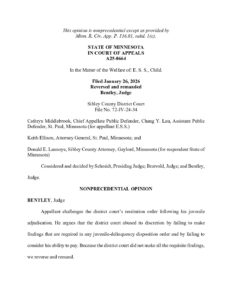
The Minnesota Court of Appeals held that the district court failed to make findings of fact required by statute when ordering restitution and remanded the case for the trial court to make the requisite findings.
The court held in relevant part: “Juvenile-delinquency orders require written findings “to show that the district court considered vital standards and to enable the parties to understand the court’s decision.” I.N.A., 902 N.W.2d at 642 (quotation omitted). These written findings are necessary to “permit meaningful appellate review” of a disposition order. In re Welfare of R.V., 702 N.W.2d 294, 308 (Minn. App. 2005). Accordingly, “inadequate written findings in a juvenile-disposition order constitute reversible error.” I.N.A., 902 N.W.2d at 642. Findings are adequate when they fully address all the required statutory factors. See id.; In re Welfare of N.T.K., 619 N.W.2d 209, 211-12 (Minn. App. 2000).
The district court’s disposition order does not expressly include findings relevant to public safety, E.S.S.’s best interests, and the necessity of the disposition to E.S.S.’s rehabilitation. See Minn. R. Juv. Delinq. P. 15.05, subd. 2(A)(1); Minn. Stat. § 260B.198, subd. 1(a), (b). The district court appeared to implicitly consider E.S.S.’s best interests and rehabilitation by noting in its order that E.S.S. is “behind his peers in school,” he “has a limited ability to earn significant income,” and that he “spent most of the past year” in a youth detention center. But implicit findings about public safety and the juvenile’s best interest are not sufficient. I.N.A., 902 N.W.2d at 642. Without explicit, written findings, we cannot meaningfully review the order or conclude that the district court met its obligations under section 260B.198 or rule 15.05.”