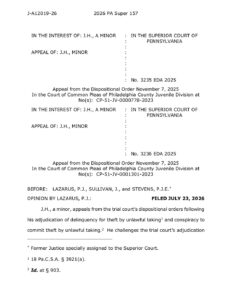
In the interest of J.H., Pa. Super. LEXIS 373 (Pa. Super. Ct. 2026)
The Pennsylvania Superior Court vacated an adjudication because the trial court prevented meaningful participation by defense counsel, violating due process. The court stated in relevant part:
While delinquency proceedings may be conducted more informally than adult criminal cases, juveniles are nonetheless entitled to due process during adjudicatory hearings, which includes, inter alia, the right to confront and cross-examine witnesses. Commonwealth v. Lee, 260 A.3d 208, 215 (Pa. Super. 2021); see also Application of Gault, 387 U.S. 1, 30 (1967). “[P]rocedural due process requires, at its core, adequate notice, opportunity to be heard, and the chance to defend oneself before a fair and impartial tribunal having jurisdiction over the case.” S.T. v. R.W., 192 A.3d 1155, 1161 (Pa. Super. 2018) (quotation marks and citation omitted). “[T]he in-court presentation of evidence is a fundamental component of due process. In almost every setting where important decisions turn on questions of fact, due process requires an opportunity to confront and cross-examine adverse witnesses.” Interest of S.L., 202 A.3d 723, 729 (Pa. Super. 2019) (alteration and citation omitted); see also Hall v. Luick, 461 A.2d 248, 250 (Pa. Super. 1983), quoting Goldberg v. Kelly, 397 US. 254, 269 (1970).
. . . .
Due process is not an end in itself; rather, it is fundamental to the truth-seeking process in judicial proceedings. As the United States Supreme Court reflected in Gault, supra, “[f]ailure to observe the fundamental requirements of due process has resulted in instances, which might have been avoided, of unfairness to individuals and inadequate or inaccurate findings of fact and unfortunate prescriptions of remedy.” Id. 387 U.S. at 19-20; see also Commonwealth v. Johnson, 234 A.2d 9, 14-15 (Pa. Super. 1967). Procedural practices that comport with due process “are our best instruments for the distillation and evaluation of essential facts from the conflicting welter of data that life and our adversary methods present. It is these instruments of due process which enhance the possibility that truth will emerge from the confrontation of opposing versions and conflicting data.” Gault, 387 U.S. at 21. The potential pitfalls of failing to meet the standards for due process, which Gault so presciently anticipated, are on full display in the instant matter. The trial court gave counsel and participants little, if any, opportunity to develop a record upon which the court might reasonably have decided the case. As such, we find the evidence was murky, at best, and, at worst, entirely absent. The trial court’s often unsupported, and sometimes erroneous, findings and conclusions rely almost entirely on inferences and deductions, or are simply inaccurate.
. . . .
Given the lack of due process afforded J.H. at the hearing, and the trial court’s unsupported conclusions, we are constrained to vacate J.H.’s orders of adjudication and disposition. On remand, we instruct the trial court to hold a full adjudicatory hearing that conforms to the requirements of due process, the Rules of Juvenile Court Procedure, and the Juvenile Act. At this hearing, the parties should be permitted to call, question, and cross-examine witnesses, and the trial court is to permit witnesses to complete their answers, unless such questions and/or answers are legally objectionable.