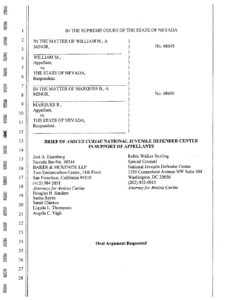
The Gault Center Amicus Brief, In the Matter of William M.
This amicus brief by The Gault Center and others argues Nevada’s certification statute violates a child’s right to effective assistance of counsel as it interferes with counsel’s ability to plan and participate in the adversarial fact-finding process and it fails to measure up to essentials of due process and fair treatment. Furthermore, amici argue this interference with a child’s right to counsel at transfer proceedings erodes public safety since it makes them more likely to face certification and transfer to adult court results in increased recidivism for these young people. Additionally, amici provide the harmful, long-lasting effects of presumptive certification provisions on young people, particularly Black and Latine youth who disproportionately face transfer to adult court.
From the Interest of Amicus Curiae Section of the Brief: “This Court requested amici to address the constitutionality of Sections 62B.390(2) and (3) on several grounds, (See Order). The NJDC, along with the other amici who have requested permission to sign onto this Brief, will address whether Sections 62B.390 (2) and (3) violate a juvenile’s rights to due process and to effective assistance of counsel, as guaranteed by the Sixth and Fourteenth Amendments to the United States Constitution.3 Amici contend that Sections 62B.390(2) and (3) violate Appellants’ rights to effective assistance of counsel because the provisions impermissibly interfere with counsel’s representation of the juvenile client.
In addressing these Constitutional violations, amici augment their arguments with a discussion of current social science and adolescent development research, which demonstrate the statute’s misguided approach to addressing youth crime, as well as the disproportionate effect certification has on communities of color. While Amici vehemently oppose any presumptive certification scheme that denies youth fundamental constitutional rights, the challenged provisions also fail to take account of widely accepted research describing the factors that are most closely associated with juvenile delinquency, thus denying youth – and the courts – the opportunity to present and consider evidence most relevant to the propriety of transfer. In stark contrast to the statute’s ostensible goals, Sections 62B.390(2) and (3) actually lead to the increased transfer of children like Marques and William to adult criminal court, contribute to the erosion of public safety, increase the likelihood of physical and emotional harm to children certified to adult criminal court and exacerbate racial disparities in the juvenile justice system.”