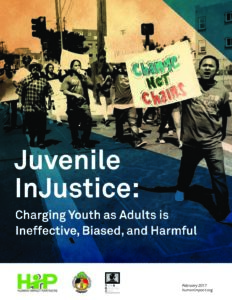
Juvenile Injustice: Charging Youth as Adults is Ineffective, Biased and Harmful
This report from Human Impact partners, CURYJ, and the California Alliance for Youth & Community Justice looks at the impact of transfer on young people in California using a Health Impact Approach (HIA).
From the report: “This report evaluates the health and equity impacts of charging youth as adults in criminal court. Our goal is to elevate the lived experiences of young people who have been tried as adults and to understand those experiences in the context of policy and public health research. In doing this, we can establish a more detailed picture of the negative health impacts of incarceration in the current criminal justice system — and move towards alternatives that do more to protect youth and their health.
. . .
This report aims to centralize the experiences of incarcerated youth of color, formerly incarcerated individuals, and their family members. Much has been written about juvenile system reform in general and juvenile transfer laws in particular. All too often, the voices of system-involved youth and their families — the people most impacted by these policies — are absent from these accounts
and analyses. By contrast, the content of this report is grounded in the personal narratives of focus group participants, the expertise of community organizations that work with systeminvolved families on a daily basis, and public health research.
Methodologically, this report follows a Health Impact Assessment (HIA) approach. An HIA is a public engagement and decision-support tool that can be used to assess policy and planning proposals and make recommendations to improve health outcomes associated with those proposals. The fundamental goal of an HIA is to ensure that health and health equity are considered in decision-making processes using a comprehensive and scientific approach that engages stakeholders in the process.”