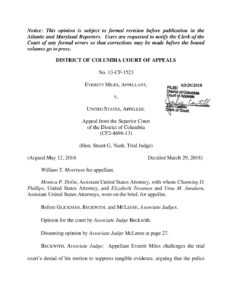
Miles v. U.S., 181 A.3d 633 (D.C. 2018)
The D.C. Court of Appeals reversed Mr. Miles’s convictions after concluding the police lacked reasonable suspicion to subject him to a Terry stop. Distinguishing the case from Wardlow v. Illinois, the Court found the anonymous tip and the circumstances around Mr. Miles’ flight from the police were not indicative of criminal activity and offered the following language in support:
“While Wardlow is not directly controlling here, the case makes clear that a defendant’s flight can be a relevant factor in the reasonable suspicion analysis. At the same time, as Justice Stevens pointed out in his partial concurrence and dissent, the Court in Wardlow stopped short of endorsing “the proposition that ‘flight is . . . necessarily indicative of ongoing criminal activity,'” and “adher[ed] to the view that ‘[t]he concept of reasonable suspicion . . . is not readily, or even usefully, reduced to a neat set of legal rules,’ but must be determined by looking to ‘the totality of the circumstances.'” Id. at 126 (Stevens, J., concurring in part and dissenting in part) (quoting Sokolow, 490 U.S. at 7-8) (ellipses and second set of brackets in original; internal cross-reference omitted). The Supreme Court has since emphasized on multiple occasions the fact-intensive and context-dependent nature of the reasonable suspicion analysis. See, e.g., Navarette v. California, 572 U.S. 393, 134 S. Ct. 1683, 1687, 188 L. Ed. 2d 680 (2014); Missouri v. McNeely, 569 U.S. 141, 133 S. Ct. 1552, 1564, 185 L. Ed. 2d 696 (2013); Arvizu, 534 U.S. at 273-74.
Our court, too, has made clear that “flight cannot imply consciousness of guilt in all cases.” Duhart v. United States, 589 A.2d 895, 900 (D.C. 1991) (quoting Smith v. United States, 558 A.2d 312, 316 (D.C. 1989) (en banc)); accord Pridgen v. United States, 134 A.3d 297, 303 n.17 (D.C. 2016); see also Alberty v. United States, 162 U.S. 499, 511, 16 S. Ct. 864, 40 L. Ed. 1051 (1896) (“Nor is it true as an accepted axiom of criminal law that ‘the wicked flee when no man pursueth, but the righteous are as bold as a lion.'”). There are myriad reasons an innocent person might run away from the police. In In re D.J., we explained that “[a]n individual may be motivated to avoid the police by a natural fear or dislike of authority, a distaste for police officers based upon past experience, an exaggerated fear of police brutality or harassment, a fear of being apprehended as the guilty party, or other legitimate personal reasons.” 532 A.2d 138, 142 n.4 (D.C. 1987); accord Wardlow, 528 U.S. at 132-35 (Stevens, J., concurring in part and dissenting in part). As to this “fear of police brutality,” Mr. Miles states in his brief that “the proliferation of visually documented police shootings of African-Americans that has generated the Black Lives Matter protests” suggests that the court was misinformed in In re D.J. when it characterized such fear as “exaggerated.” Appellant’s Br. 33 (citing Richard Pérez-Peña, Fatal Police Shootings: Accounts Since Ferguson, N.Y. Times, Apr. 8, 2015, http://www.nytimes.com/interactive/2015/04/08/us/fatal-police-shooting-accounts . html (“[I]n the year since an officer fatally shot Michael Brown . . . 1,000 or more people died at the hands of law enforcement officers . . . . That review reveals some expected patterns, like the disproportionate presence of African-Americans, people with mental illnesses, and young men among the dead.”)). In any event, an investigatory stop and frisk is not a “petty indignity”—”[i]t is a serious intrusion upon the sanctity of the person,” Terry, 392 U.S. at 16-17—and though we lack adequate empirical grounds for fathoming the extent to which innocent people might flee to avoid being subjected to one, it seems safe to say that the number is not insignificant. The critical question, therefore, is whether the principles discussed in Wardlow support a conclusion that Mr. Miles’s flight—under the circumstances of this case—sufficiently corroborated the anonymous tip to show that it was reliable in its assertion of illegality and accordingly to allow the police to conduct an investigatory stop.
We conclude that the answer to this question is no.”