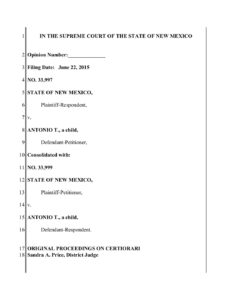
New Mexico v. Antonio T., 352 P.3d 1172 (N.M. 2015)
In New Mexico v. Antonio T., the Supreme Court of New Mexico ruled any statements elicited by a school official in the presence of a law enforcement officer may not be used against the child in a delinquency proceeding unless the child made a knowing, intelligent, and voluntary waiver of his statutory right to remain silent under N.M. Sec. 32A-2-14(C), (D).
In its ruling, the Court offered the following language in support:
“However, the character of Principal Sarna’s school disciplinary investigation changed once she requested Deputy Charley to be present when she questioned Antonio about his suspected delinquent behavior. While the State maintains that Deputy Charley’s presence in the room was innocuous, Deputy Charley’s presence in the room created a coercive and adversarial environment that does not normally exist during interactions between school officials and students. See T.L.O., 469 U.S. at 349-50 (Powell, J., concurring). Unlike school officials, whose primary duties focus on “the education and training of young people[,] . . . [l]aw enforcement officers function as adversaries of criminal suspects. These officers have the responsibility to investigate criminal activity, to locate and arrest those who violate our laws, and to facilitate the charging and bringing of such persons to trial.” See id. (Powell, J., concurring).
Deputy Charley’s mere presence during Principal Sarna’s questioning of Antonio converted the school disciplinary interrogation into a criminal investigatory detention, and it therefore triggered the protections provided by Section 32A-2-14(C). Before encountering Antonio, Deputy Charley was already on notice that Antonio was suspected of delinquent behavior. Principal Sarna testified that she involved Deputy Charley in the school’s investigation so he would know that Antonio was under the influence, and also to test Antonio’s breath for alcohol. As Principal Sarna interrogated Antonio about his suspected delinquent behavior, Deputy Charley noticed that Antonio’s speech was slurred and slow. During Antonio’s interrogation, Deputy Charley stood about five feet away from Antonio preparing a portable breath alcohol test while wearing a full uniform, including his badge and duty belt with a holstered gun. At a minimum, Antonio was not free to leave Principal Sarna’s office until Deputy Charley administered the portable breath alcohol test to Antonio.
Deputy Charley’s presence in the room not only created a coercive and adversarial environment, it also granted him access to evidence necessary to prosecute criminal delinquent behavior.”