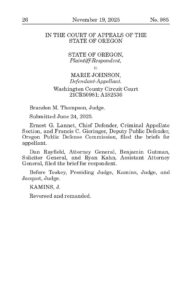
Oregon v. Johnson, 2025 Or. LEXIS 1863 (Or. 2025)
The Oregon Court of Appeals held that the trial court erred where it failed to instruct the jury on the “choice-of-evils” defense.
The court stated in relevant part: Regarding the first assignment of error, we review a trial court’s refusal to provide a requested jury instruction for legal error. State v. Jackson, 334 Or App 463, 465, 555 P3d 1279 (2024). “A criminal defendant is entitled to have
the jury instructed in accordance with [their] theory of the case if the instruction correctly states the law and there is evidence to support giving it.” State v. McNally, 361 Or 314, 320, 392 P3d 721 (2017). We review the record in the light
most favorable to the party requesting the jury instruction— in this case, defendant. Jackson, 334 Or App at 465. Defendant, a Black woman, arrived at her son’s school to pick him up and was still seated in the driver’s seat of her parked car when she was approached by two officers. One officer stood next to defendant’s door and told her that she had a Texas arrest warrant. Defendant believed
that there was a court order resolving the warrant, which she presented to the officers, and despite repeatedly asking to see the warrant, neither officer showed it to her. One of the officers instead stated, “When you go to jail, you’ll have a copy,” and that “[the warrant]’s at the Washington County Jail.” One of the officers also placed spike strips behind her car, though defendant did not see them. When the officers did not believe her, defendant felt frightened, threatened, and scared for her life. She believed the officers lacked the authority to arrest her and feared they would harm her. “[B]ecause [she did not] want to die,” defendant closed her car door, backed up, and drove out of the parking lot. One of the officers followed defendant in his car using lights, sirens, and the public address system. Defendant did not hear or see the officer’s car, although she later pulled over for what turned out to be an unrelated police car. At that point, defendant called 9-1-1, asked why the police were after her, and informed the dispatcher that she was “afraid of getting killed.”
. . .
Considering the record in the light most favorable to the defendant, defendant’s testimony is sufficient for a juror to determine that a reasonable person would believe that the officers created a threat of imminent physical injury greater than the injury of defendant’s offense—driving away (before pulling over and calling 9-1-1). See Jackson, 334 Or App at 470 (“[C]onsidering the evidence in the light most favorable to the proponent of the instruction means that we do not attempt to resolve conflicts in the evidence * * *. If the testimony provides evidence to support giving the instruction, that evidence is considered in the analysis.”). Because there is evidence to support the elements of a choice-of-evils defense and it is not inconsistent with other provisions of law, the court erred by failing to so instruct the jury. The error is not harmless because it prevented the jury from having a complete understanding of the applicable law and that may have affected the verdict. Cf. State v. Leckenby, 200 Or App 684, 690, 117 P3d 273 (2005) (failure to instruct on a lesser included offense is not a harmless error because “the jury did not have a complete statement of the law that applied to the case” and that may have impacted the outcome).”