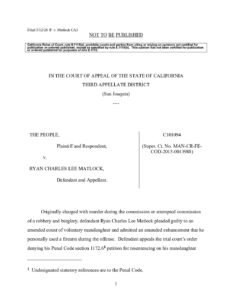
People v. Matlock 2026 LEXIS 1708 (CA. 2026)
The California Court of Appeals Third District vacated 19-year-old Matlock’s voluntary manslaughter conviction and remanded the case for resentencing, finding that substantial evidence did not support the trial court’s finding that Matlock was a “major participant who acted with reckless indifference to human life.”
The court reasoned in part, “Finally, we recognize that defendant’s youth does have some bearing on his recklessness. (People v. Keel, supra, 84 Cal.App.5th at p. 562 [a person’s youth can interfere with his or her ability to appreciate the risks and consequences of their conduct].) Youthful offenders are often more impulsive and vulnerable to peer pressure than adults. (People v. Oliver (2023) 90 Cal.App.5th 466, 489.) Here, although defendant cried throughout his police interview, which suggests immaturity, there is scant evidence that defendant felt compelled or peer pressured to assist with the robbery. Defendant’s age and maturity and his apparent ability to withstand peer pressure appear neutral in the reckless indifference analysis.
In sum, the totality of the evidence does not show that at the time of the underlying felony defendant “consciously disregard[ed] ‘the significant risk of death his . . . actions create[d].’ ” (In re Scroggins, supra, 9 Cal.5th at p. 677.) Only knowingly creating a grave risk of death satisfies this requirement (ibid.), and the evidence here falls short of that benchmark. Defendant planned and participated in a garden-variety armed robbery with others whom he did not know would take lethal action. He tried to minimize the risk of harm during the robbery by holding the others off until the person who was most likely to resist left the house. And the fleeting nature of the deadly interaction, which occurred when defendant may not have even been present or close by, provided him with no meaningful opportunity to restrain his cohorts. He did not prevent other individuals in the house from seeking aid for Timothy and emergency aid was rendered shortly after the shooting. Under these circumstances, insufficient evidence shows that defendant possessed the necessary mental state of reckless indifference section 189, subdivision (e)(3) and interpretive caselaw now requires.”