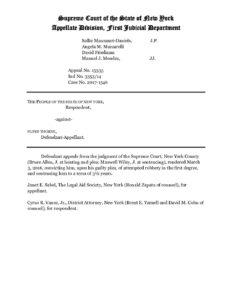
People v. Thorne, 207 A.D.3d 73 (N.Y. App. Div. 2022)
The New York Supreme Court Appellate Division reversed the guilty plea and conviction of Mr. Thorne after the court denied his motion to suppress, finding that the arresting officers lacked requisite reasonable suspicion to stop him. The Court, citing several inconsistencies in the radio description of the assailant compared to Mr. Thorne, offered the following language in support:
“The officers did not have reasonable suspicion to conduct a level three forcible stop and detention by ordering defendant to put his hands against a wall, grabbing his arms, and forcing him to the ground. Defendant matched the description only in that he was a black male. That a defendant matches a vague, general description, such as the one the complainant gave of the perpetrator, is insufficient to give rise to reasonable suspicion, particularly where, as here, key parts of the description do not match (see People v Bilal, 170 AD3d 83, 87-88 [1st Dept 2019], appeal dismissed 34 NY3d 1085 [2020]; People v Polhill, 102 AD3d 988 [2d Dept 2013], lv granted 21 NY3d 946 [2014], appeal dismissed 24 NY3d 995 [2014] [complainant’s description of two black males wearing “dark clothing” did not furnish reasonable suspicion]; People v Jones, 174 AD3d 1532 [4th Dept 2019], lv denied 34 NY3d 982 [2019] [generic description of black male insufficient]; People v Miller, 191 AD3d 111 [4th Dept 2020] [no reasonable suspicion where “court failed to give adequate consideration to the difference between the location where the dispatcher stated that the suspect[] had been observed running from the crime scene . . . and the location where the officer stopped defendant”] [citation omitted] ). This is true even when the suspect is the only black male in the vicinity (see People v Ross, 251 AD2d 1020, 1021 [4th Dept 1998], appeal denied 251 AD2d 1020 [1998]), which was not demonstrated to be the case here.”