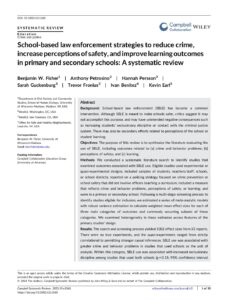
School-Based Law Enforcement Strategies to Reduce Crime, Increase Perceptions of Safety, and Improve Learning Outcomes in Primary and Secondary Schools: A Systematic Review
This literature review synthesizes 32 studies evaluating the impact of school-based law enforcement on 1) crime and behavior, 2) perceptions of school safety, and 3) student learning.
From the summary:
Contrary to what is intended, schools with SBLE had higher rates of crime and behavior problems than schools without SBLE. This was primarily driven by higher rates of exclusionary discipline, with no detectable improvements to school crime or violence.
We also found that students in schools with SBLE tended to feel safer at school, although this finding is less trustworthy because it is based on very little data.
None of our other analyses showed that SBLE had beneficial effects.
These results suggest that SBLE is an ineffective practice for keeping schools safe, and even has detrimental consequences.
The findings are based on studies that vary in the extent to which we can infer causal relationships between SBLE and the outcomes of interest, so we urge caution in interpreting this as a cause‐and‐effect relationship. Still, the study’s findings are consistent across studies with different methodological characteristics.