State v. Arrington, 2026-Ohio-2810 (Ohio Ct. App. 2026)
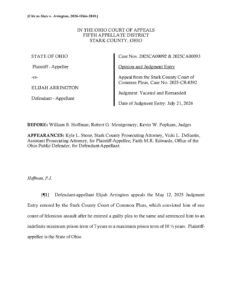
The Fifth District Ohio Court of Appeals vacated and remanded a sentence of a 17 year old because the trial court failed to consider youth-mitigating factors during sentencing. The court stated in relevant part:
“On a silent record, a trial court is presumed to have considered the statutory purposes and principles of sentencing, and the statutory seriousness and recidivism factors.” State v. Goldblum, 2014-Ohio-5068, ¶ 50. Here, the record was not silent. The trial court, at the sentencing hearing and in its sentencing entry, expressly stated it considered the purposes and principles of felony sentencing under R.C. 2929.11, as well as the seriousness and recidivism factors set forth in R.C. 2929.12. However, the trial court did not make any mention of R.C. 2929.19(B)(1)(b) at the sentencing hearing or in its sentencing entry. Because the trial court expressly stated its consideration of R.C. 2929.11 and R.C. 2929.12, we cannot presume from its silence relative to R.C. 2929.19(B)(1)(b) the trial court considered those statutory factors.
Accordingly, we find the record does not affirmatively demonstrate the trial court considered the youth-mitigating factors required by R.C. 2929.19(B)(1)(b). We find the trial court’s failure to consider the factors set forth in R.C. 2929.19(B)(1)(b) renders Appellant’s sentence clearly and convincingly contrary to law. As such, we vacate Appellant’s sentence and remand the matter to the trial court for resentencing.