State v. Conkey, 2026 Ohio LEXIS 594 (Ohio 2026)
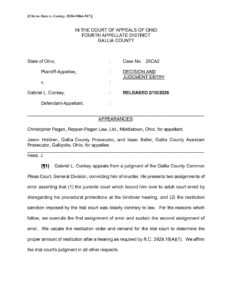
The Ohio Court of Appeals, Fourth District, vacated and remanded the trial court’s restitution order, where the trial court allowed unsworn testimony from the victim about restitution and a failed to hold a contested restitution hearing pursuant to state statute.
The court reasoned in part: ““‘“[T]he amount of the restitution must be supported by competent, credible evidence in the record from which the court can discern the amount of the restitution to a reasonable degree of certainty.”’” State v. Martin, 2024-Ohio-2334, ¶ 100 (4th Dist.), quoting State v. Alexander, 2012-Ohio-2041, ¶ 12 (4th Dist.), quoting State v. Johnson, 2004-Ohio-2236, ¶ 10 (4th Dist.). “‘“The evidence to support a restitution order can take the form of either documentary evidence or testimony.”’” State v. White, 2019-Ohio-4288, ¶ 23 (4th Dist.), quoting State v. Noble, 2017-Ohio-1440, ¶ 52, quoting State v. Jones, 2014-Ohio-3740, ¶ 23 (10th Dist.).
{{¶26} The trial court erred by failing to hold a restitution hearing under R.C. 2929.18(A)(1). Because defense counsel disputed the amount of restitution, the trial court had to conduct a hearing pursuant to the statute. Instead, the court awarded restitution based on unsworn statements, which are not evidence. State v. Reynoso, 2025-Ohio-3119, ¶ 18-19, 23 (11th Dist.) (unsworn statements are not evidence, so victim’s unsworn statements were not competent evidence that would support restitution order).2 Accordingly, we conclude that the restitution order is clearly and convincingly contrary to law. We sustain the second assignment of error, vacate the restitution order, and remand for the trial court to determine the proper amount of restitution after a hearing as required by R.C. 2929.18(A)(1). This decision renders moot the contentions that the trial court erred by failing to provide Conkey notice and a meaningful opportunity to present restitution evidence and defenses and in awarding more than the costs for funeral expenses incurred under R.C. 2929.01(L), so we need not address them.”