State v. D.R. 2026 LEXIS 737 (WA. 2026)
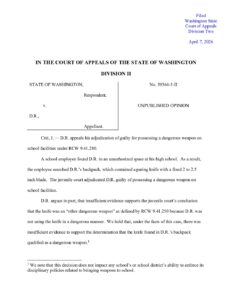
The Washington Court of Appeals found that insufficient evidence supported the trial court’s conclusion that a knife found in D.R.’s backpack was an “other dangerous weapon” as defined by RCW 9.41.250 because D.R. was not using the knife in a dangerous manner,” ordering the trial court to vacate the guilty adjudication and dismiss the charge with prejudice.
The court reasoned in part, “At issue here is whether the paring knife, with a blade measuring between 2 to 2.5 inches, found in D.R.’s backpack, constituted an “other dangerous weapon” as defined in RCW 9.41.250. D.R.’s primary argument is that the paring knife found in his backpack did not have a long enough blade to be a deadly weapon per se and was not being used in a manner which was likely to produce, or which may have easily and readily produced, death. We agree.
There is no dispute that the paring knife blade was less than 3 inches long. Thus, the paring knife can only be a dangerous weapon if it is used in a dangerous manner. See Leatherman, 100 Wn. App. at 322-23 and RCW 9.94A.825.
Where knives with blades shorter than 3 inches have been found to be deadly weapons, it has been because of the manner in which the knives were being used. See State v. Cook, 69 Wn. App. 412, 418, 848 P.2d 1325 (1993) (a pocketknife with a blade shorter than 3 inches was a deadly weapon because it was being held to the victim’s throat during the underlying crime) and State v. Thompson, 88 Wn.2d 546, 550, 564 P.2d 323 (1977) (a pocketknife with a blade between 2 to 3 inches long was a deadly weapon because it was held to the victim’s neck during the underlying crime).
Here, D.R. was not using the paring knife in a dangerous manner. The evidence presented at the fact-finding hearing, even taken in the light most favorable to the State, proves only that D.R. had the paring knife in his backpack; the paring knife was not being used in any manner. Lowrey testified that he found the paring knife only after bringing D.R. to the school office and conducting a search of D.R.’s backpack. There was no evidence presented that D.R. threatened anyone with the paring knife or was going to use the paring knife in any manner, much less a manner which would be considered dangerous.
The State provided no evidence showing that D.R. was making, or had ever made, any use of the paring knife other than having it in his backpack. Therefore, no rational trier of fact could find beyond a reasonable doubt that, under the facts of this case, the paring knife found in D.R.’s backpack was a dangerous weapon for purposes of RCW 9.41.280. Consequently, there is insufficient evidence to support D.R.’s adjudication of guilt.”