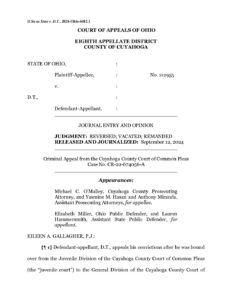
State v. D.T., 2024-Ohio-4482 (Ohio Ct. App. 2024)
The Ohio Appellate Court vacated a youth’s convictions and transfer order and offered the following language in support. “Because the juvenile court (1) did not identify all of the factors it considered, i.e., the “other information factors” referenced at the amenability hearing, (2) did not identify or discuss the factual or evidentiary basis for its determination that particular factors did or did not apply and (3) did not explain its weighing of those factors, we do not know, as detailed above, to what extent the juvenile court’s decision may have been based on erroneous facts and cannot properly assess whether the juvenile court’s decision was the product of a sound reasoning process or an unreasonable, arbitrary or unconscionable one. Certain courts, when faced with similarly deficient records, have reversed or vacated the juvenile court’s amenability determination and remanded the cases for further proceedings….We do the same here. D.T.’s second assignment of error is sustained. We reverse the trial court’s judgment, vacate D.T.’s convictions, vacate the juvenile court’s transfer order and remand the case to the juvenile court for (1) a competency hearing and written determination of D.T.’s competency in accordance with R.C. 2152.58 and (2) if D.T. is deemed competent to proceed, for the juvenile court to reconsider the evidence and its amenability determination, resolve any inconsistencies in its findings, identify on the record all factors it considered in determining D.T.’s amenability, weigh those factors and explain the basis for its amenability determination.”