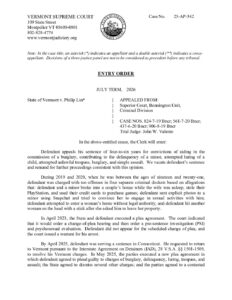
State v. Lin, 2026 Vt. Unpub. LEXIS 93 (Vt. 2026)
The Supreme Court of Vermont held that proceeding with sentencing without a previously ordered psychosexual evaluation that would take into account a young person’s disability constituted plain error, warranting vacatur and resentencing.
The Court stated in relevant part:
The absence of the psychosexual evaluation affected defendant’s right to have his sentence be based on accurate information. See State v. Neale, 145 Vt. 423, 436, 491 A.2d 1025 (1985) (explaining that “sentencing court’s discretion is not absolute; the court may not rely upon improper or inaccurate data in reaching its sentencing decision” (quotation omitted)). We cannot say on this record that the court would have imposed the same sentence if the psychosexual evaluation had been available. While the State argues that defendant could have presented alternative evidence of his autism diagnosis and mental-health issues, or arranged earlier to complete a psychosexual evaluation, the record shows that there were significant practical barriers to such actions, including defendant’s incarceration and treatment out of state and systemic delays in obtaining evaluations within Vermont. We therefore conclude that the error affected the outcome of the sentencing proceeding, satisfying the prejudice requirement. See State v. Yoh, 2006 VT 49A, ¶ 41, 180 Vt. 317, 910 A.2d 853 (holding error was prejudicial where it affected outcome of trial proceedings). For this reason, we vacate defendant’s sentence and remand for resentencing upon completion of the psychosexual evaluation.
Defendant’s sentence is vacated and the matter is remanded for further proceedings consistent with this opinion.