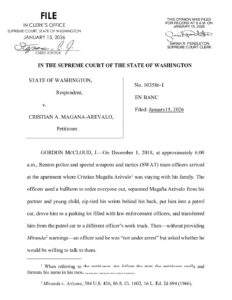
State v. Magana-Arevalo, 2026 Wash. LEXIS 59 (Wash. 2026)
The Supreme Court of Washington found a Miranda violation based on a totality of the circumstances analysis, which the Court noted must include consideration of race and age. The Court stated in relevant part:
“The United States Supreme Court has established that in determining whether a suspect is in custody under Miranda, we must “‘examine all of the circumstances surrounding [an] interrogation,’ including any circumstance that ‘would have affected how a reasonable person’ in the suspect’s position ‘would perceive [their] freedom to leave.’” J.D.B. v. North Carolina, 564 U.S. 261, 270-71, 131 S. Ct. 2394, 180 L. Ed. 2d 310 (2011) (emphasis added) (citation omitted) (quoting Stansbury v. California, 511 U.S. 318, 322, 325, 114 S. Ct. 1526, 128 L. Ed. 2d 293 (1994)).
The Court in J.D.B. therefore ruled that courts should consider a child’s age in the totality of circumstances analysis because, objectively viewed, a reasonable child may feel greater pressure to submit to police authority than would a reasonable adult. Id. at 272.
Other courts applying federal constitutional law have said the same thing about race or ethnicity; they recognize that objectively viewed, these factors can also be relevant “to the question of whether a seizure occurred.” United States v. Smith, 794 F.3d 681, 688 (7th Cir. 2015) (quoting United States v. Mendenhall, 446 U.S. 544, 558, 100 S. Ct. 1870, 64 L. Ed. 2d 497 (1980)); see United States v. Washington, 490 F.3d 765, 768, 773 (9th Cir. 2007) (considering “[r]ecent relations between police and the African-American community in Portland,” in particular “the publicized shootings by white Portland police officers of African-Americans,” under the totality of circumstances when analyzing whether African-American defendant was seized).
We used a similar totality of the circumstances analysis in State v. Sum, 199 Wn.2d 627, 639, 643, 511 P.3d 92 (2022). We held that race and ethnicity are relevant factors for the court to consider when doing an objective assessment of the totality of circumstances to determine whether a person has been seized. We recognized that “an objective observer is aware that implicit, institutional, and unconscious biases, in addition to purposeful discrimination, have resulted in disproportionate police contacts, investigative seizures, and uses of force” against people of color in Washington. Id. at 653.
We apply the same objective-observer/totality-of-circumstances analysis when assessing whether Magaña Arévalo was in custody on December 1. As the court explained in Washington, 490 F.3d at 773, applying federal constitutional law, that means considering how an objective observer would view the relationship between members of the defendant’s community and law enforcement, considering factors such as police shootings. In Washington, between 2013 and 2020, Latinos were killed by police at a rate 1.3 times greater than non-Hispanic white people, and police use-of-force rates, stop rates, and incarceration rates of Latinos are all higher than the rates of their non-Latino counterparts.
How do we weigh this factor? Our court in Sum explained how to consider race and ethnicity when applying the totality of circumstances analysis to determine whether a person is “seized” by police. We explained that people of color “are subject to excessive police contacts, investigative seizures, and uses of force by law enforcement.” Sum, 199 Wn.2d at 651. We continued that communities of color “as a whole, [are] generally well aware of such patterns of excessive police scrutiny. As a result, ‘generations of children have had to grow up with “the Talk,”’ in which parents must educate their children ‘about how to interact with law enforcement so no officer will have any reason to misperceive them as a threat and take harmful or fatal action against them.’” Id. (quoting United States v. Knights, 989 F.3d 1281, 1297 & n.8 (11th Cir. 2021) (Rosenbaum, J., concurring)). We concluded, “‘Against that awareness’ an encounter with law enforcement would certainly feel ‘more pointed and coercive.’ Thus, ‘[t]he fear of harm and resulting protective conditioning to submit to avoid harm at the hands of police is relevant to whether there was a seizure because feeling ‘free’ to leave or terminate an encounter with police officers is rooted in an assessment of the consequences of doing so.’” Id. at 651 (emphasis added) (alteration in original) (citation omitted) (quoting Dozier v. United States, 220 A.3d 933, 943, 944 (D.C. 2019)).
Magaña Arévalo’s Latino ethnicity cannot be ignored in the objective-observer/totality-of-circumstances analysis. Like all the other factors listed above, it also militates in favor of a finding of custody.”
This decision also has a concurring opinion highlighting the “urgent need to give independent meaning to our state constitution.”
The concurring opinion states: “As federal jurisprudence becomes “unconscionably irreconcilable with our Nation’s constitutional guarantees,” this court plays a crucial “role as a democratic, accountable institution elected to safeguard the numerous interrelated individual rights under our State Constitution.” Vasquez Perdomo, 222 L. Ed. 2d at 1230 (Sotomayor, J., dissenting); Br. of Amici Curiae Ctr. for C.R. & Critical Just., Am. C.L. Union of Wash., & King County Dep’t of Pub. Def. at 36. To fulfill this role, we must examine the current implications of continuing to interpret state constitutional provisions in lockstep with federal law and, in appropriate cases with sufficient briefing, we must be open to recognizing heightened state law protections where we have not previously done so.”