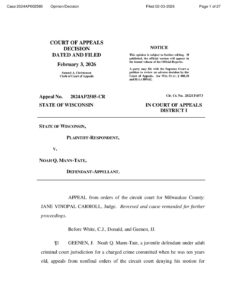
State v. Mann-Tate, 2026 WI App 17 (Wis. Ct. App. 2026)
The Court of Appeals of Wisconsin held that the state’s reverse waiver statute was unconstitutional “to the extent it does not require circuit courts to consider the unique attributes of youth identified by the United States Supreme Court.” In Wisconsin, a youth’s case that is directly filed in adult criminal court may be sent to juvenile court in a “reverse waiver” procedure if the youth proves by a preponderance of the evidence three statutory factors: that the youth could not receive adequate treatment in the adult, criminal system; that sending the case to juvenile court would not depreciate the seriousness of the offense; and that retaining jurisdiction in adult, criminal court is not necessary for deterrence. Relying on Miller v. Alabama and its progeny, the Court of Appeals held that the same considerations of adolescent development are constitutionally relevant at the transfer stage pursuant to a young person’s due process rights under the 14th Amendment. The Court of Appeals stated, “The reverse waiver procedure is rendered functionally meaningless if courts are not required to consider that children’s ‘lack of maturity and … underdeveloped sense of responsibility’ leads them to poor decision making. This concept is so fundamental that the Supreme Court described it as something ‘any parent knows.’” (citation omitted). As such, the Court of Appeals held that reverse waiver determinations must consider the following six Miller factors to comport with the demands of due process: 1) youth’s age and adolescent development, 2) family and home environment, 3) circumstances of the offense, 4) impact of peer pressure, 5) effect of age in ability to navigate the legal system, and 6) the possibility of rehabilitation. This decision extends the Miller factors to transfer/reverse transfer determinations and offers a compelling argument to strengthen developmental considerations at the transfer phase under a due process framework.