State v. S.H.-M., 2025 Wash. App. LEXIS 2317 (Wash. Ct. App. 2025)
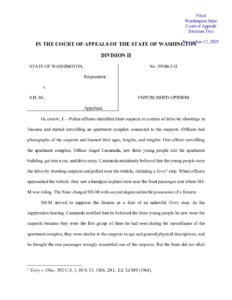
An appellate court in Washington reversed a trial court’s denial of a young person’s motion to suppress a firearm as a fruit of an unlawful Terry stop. This case involved misidentification by the police officers of three youth of color and the court stated in relevant part:
SH-M argues that the trial court erred when it denied his motion to suppress the evidence found as a result of the traffic stop because the stop was a violation of his rights under the Fourth Amendment to the United States Constitution and article 1, section 7 of the Washington Constitution. Although we agree with the trial court that Castaneda’s identification was made in good faith, we agree with SH-M that the State did not present clear and convincing evidence at the suppression hearing sufficient to support a reasonable, articulable suspicion for the Terry stop.
. . . .
Federal cases hold that a Terry stop may be justified based on an officer’s mistake of fact, including a mistaken identity, so long as the mistake itself was reasonable and based on articulable facts known to the officer at the time of the stop. For instance, in United States v. Lang, the Tenth Circuit upheld a Terry stop based on a police officer’s reasonable misidentification of a car passenger. 81 F.3d 955, 966 (10th Cir. 1996). There, the officer had a mug shot and a description of a murder suspect that outlined the suspect’s height, weight, and hairstyle. Id. After making “a visual comparison between the mug shot pictures and the physical features of the vehicle’s passenger,” the officer mistakenly concluded that the passenger was his suspect and detained him. Id. Though Lang’s height and weight differed from the suspect’s, “the district court specifically found the mug shot picture of [the suspect] ‘looked very much like … Lang.’” Id. (quoting record). Considering the finding about their similar appearances, the 10-second time period the officer had to make the comparison, and the difficulty of identifying someone in a moving vehicle, the Tenth Circuit held that the misidentification was reasonable and, accordingly, the stop was justified. Id.
However, the Washington Supreme Court has held that general physical similarities alone do not create a reasonable, articulable suspicion that justifies misidentification. In State v. Smith, the court held that officers lacked reasonable, articulable grounds to arrest a person who “matched the general physical description” of the suspect they sought. 102 Wn.2d 449, 454, 688 P.2d 146 (1984). Although Smith concerned an erroneous arrest rather than a Terry stop, it is relevant here because the court addressed whether the misidentification was based on “reasonable, articulable grounds.” Id.
The Smith court explained, “The mere fact that petitioner fit the description of a brown-haired, white male, 5 feet 10 inches tall, weighing 145 pounds, is insufficient to meet the Sanders test of reasonable, articulable grounds to believe that the suspect is the intended arrestee.” Id. (citing Sanders v. United States, 339 A.2d 373, 379 (D.C. 1975)). The court also pointed out that the arrest warrant specified the suspect had tattoos on both hands, but the officers failed to check the arrestee’s hands before detaining and searching him. Id. at 451-52.
An officer’s good faith belief in their reasons for making a Terry stop is highly relevant to determining if a stop was pretextual—that is, if the investigating officer’s given reason for detaining an individual is not their true reason. State v. Ladson, 138 Wn.2d 343, 358, 979 P.2d 833 (1999); see also State v. Day, 161 Wn.2d 889, 896-97, 168 P.3d 1265 (2007). This is significant because pretextual stops are unconstitutional in Washington. Ladson, 138 Wn.2d at 345. However, it is clear that there is no general “good faith” exception to the exclusionary rule under the Washington Constitution. State v. Afana, 169 Wn.2d 169, 184, 233 P.3d 879 (2010). And our courts have explicitly distinguished good faith from reasonable, articulable suspicion in related contexts.
. . . .
We do not disturb the trial court’s conclusion that Officer Castaneda’s misidentification was made in good faith. But Washington courts must suppress evidence even when the police “have erred innocently” if failing to do so would violate an individual’s constitutional rights. Day, 161 Wn.2d at 894. Because the State did not present clear and convincing evidence that the investigatory stop of SH-M and his companions was reasonable, we reverse.”
File Type:
pdf
Categories:
Court Decisions, Resource Library