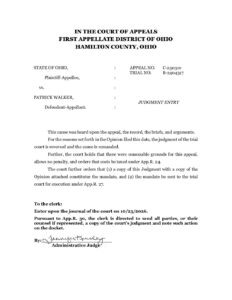
State v. Walker, 2026-Ohio-4187 (Ohio Ct. App. 2026)
The 1st District Ohio Court of Appeals reversed a trial court’s denial of a suppression motion, finding that the police lacked probable cause to arrest for obstruction where an individual’s dirt bike lurched forward a few feet before stopping.
The court stated in relevant part:
We must therefore determine whether the officers had reason to believe that Walker’s affirmative act—his brief forward motion on his dirt bike after receiving the command to stop—”hamper[ed] or impede[d]” Officers Gibson and Epure “in the performance of [their] lawful duties.” R.C. 2921.31(A); see State v. Coffman, 2024-Ohio-1182, ¶ 27 (1st Dist.) (requiring “a nexus” between the affirmative act and the impediment or hindrance). We have held, time and time again, that a defendant only obstructs official business if his actions actually cause a “substantial stoppage” of an officer’s work. In re R.B., 2021-Ohio-3749, ¶ 18, 179 N.E.3d 749 (1st Dist.); see State v. Stephens, 57 Ohio App.2d 229, 230, 387 N.E.2d 252 (1st Dist. 1978). In other words, the defendant’s conduct must have created “more-than-de-minimis hindrance or impediment between that officer and the officer’s object.” Chambers at ¶ 50; see also In re S.J., 2023-Ohio-3441, ¶ 35, 225 N.E.3d 368 (1st Dist.); Coffman at ¶ 29.
. . . .
Walker’s brief and unsuccessful movement could not be said to have “hamper[ed] or impede[d]” the officers. In some circumstances, a defendant can “obstruct” an officer’s attempts to complete a task, even though the defendant ultimately fails to prevent the task’s completion. State v. Stayton, 126 Ohio App.3d 158, 163-164, 709 N.E.2d 1224 (1st Dist.). So, even if officers ultimately catch a fleeing individual, the flight may still cause a “substantial stoppage” in their performance of duties. See, e.g., State v. Walker, 2025-Ohio-2982, ¶ 26 (1st Dist.) (40-second chase around and outside apartment building created substantial stoppage); State v Lohaus, 2003-Ohio-777, ¶ 12 (1st Dist.) (defendant’s flight across several lawns leading to physical struggle produced substantial stoppage). But here, Walker did not lead the officers on any wild chase. He jolted several feet forward on his bike then stopped. The time from the officers’ command to their removal of Walker from his bike was less than five seconds. Walker’s actual movement lasted even less time. Walker began an attempt to flee that lasted less than five seconds and petered out before the officers had even reached him. This is the quintessential example of “de minimis interference.” Compare Coffman, 2024-Ohio-1182, at ¶ 29 (1st Dist.) (holding that a 20-second pursuit terminated by officers tasing defendant was de minimis interference that did not hamper or impede). Even if the officers believed Walker intended to hamper or impede them, they could not reasonably believe he actually did so.