National Juvenile Defender Center Amicus Brief, In the Interest of D.C.M.
Advocacy Talking Points for Transgender Youth

This resource is part of the Youth Defender Advocacy Program (YDAP) curriculum, a specialized trial advocacy training program for youth defenders.
Read MoreAnnotated Bibliography: Adolescent Development
This resource is part of the Youth Defender Advocacy Program (YDAP) curriculum, a specialized trial advocacy training program for youth defenders.
Read MoreAdolescent Development – Forensic 2
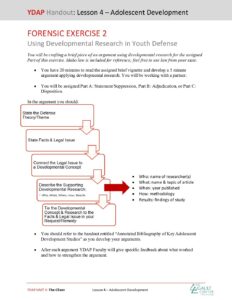
Adolescent Development Facilitator’s Guide
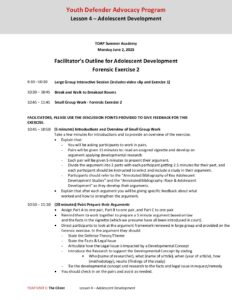
Access to Counsel Information Card
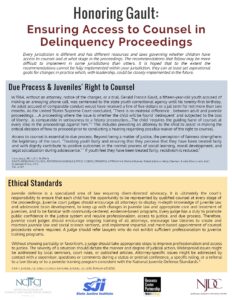
AAPL Practice Guideline for Forensic Assessment
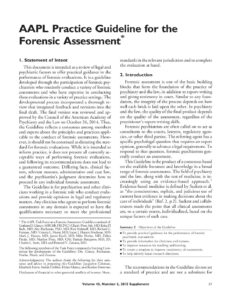
1 Page Framework for Litigating Race Adolescence and Trauma
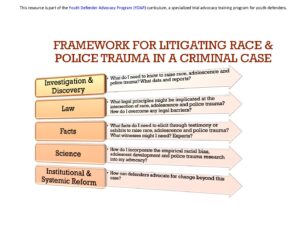
This resource is part of the Youth Defender Advocacy Program (YDAP) curriculum, a specialized trial advocacy training program for youth defenders.
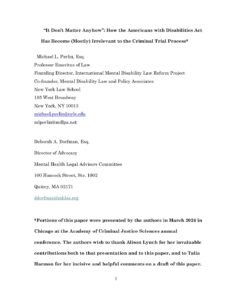
Read More“It Don’t Matter Anyhow”: How the Americans with Disabilities Act Has Become (Mostly) Irrelevant to the Criminal Trial Process

The Law and Lawlessness of U.S. Immigration Detention
From the introduction: “This Article proceeds in three parts. Part I describes how federal courts have interpreted potential sources of substantive immigration detention law and why some have produced, through their decisions, lawlessness for immigrants facing poor conditions of confinement. I focus on three areas: substantive due process, statutory immigration law interpretation, and the enforcement…
Read MoreInvoluntary: How a Lack of Analysis of Age under the Fifth Amendment Highlights the Intersectionality of Age and Race

Abstract: In the wake of Miller v. Alabama and its progeny, there has been a wider acceptance that juvenile’s need more protections in our judicial system. This is a result of a growing body of research stating that young people’s brains do not fully develop until the age of twenty-five. States across the country are…
Read MoreThe Road to Slow Deportation
From the abstract: “This Article frames the experience of traffic stops for noncitizens as a form of “slow deportation.” It describes how the use of traffic stops to police noncitizens extends the system of racialized social control to immigrant communities with the effect of surveilling both race and status. It surveys scholarship across disciplines, racial…
Read MoreThe Core Science of Adolescent Development

A brief on the core changes happening during the remarkable period of growth from 10 to 25 years old. The brief highlights the opportunities for positive development during this period of adolescence and the critical need for social systems to adapt to youth in a way that supports their success.
Read MoreDeportation Threatens the Psychological, Physical, and Socioeconomic Well-being of Children and Families
State and Federal Constitutional Right to Counsel in an Age of Case Specific Inadequacies
From the introduction: “In this Article, [the author] examines the question of whether state courts, under their state constitutions, may be better suited than federal courts to provide effective remedial measures designed to ensure that criminal defendants receive effective assistance of counsel in criminal prosecutions.”
Read MorePeople v. M.N.B., 2025 Mich. App. LEXIS 1591 (Mich. Ct. App. 2025)
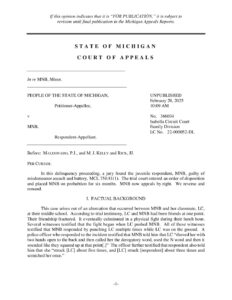
On February 28, 2025, the Michigan Court of Appeals ruled that the trial court’s denial of a racial justice expert violated a young person’s due process rights to present a defense. This case involved an altercation between two middle school students involving the use of a racial slur and other racially derogatory comments. Defense counsel…
Read MoreLetter from the Gault Center on the 20th Anniversary of Roper v. Simmons

“It Don’t Matter Anyhow”: How the Americans with Disabilities Act Has Become (Mostly) Irrelevant to the Criminal Trial Process
Quattrone Center for the Fair Administration of Justice Amicus Brief, Farella v. Anglin
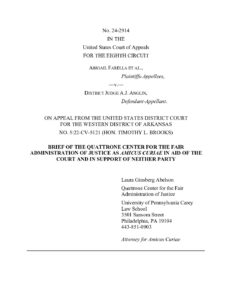
From the introduction: “A subset of the research that has been conducted on the effects of counsel at first appearance in criminal cases examines the effects of providing counsel to individual defendants on the system itself, rather than the effects on the individuals. As discussed below, this research shows that providing counsel at first appearance…
Read MoreExpedited Removal Toolkit: A Guide for Advocates Assisting People Facing Expanded Expedited Removal

Expedited Removal Toolkit: A Guide for Advocates Assisting People Facing Expanded Expedited Removal

State v. K.R.W.

From the discussion: “The issue in this case is whether the circuit court erred when it denied K.R.W.’s suppression motion. This court reviews a suppression decision under a two-step analysis. State v. Meisenhelder, 2022 WI App 37, ¶7, 404 Wis. 2d 75, 978 N.W.2d 551. Findings of fact will be upheld unless they are clearly…
Read MoreCollaborative Creation of a Logic Model and Performance Metrics for Evaluating a Violence Reduction Program

“This paper describes a community-based participatory research (CBPR) approach to evaluation used by an academic-practitioner partnership to refine the logic model for a violent crime reduction program and develop associated performance measures. Through qualitative and quantitative data collection, including semi-structured interviews, engagement with program stakeholders (e.g., program leaders and staff, peer researchers, community residents), community…
Read More