Shackling Children in Court: Implications for Adolescent Development

Juvenile Offender and Victims: 2014 National Report
DOJ Statement of Interest in Varden v. Clanton

American Bar Association Resolution on Indiscriminate Juvenile Shackling

CAIJS Shackling Reform Model Statute & Court Rule (2015)

Model statute on shackling reform.
Read MoreSticker Shock: Calculating the Full Price Tag for Youth Incarceration (2014)

Guiding Principles for Providing High-Quality Education in Juvenile Justice Secure Care Settings

Dear Colleague Letter: Federal Pell Grant Eligibility for Students Confined or Incarcerated in Locations That Are Not Federal or State Penal Institutions

Dear Colleague Letter: Educational Needs of Students with Disabilities in Correctional Facilities

Dear Colleague Letter: Civil Rights in Juvenile Justice Residential Facilities

Restoring Justice: A Blueprint for Ensuring Fairness, Safety, and Supportive Treatment of LGBT Youth in the Juvenile Justice System

CAIJS Fact Sheet on Indiscriminate Juvenile Shackling
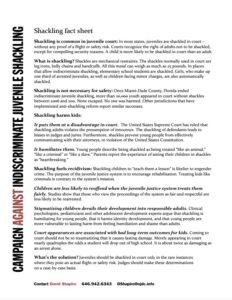
Fact sheet on the use of shackling in youth court.
Read MoreShackling Children in Juvenile Court: The Growing Debate, Recent Trends, and the Way to Protect Everyone’s Interest
Issue Brief: Rethinking Juvenile Detention in Ohio

From Courts to Communities: The Right Response to Truancy, Running Away, and Other Status Offenses

Issue Brief-Ending the Indiscriminate Shackling of Youth
In juvenile courts throughout the nation, children arrive, face full hearings, and depart weighed down by handcuffs, leg irons, and belly chains. They appear this way not because they pose a threat to others in the courtroom or are a flight risk but because most jurisdictions indiscriminately shackle all youth in juvenile court, often without…
Read MoreDual Status Youth – Technical Assistance Workbook

Legal Socialization of Children and Adolescents

Juvenile Defense Law School Clinics: Building Leaders, Client Capacity, and Innovation
Youth involved in delinquency proceedings are constitutionally entitled to have highly competent lawyers represent them at every critical stage of the case. To provide this high-level representation, defense attorneys who work in juvenile court should receive specialized training: they should be familiar with the juvenile court process and the role of the juvenile defender, the…
Read MoreIssue Brief: Using Developmentally Appropriate Language to Communicate with Court-Involved Youth

For any young person, navigating the juvenile delinquency process can be daunting. Youth are required to understand, make decisions, and act on their rights and responsibilities in court. Yet courtinvolved youth are likely to face challenges that impact their ability to understand and participate in juvenile court. The legal jargon, abstract language, and complex terminology…
Read MoreIssue Brief-Specialized Training: Advancing the Ethical and Professional Representation of Youth

There is an immediate and predominant need for specialized training in juvenile defense: training is both the foundation and the gateway to comprehensive advocacy by juvenile defenders, and it is key to ensuring that youths’ constitutionally mandated due process rights are protected. To be effective and zealous advocates, juvenile defenders must develop a set of…
Read MoreIssue Brief-Juvenile Defense Standards: A Framework for the Specialized Representation of Youth

The Supreme Court’s 1967 ruling in In re Gault established the right for all children to have counsel in delinquency proceedings, but the nature of that right has often been unclear or misunderstood, even by some juvenile defenders charged with protecting the liberty and interests of their young clients. Juvenile defense standards provide juvenile defenders…
Read More