
Pennsylvania (Pittsburgh Beehive) CLE Accreditation Letter

Oregon CLE Accreditation Letter

Ohio CLE Accreditation Letter

Nebraska CLE Accreditation Letter
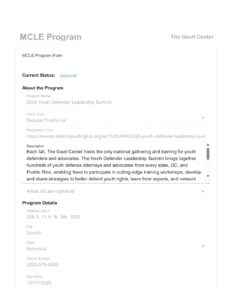
Montana CLE Accreditation Letter
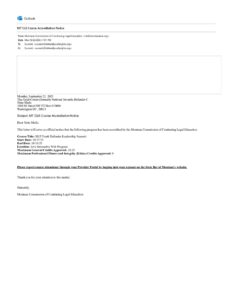
Missouri CLE Accreditation Letter

Minnesota CLE Accreditation Letter
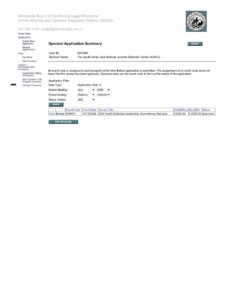
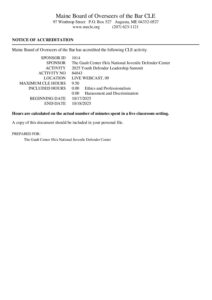
Maine CLE Accreditation Letter
Lived Experience Office Hours (Juvenile Justice Advocates of California)

Summit 2025 Booklist

Sharing books that have been recommended or shared with us as we developed the content for the 2025 Youth Defender Leadership Summit. Happy reading!
Read MoreYouth Justice Policies to End Girls’ Incarceration
This report from Vera Institute for Justice provides examples of reforms from various states that are working to reduce the incarceration of girls in detention and long-term placement. “Over the last decade, as a direct result of focused efforts by youth advocates and a growing body of research on developmentally appropriate practices, many states have…
Read MoreIn re J.S. 2025 Or. LEXIS 1645 (Or. 2025)
The Oregon Court of Appeals held that a plea colloquy has to affirmatively demonstrate that a young person understands the “consequences of an admission, including the maximum disposition associated with it”. The court stated in relevant part: “For an admission by a youth to be valid, the youth must be aware, in a manner consistent…
Read MoreIn the Interest of A.B. 2025 Mo. LEXIS 667 (Mo. 2025)

The Missouri Court of Appeals, Western District held that courts must ensure that a juvenile court admission is voluntarily, knowingly and intelligently made, and requires the court to establish a factual basis. The court stated in relevant part: ““A plea of guilty is constitutionally valid only to the extent it is ‘voluntary’ and ‘intelligent.’” Booker…
Read MoreIn re H.T., 2025 Cal. App. LEXIS 703 (Ca. Ct. App. 2025)

The Third District Court of Appeal in California held that the plain language of California’s state statute authorized the juvenile court to order the County to pay for a young person’s housing. The court explained in relevant part: “As evidenced by both the plain language and the history of section 900, subdivision (b), the Legislature…
Read MoreIn Right Relationship: Practicing and Teaching Trauma Responsive Restorative Advocacy

From the abstract: “Attorneys who can recognize and respond to trauma and stress, in both their clients and in themselves, are better positioned to provide effective advocacy and help shape a more restorative legal practice. As clients and communities face mounting pressure amid growing social, economic, climate, and systemic challenges, legal education must evolve to…
Read MoreThe Accountability Deficit: When Immigration Detention Obstructs One’s Day in Criminal Court
“The right to have your day in court is foundational to the U.S. criminal legal system. Yet, many noncitizens in immigration detention facing criminal charges are denied this right when ICE routinely fails to produce immigration detainees to criminal court to resolve charges. In immigration proceedings, immigration judges regularly use those unresolved charges to detain…
Read MoreCriminal Court’s Disability

“Do criminal courts meaningfully accommodate psychiatric disability? A review of competency proceedings across the United States suggests not. In competency to stand trial (CST) proceedings, criminal courts offer a narrow vision of psychiatric disability that excludes many defendants. Ultimately, the institutional context of criminal court under-mines even the meager accommodations that the competency framework provides.…
Read MoreJuvenile Justice Amici Amicus Brief, New York v. Guerrero
This amicus brief from over 26 juvenile justice amici, including the Gault Center, , argues 1) the spirit and text of New York’s passage of landmark Raise the Age Law rejects the attitudes that underlay the Juvenile Offender Act of 1978, 2) New York’s Raise the Age Law and its legislative history demands a youth subject to adult prosecution only in “extremely rare and exceptional cases”, 3) before courts…
Read MoreHand in Hand: Schools’ Embrace of AI Connected to Increased Risks to Students
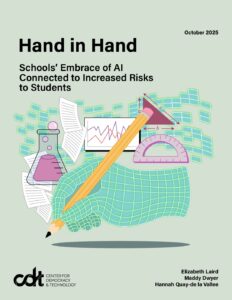
The Center for Democracy & Technology released a report on the current status of AI use in schools and emerging risks. This report covers the interaction of AI with the classroom, students, IEPs, literacy, deepfakes, student activity monitoring, and student privacy. From the report: “Artificial intelligence (AI) has continued to alter the educational experiences of…
Read MoreNo Second Chance – Inappropriate Use of Juvenile Delinquencies in Immigration Law Adjudications
Abstract: “Records generated by youth legal systems—or “juvenile justice systems”—are increasingly being used against young people in immigration proceedings. This practice undermines the core purpose of these youth-focused systems and can have devastating, life-altering consequences, including the denial of immigration benefits or deportation. Juvenile justice systems in the United States are founded on the recognition…
Read MoreSeptember Spotlight on Criminal Justice: What Works to Reduce Juvenile Crime?
From the R Street Institute: “Juvenile crime has captured headlines and consumed policymaking conversations in recent months. In fact, say six out of 10 major city mayors say juvenile crime is a problem in their city. But despite the temptation to “get tough” on all children who run afoul of the law, the research is clear: Harsher punishments, trying youth…
Read MoreState v. Kanakanui, 2025 Haw. App. LEXIS 459 (Haw. Ct. App. 2025)

The Intermediate Appeals Court of Hawaii found that defense counsel’s failure to object to references about the individual’s juvenile incarceration and prior arrests constituted ineffective assistance of counsel requiring reversal and a new trial. The Court stated in relevant part: “Specific acts or omissions having an obvious tactical basis for benefitting the defense will not…
Read MoreHeat Camps: Juvenile Curfews, Extreme Heat & the Eighth Amendment
“For decades, in the summertime, America has confined certain of its youth in what are essentially open-air heat camps. In city after city, camp-form is established through the enactment of warm-weather juvenile curfews which keep the youth at home or in state-sponsored centers during summer nights and, increasingly, during days as well. Local governments justify…
Read MoreMessaging Memo: Responding to Harmful Youth Justice Policies

This memo from Fenton Communications Agency provides youth advocates with messaging strategies to respond to the D.C. Crimes Act and the Juvenile Sentencing Reform Act pending in Congress. The memo includes succinct responses to questions posed about public safety, youth crime, and transfer laws. The memo also provides suggested talking points on tone and relevant…
Read MoreIn the Matter of L.K. 2025 N.C. App. Unpub. LEXIS 599 (N.C. App. 2025)
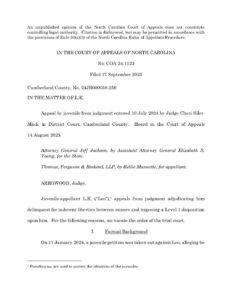
The Court of Appeals in North Carolina vacated a judgment adjudicating L.K. delinquent for indecent liberties between minors and imposing a Level 1 disposition upon him, based upon the trial court’s failure to state a standard of proof. The court stated in relevant part: “In the case sub judice, our review of the transcripts and…
Read More