
Sentencing


This article from Dr. Antoinette Kavanaugh and Dr. Thomas Grisso examines the roles experts can play in “Montgomery” resentencing cases. From the article: “In summary, experts can play an important role in the approximately five hundred Miller/ Montgomery cases pending in Pennsylvania’s courts. Experts retained by the defense can serve as educators or evaluators. In…
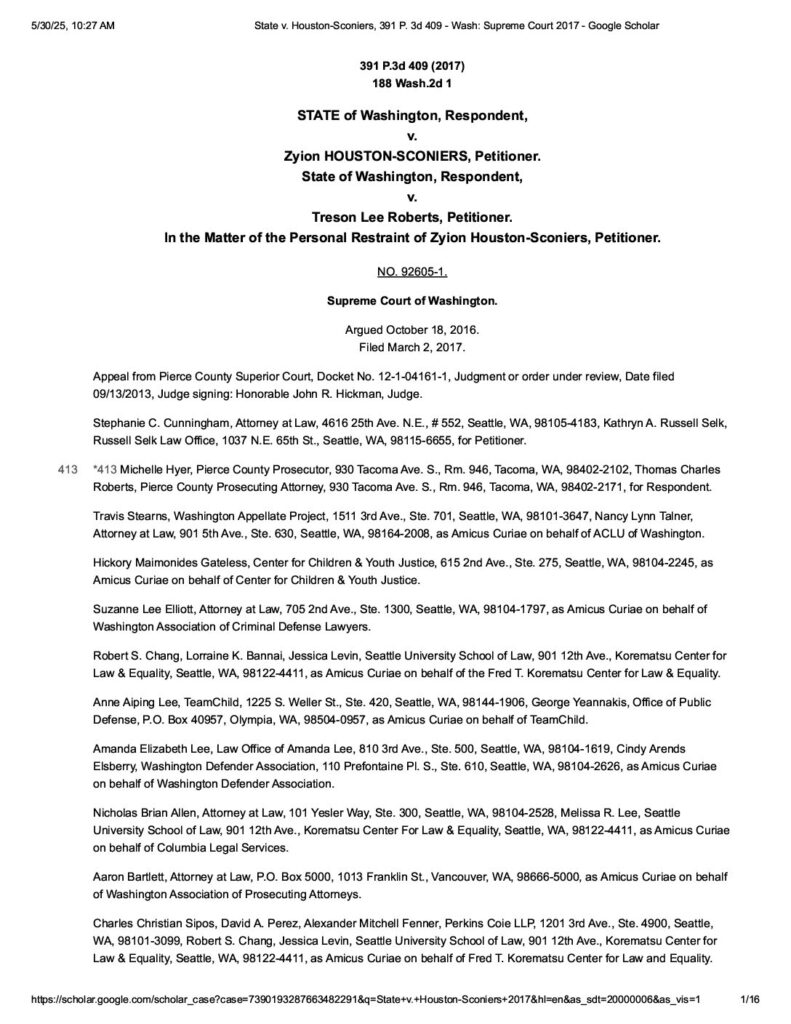
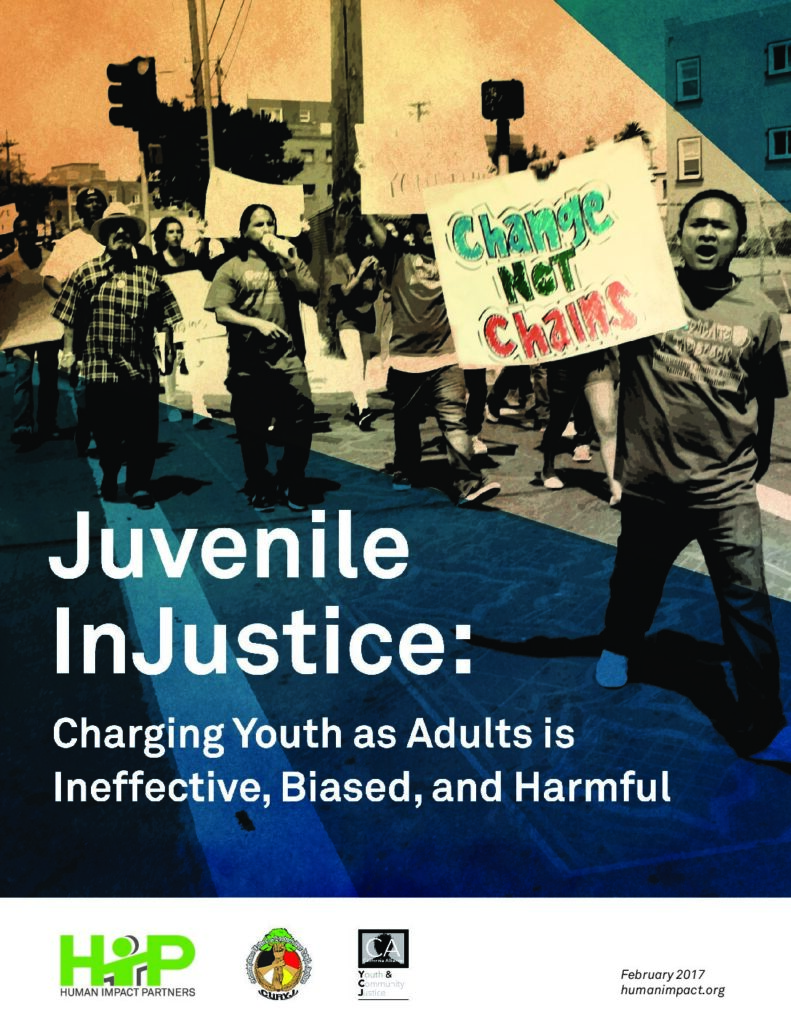
This report from Human Impact partners, CURYJ, and the California Alliance for Youth & Community Justice looks at the impact of transfer on young people in California using a Health Impact Approach (HIA). From the report: “This report evaluates the health and equity impacts of charging youth as adults in criminal court. Our goal is…
The Campaign for the Fair Sentencing of Youth issued Trial Defense Guidelines for representing youth facing a possible life sentence. “The objective of these guidelines is to set forth a national standard of practice to ensure zealous, constitutionally effective representation for all juveniles facing a possible life sentence (“juvenile life”) consistent with the United States…

From the introduction: ” Recent Supreme Court cases have recognized the science underlying the common-sense notion that children are not “little adults.” Their brains function in a completely different manner than those of adults. In 2005, the Court abolished the juvenile death penalty and recognized the neuroscience underlying the claim that those under the age…

The Iowa Supreme Court struck down mandatory minimum sentencing schemes as applied to a young person transferred to adult court, finding mandatory minimum sentences to be in violation of federal and state prohibitions against cruel and unusual punishment and the best interest clause in Iowa’s juvenile code. The court notes “the statutory recognition of the…

This amici brief by Juvenile Law Center, Loyola Civitas Childlaw Clinic, and others argues automatic prosecution and mandatory sentencing of young people charged with felony murder is unconstitutional in light of recent Supreme Court case law as Illinois law does not allow for individual sentencing based on maturity and culpability. Furthemore, the brief argues the…
This amicus brief by Juvenile Law Center and others argues California Penal Code 190.5(b) is unconstitutional because it presumes life without parole is the appropriate sentence for certain young people in adult court and it disregards Miller’s requirement of individualized sentencing. Furthermore, amici argue that a young person’s sentence must provide a “meaningful opportunity to…
This amicus brief by Juvenile Law Center argues California’s Penal Code Sec. 190.5(b) is unconstitutional because it presumes life without parole is an appropriate sentence for [youth] and this presumption contravenes Miller’s requirement of individualized sentencing and that this type of sentence be uncommon for young people. Furthermore, amici argue any life without parole sentence…
This amicus brief by The Juvenile Law Center and The Gault Center wrote the amicus, urging the Supreme Court to Grant Certiorari in the case of Bunch v. Bobby. This brief argues that juvenile life without parole sentences are unconstitutional for non-homicide offenses as articulated in Graham must be applied to sentences that are the…


In the case of C.P, the Ohio Supreme Court ruled that R.C. 2152.86, which created a new class of youth adjudicated of sex offenses who would automatically be subject to mandatory, lifetime sex-offender registration and notification requirements, violated the U.S. and Ohio Constitutions. In its ruling, the Court offered the following language in support: “In…

This amici brief prepared by the Juvenile Law Center et al. highlights the particular characteristics of adolescent development and youth that make juvenile life without parole sentences unconstitutional and in violation of the 8th Amendment to the U.S. Constitution. The brief addresses youth’s culpability, potential for change, and risk taking behavior compared to adults as…
This amicus brief by Center on Wrongful Convictions of Youth, Juvenile Law Center, and others argues that a juvenile court adjudication should not be used to enhance a sentence in adult court under Apprendi v. New Jersey, 530 U.S. 466 (2000), because a juvenile court adjudication lacks the same reliability as a criminal conviction, and…

The U.S. Supreme Court held juvenile life without parole for non-homicide offenses violates the 8th Amendment and offered the following language in support. “Roper established that because juveniles have lessened culpability they are less deserving of the most severe punishments. 543 U.S., at 569, 125 S. Ct. 1183, 161 L. Ed. 2d 1. As compared…
This amicus brief prepared by Juvenile Law Center, The Gault Center, and others argues the 6th Amendment protects the right to jury trials in juvenile court sentencing hearings resulting in serious adult sentences. Amici argue the New Mexico Supreme Court should affirm the Court of Appeals’ judgment and find that the rule from Apprendi applies…

In New Mexico v. Jones, the New Mexico Supreme Court held that before an adult sentence is imposed on a young person based on the state’s “Youthful Offender” status, which enables either a juvenile or adult sentence, an amenability hearing must first be held to determine whether a young person is amenable to rehabilitation or treatment in the juvenile legal system. The court offered the following language in support: …

This amicus brief by The Juvenile Law Center, The Gault Center, and others highlights the unique developmental status of youth, relevant social science research, and Supreme Court Jurisprudence, that make a life without parole sentence for non-homicide crimes unconstitutional in violation of the 8th Amendment of the U.S. Constitution. As stated in their brief: “The…


From the introduction: “In this policy brief, we will focus more precisely on the question of who has been most affected by the growth of the corrections system, and illustrate how the impact of the decision to fund the prisons over schools has been concentrated among Americans with little education. The improved high school completion…

The U.S. Supreme Court held that when mental health is a significant factor in an accused person’s defense, they must have the ability to hire an independent expert provided to the defense at the expense of the state if they cannot afford it. The Court reversed and remanded the holding of the Oklahoma Court of…
- « Previous
- 1
- …
- 4
- 5
- 6
