Latino Youth Incarceration (2025 Update)

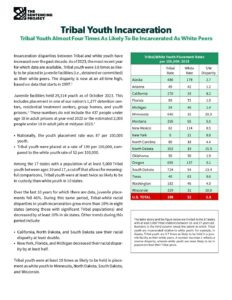
Tribal Youth Incarceration (2025 Update)
Ending the Cycle: A New Approach to Decriminalize Mental Illness
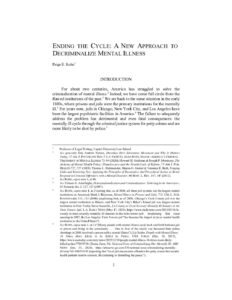
“Today, America faces a health paradox: the nation’s largest jails are the nation’s largest psychiatric institutions. In a criminal justice system designed for punishment, solutions like mental health units or mental health courts try to address this contradiction. Yet, if mental illness is a health issue, and not a criminal issue, then increased investments in…
Read MorePeople v. Clark-Collins, 572 P.3d 604 (Colo. 2025)

In People v. Clark-Collins, the Supreme Court of Colorado remanded the case ordering the district court to amend its standing order on the presentation and scope of testimony and evidence at a reverse transfer hearing as follows: “While the trial court has significant discretion regarding the presentation of evidence and the application of the rules of evidence, there are limits. In…
Read MoreIn re A.M., 2025 Pa. Super. LEXIS 366 (Pa. Super. Ct. 2025)

People v. Boyd-Malone, 2025 Cal. App. Unpub. LEXIS 4860 (Cal. Ct. App. 2025)
State v. Miller, 2025 Minn. App. Unpub. LEXIS 583 (Minn. Ct. App. 2025)

Language Guide: Discussing Disabilities in the Juvenile Legal System

Guide for Interviewing Youth with Disabilities
Youth Detention and Incarceration Facilities in the United States (2010 to February 2023): Mapping Closure Intents and Implementation
From the Discussion: “This study illuminates pathways for future research to explore facility closures. Such research should investigate the impact of specific drivers supporting completed closures of youth facilities, including the combination of stated reasons to appeal to different audiences. Notably, we only found 1 paper in our scoping review that explores the strategies used…
Read MoreKey Statutes & Cases Related to Youth with Disabilities in the Juvenile Legal System

Summaries of DOJ Actions Related to Disabilities & Youth

Youth Justice in the United States

This report from the National Center for Youth Law examines the emerging policies across the United States that are likely to reverse the downward trend of youth incarceration rates.
Read MoreDisability Criminalization: A Primer

Improving Health and Safety as Youth and Young Adults Leave the Justice System: State Implementation of New Policies to Strengthen Continuity of Care at Reentry

The Health and Reentry Project highlights promising Medicaid policy changes that promote continuity of care for young people returning to their communities following incarceration. The changes will support reentry for young people who are eligible for Medicaid or the Children’s Health Insurance Program by introducing them to services that would start 30 days before release…
Read MoreAn Equal Chance to Succeed: Challenging Barriers for Disabled People on Probation and Parole

From the introduction: “Probation, parole, and other forms of post-conviction supervision are challenging for anyone, requiring strict adherence to dozens of complex rules under threat of incarceration for any slip-up. For the high number of people on supervision who have disabilities, supervision is even more challenging. Disabled people regularly face barriers to understanding their supervision…
Read MoreCreating Community Care: Decarceration Strategies in Competency Litigation by Rebecca Schaeffer
Pierce County Juvenile Justice Assessment
From the Introduction: “Following a 2024 County Council request, the Pierce County Performance Audit Committee contracted with the CoLab for Community and Behavioral Health Policy at the University of Washington to conduct an audit of the county’s juvenile justice system against national and research best practice. The assessment is intended to guide future county investments…
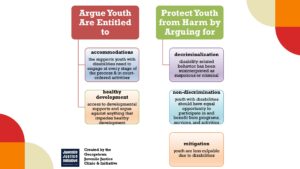
Read MoreDefending Youth at the Intersection of Race & Disability Webinar- Five Arguments
Williams v. Maryland, 2025 Md. LEXIS 305 (Md. 2025)

In re F.M.V., 2025 Tex. App. LEXIS 5495 (Tex. Ct. App. 2025)

Plea Bargains as Drivers of Incarceration-Related Health Outcomes
From the abstract: “The discipline of public health has begun to recognize the structural inequities of the carceral system as drivers of poor individual and population health. Thenumberofpeopleincarceratedandthelengthoftheirincarcerationdeterminethescopeandgravityoftheirexposureto these individual and public health effects. Plea bargains all but guarantee a period of incarceration, often for many years, because prosecutors have significant bargaining power against defendants…
Read MoreA New Exclusionary Rule to Protect Bodily Integrity and Discourage Pretext Stops

From the introduction: “Although the Fourth Amendment grants the Supreme Court power over searches and seizures, it would be unrealistic to turn to the Court for help. In theory, the Fourth Amendment exclusionary rule shapes future police behavior by excluding evidence from trials if the police obtained it unlawfully. However, when it comes to racial…
Read More