
People v. Hannah, 2025 N.Y. App. Div. LEXIS 4359 (N.Y. App. Div. 2025)
Cross-Systems Touches: Youth Homelessness & Systsem Involvement
Representing Noncitizen Clients in Juvenile Court Proceedings
Guidance on Adjustment of Status for Youth with Special Immigrant Juvenile Status Using INA § 245(h) with a Non-SIJS Petition
Youth Defender Guide: Upholding the Rights of Immigrant Youth in Juvenile Court

State v. Lawson, 2025-Ohio-2650 (Ohio Ct. App. 2025)

The Public Defender Service for the District of Columbia Memorandum on Electronic Monitoring: Compliance with Restrictive Rules, Effects on School, Jobs, Family
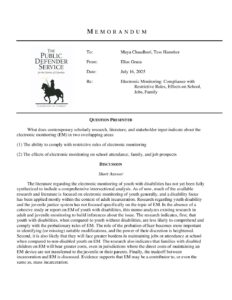
This memorandum from the Public Defender Service for the District of Columbia discusses the contemporary research and literature on electronic monitoring and its impacts on school attendance, family, and employment. The memorandum also discusses the real-world practicalities that make it difficult for youth to comply with the restrictive rules that often accompany electronic monitoring orders. From the memorandum: “The literature regarding the electronic monitoring of youth with disabilities has not yet been fully synthesized to…
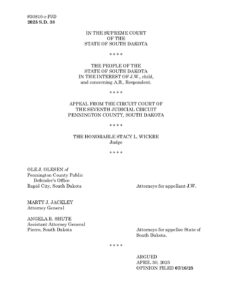
Read MoreIn the Interest of J.W., 2025 S.D. 38 (S.D. 2025)
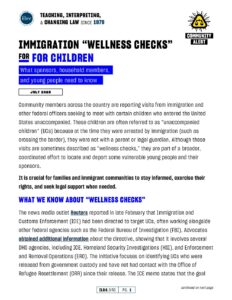
Immigration “Wellness Checks” for Children
Memorandum from the American Civil Liberties Union: Problems with Electronic Monitoring for Young People with Disabilities
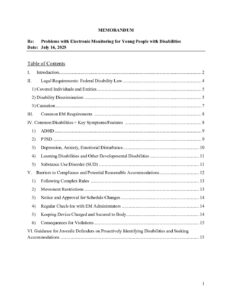
This memorandum from the American Civil Liberties Union provides litigation strategies for defenders challenging electronic monitoring conditions for young people with disabilities. From the Introduction to the memorandum: “Overall, this research project/memo aims to reduce the use of EM for kids with disabilities. Although there is no straightforward disability or accommodations-related argument for ending EM…
Read MoreIn re J.H., 2025 Cal. App. Unpub. LEXIS 4341 (Cal. Ct. App. 2025)

In re B.R., 2025 Cal. App. Unpub. LEXIS 4284 (Cal. Ct. App. 2025)

ACLU Amicus Brief, State v. K.R.C.
Juvenile Law Center, et al. Amicus Brief, State v. K.R.C.
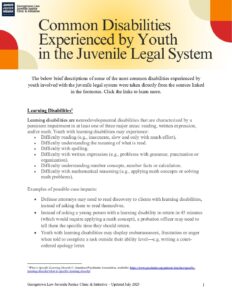
Common Disabilities Experienced by Youth in the Juvenile Legal System
How Can Adults Support the Mental Health and Wellbeing of LGBTQ+ Youth?

Framing Guidance How to Communicate about Transgender Youth

From the introduction: “We know how to support transgender youth. Policies, practices, and care that accept and affirm young people’s gender identities can help transgender young people thrive. Research clearly shows that support and acceptance from parents, using young people’s chosen names, enacting inclusive policies and practices at schools and in the community, and providing…
Read MoreState v. Indiana, 2025 Ind. LEXIS 374 (Ind. 2025)
In re K.K., 2025 Md. App. LEXIS 531 (Md. App. Ct. 2025)

Technology Roundtable: Navigating Mental Health in a Digital World
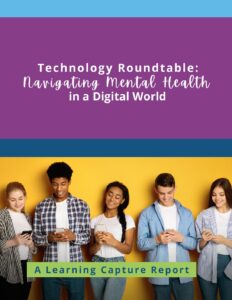
From the introduction: “This report brings together the voices of our participants and current research to explore how social media is shaping mental health, generational experiences, and the way we connect with one another. Inspired by a rich community discussion and grounded in research, this narrative highlights key themes and insights to help inform program…
Read MoreState v. Lahneman, 2025 N.J. Super. Unpub. LEXIS 1179 (N.J. Super. Ct. App. Div. 2025)
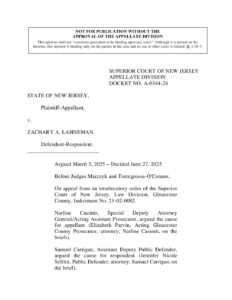
In re M.S., 2025 Cal. App. Unpub. LEXIS 3985 (Cal. Ct. App. 2025)

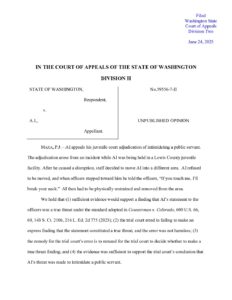
State v. Washington, 2025 Wash. App. LEXIS 1228 (Wash. Ct. App. 2025)
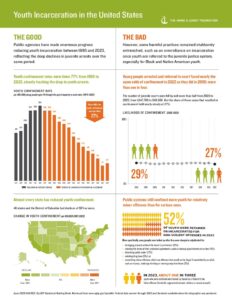
Youth Incarceration in the United States
Defending Olmstead: Strategies for Combatting Institutional Bias to Improve Access to Mental Health Services in the Least Restrictive Setting

From the introduction: “The term ‘institutional bias’ identifies the concept that, throughout history, public policy and perception innately defer to institutionalization as the default living arrangement for people with mental health disabilities to segregate them from society. In theory, the passage of the Americans with Disabilities Act6 (ADA) in 1990 and the groundbreaking Supreme Court…
Read More