
Planning a YDAP Training: Timeline
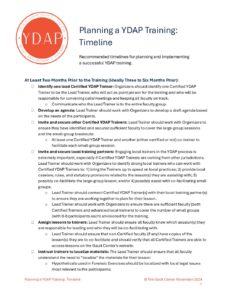
A checklist of recommended timelines for planning and implementing a successful YDAP training.
Read MoreYDAP Coordinator and Trainer Guide
A comprehensive guide for both Certified YDAP Trainers and Training Coordinators, designed to help meet the requirements needed to deliver a YDAP training.
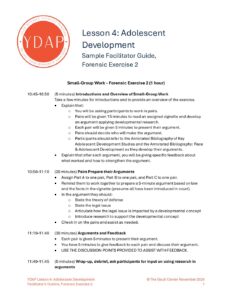
Read MoreLesson 4 Sample Facilitator Guide Forensic Exercise 2
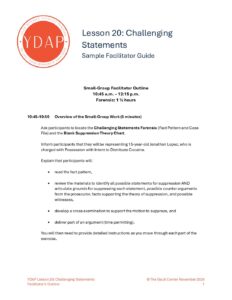
Lesson 20 Sample Facilitator Guide Small Group
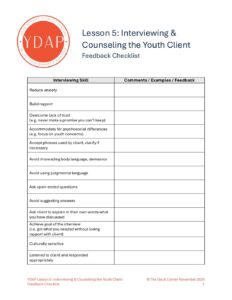
Lesson 5 Feedback Checklist
Ochoa v. State, 707 S.W.3d 344 (Tex. Crim. App. 2024)

YDAP Feedback Method & Checklist
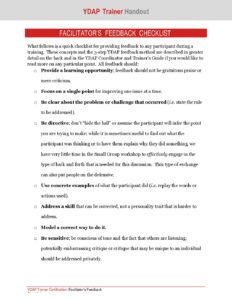
A detailed explanation of the three-step YDAP Feedback Method, including a Facilitator Feedback Checklist and Feedback Fill-in-the-Blank, for Certified YDAP Trainers to use during small-group and forensic exercises in YDAP trainings.
Read MoreDisability Rights TN v. TN Department of Children’s Services, Class Action Complaint

Disposable Children: The Prevalence of Child Abuse and Trauma Among Children Prosecuted and Incarcerated As Adults in Maryland
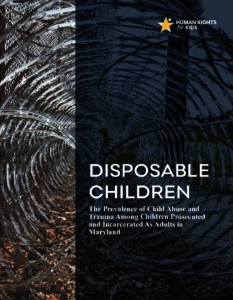
This report details the results of the first-ever state-wide Adverse Childhood Experiences (ACEs) survey administered to people currently incarcerated for crimes they committed as children (under eighteen). The trauma measured from ACEs surveys include physical, sexual, and emotional abuse; physical and emotional neglect; separation from parents; mental illness or substance abuse in the home; parent…
Read MoreDeveloping a Positive Youth Justice System

This report from National Institute for Criminal Justice Reform offers six principles of a positive youth justice system (‘PYJS’) including: 1) Minimize contact with the juvenile justice system, 2) partner with youth and families to develop and share ownership of case plans, 3) community-based organizations should take the lead, 4) build on youth assets and…
Read More02. Checklist for Reviewing Youth Competence Reports
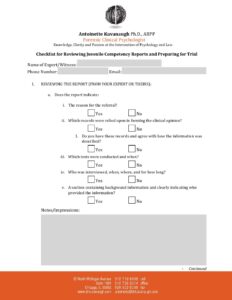
This resource is part of the Youth Defender Advocacy Program (YDAP) curriculum, a specialized trial advocacy training program for youth defenders.
Read MoreThere Are No Bad Kids: An Antiracist Approach to Oppositional Defiant Disorder
Carceral Systems and Mental Health Crises—Health Care, Not Handcuffs

Immigration Policy and Latinx/é Children from Mixed-Status Families: Mental Health Consequences and Recommendations for Mental Health Providers
Abstract: “The impact of immigration policies on Latinx/é mixed-status families and their children is undeniable. Changes in immigration policy, focused on increased deportation enforcement, within the last three decades have led to an increased fear of deportation and unique circumstances mixed-status families must navigate. These circumstances, combined with fear of deportation, have had deleterious effects…
Read MoreNavigate Guide: A Resource in Support of “When No Thing Works” by Norma Wong
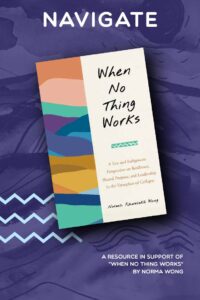
A resource guide to navigate a personal or group reading journey of Norma Wong’s “When No Thing Works.” This guide provides questions to accompany each chapter of the book as well as resources for hosting your own Navigation Circle.
Read MoreDelinquency Cases in Juvenile Court, 2021

The Office of Juvenile Justice and Delinquency Prevention and the National Institute of Justice released a fact sheet highlighting key delinquency caseload trends from 2021. There were 437,300 delinquency cases in the United States, down by 39% from 2020, contributing to an overall decline in delinquency cases since its peak in 1997. In 2021, 44%…
Read MoreA Guide to Applying Youth Voice: Tips to Implement Youth Voice Through a Youth Advisory Council
The Risks and Consequences of Innocence in School Discipline: Implications for Policy and Research

Center Us: Native Youth Survey Report

The Center for Native American Youth (CNAY) at the Aspen Institute released a report detailing survey results of nearly one thousand Native youth on their needs and priorities across issues that matter most to them. This survey was built and disseminated by Native youth leaders who worked in partnership with CNAY staff to practice and…
Read MoreThe 21st Birthday Eligibility Cutoff for SIJS: USCIS Policy and the Risks of Applying On or After the 21st Birthday

Research Overview on Positive Youth Development

This resource highlights research demonstrating the critical importance of community-based alternatives that promote positive youth development and, in turn, public safety. Specifically, this resource outlines a sampling of studies establishing the importance of fresh air and free time; counseling; sports and extracurricular activities; and family, community, spiritual, or other mentorship activities for youth to thrive. This…
Read MoreJuvenile Law Center et al., Amicus Brief, People v. Czarnecki

Equity for Whom? How Private Equity and the Punishment Bureaucracy Exploit Disabled People
From the abstract: “In this report, we invite readers to explore the historical, racialized, disablist, and political economic contexts of mass incarceration, including the ways that incarceration has expanded beyond prisons, jails, and correctional supervision in the 21st century. As well, publics often think of incarceration narrowly, such that they make invisible the containment of…
Read More

