Southwest ADA Center, Americans with Disabilities Act Advancing Court Accessibility for Individuals with Disabilities
American Academy of Pediatric Neuropsychology, the American Civil Liberties Union of New Jersey, the Gault Center et al. Amicus Brief, State v. Jones et al.
This amicus brief from American Academy of Pediatric Neuropsychology, the American Civil Liberties Union of New Jersey, the Gault Center, and others argues there is no reasonable, scientific basis for drawing the line for adolescence at age 18, and therefore protections from Comer (including reconsideration of lengthy sentences for homicide offenses committed by individuals under 18) should extend to young people who were 18 to 20 years old. Additionally, the brief…
Read MoreSupport or Court: How States Respond to Youth Who Commit Status Offenses and Children Who Break the Law

This brief describes how states currently treat two categories of young people: youth who commit status offenses—behaviors that are not categorized as crimes—and young children who do not have the developmental capacity to fully understand the crimes they are committing. Through a 50-state scan of policy and practice, we detail how states respond to these…
Read MoreFrom First Offense to Future Arrests: The Impact of Probation on Youth

A new study by The Pew Charitable Trusts shows that young people assigned to probation after their first offense are more likely to be rearrested in the future, particularly for technical violations, than their peers diverted away from probation. The study, based on data provided by the Texas Juvenile Justice Department (TJJD) and analyzed by…
Read MoreIn the Matter of Registrant R.H. (N.J. Supreme Court)

From Retributive to Restorative: An Alternative Approach to Justice in Schools

School districts historically approached conflict-resolution from the perspective that suspending disruptive students was necessary to protect their classmates, even if this caused harm to perceived offenders. Restorative practices (RP) – focused on reparation and shared ownership of disciplinary justice – are designed to address undesirable behavior without imparting harm. This study looks at Chicago Public…
Read MoreHighlights from the 2022 Juvenile Residential Facility Census

This one-page infographic illustrates statistics from the Office of Juvenile Justice and Delinquency Prevention’s Juvenile Residential Facility Census
Read MoreCharacteristics of Cases Judicially Waived from Juvenile Court to Criminal Court
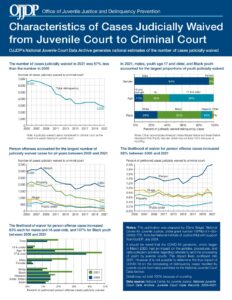
This one-page infographic from the Office of Juvenile Justice and Delinquency Prevention illustrates statistics on waiver from juvenile to criminal courts.
Read MoreReport on Youth Seclusion & Restraint in Colorado Youth Facilities -July 2024

Semi-annual report from the Colorado Division of Youth Services on use of seclusion and restraint in their youth facilities.
Read MoreCultivating Purpose in Adolescence

This report describes the process of developing or cultivating purpose and explains why purpose is one of the key aspects of healthy development in adolescence. Cultivating purpose is widely beneficial for adolescents, and it is particularly important for adolescents from traditionally underserved groups. Purpose is essentially a renewable resource that has the potential to benefit…
Read MoreThe Intersection of Adolescent Brain Development and Anti-Black Racism
The focus of this paper is on the experience of Black adolescents who are growing up amidst evolving national beliefs about racism, ongoing political debate surrounding the Black Lives Matter movement, and a growing national awareness about the experience of being Black in America.
Read MoreUnheard: The Epidemic of Severe Childhood Trauma Among Girls Tried as Adults

This research article explores the history of girls prosecuted as adults in courts across the United States. It explores the effects of childhood trauma and victimization on brain and physical development and the connection to involvement in the criminal legal system as children. The article describes the results of a survey of young women who…
Read MoreExperiencing Probation: Insights from Young People and Families
How Can Age Affect my Immigration Relief Options?

Justice Is Not a Game: The Devastating Racial Inequity of Washington’s Three Strikes Law
From the introduction: “The report begins by examining the racial impact of the Persistent Offender Accountability Act (POAA) through data. The racially disparate application of the Three Strikes Law has been documented since shortly after the law’s passage and has held constant for more than two decades. This report presents the most recent data related…
Read MoreBlack Girls and the Pipeline from Sexual Abuse to Sexual Exploitation to Prison

From the introduction: “In this chapter, I consider the reciprocal effect of Black girls living within spaces and environments influenced by structural racism who are subjected to abuse at higher rates. I argue that there is a uniquely gendered and raced pipeline for these girls that warrants closer inspection. Here, I describe the pipeline that…
Read MoreWorksheet: Youth Defender Agency/Office Audit (Completed)
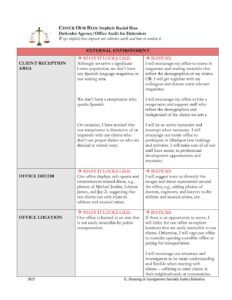
This resource is part of the Youth Defender Advocacy Program (YDAP) curriculum, a specialized trial advocacy training program for youth defenders.
Read MoreYEAH Philly Violent Crime Initiative Year One Process Evaluation

From the executive summary: “YEAH (Youth Empowerment for Advancement Hangout) is a community-based organization working to empower, advocate for, and meet the needs of young people ages 15 to 24 based in West and Southwest Philadelphia. Kendra Van de Water and James Aye co-founded YEAH in 2018 to address the stark lack of safe, culturally…
Read MoreThe Impact of Covid-19 on the Nation’s Juvenile Court Caseload

The COVID-19 pandemic, declared a public health emergency in the United States on March 13, 2020, had an impact on the policies, procedures, and data collection activities of juvenile courts relating to the referrals and processing of youth. Mitigation efforts such as stay-at-home orders and school closures impacted the volume and types of law-violating behavior…
Read MoreHeinous Allegations: Abuses in Youth Custody in Tulsa County, Oklahoma

Gender Affirming Language in Immigration Court
Center for Law, Brain, and Behavior Amicus Brief, Arizona v. Jerald
This amicus brief from the Center for Law, Brain, and Behavior highlights the adolescent capacity for significant growth and social maturation as well as criminological evidence on the unlikelihood of reoffending and responsiveness to evidence-based treatment among youth accused of sex offenses. The brief ultimately calls for the court to find that a de facto life without parole sentence is grossly disproportionate based on developmental science and research. From the Summary of Argument: “Evan McCarrick Jerald is…
Read MoreJuvenile Life Without Parole in Pennsylvania: Age, Cognitive Immaturity, and Culpability

Abstract: “While there has been momentum at both the federal and state levels to curtail extreme punishments for justice-involved juveniles (The Campaign for the Fair Sentencing of Youth, 2023), 22 states continue to permit the sentence of juvenile life without parole (JLWOP). Pennsylvania is among them. This essay focuses on judicial rationale in five JLWOP re-sentencing cases in…
Read More