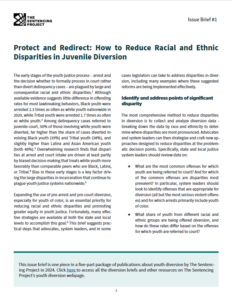
A Checklist to Assess the Presence of a Constitutional Violation under 34 U.S.C. 12601
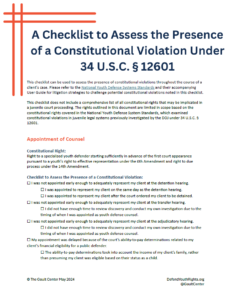
This checklist can be used to assess the presence of constitutional violations throughout the course of a client’s case. Please refer to the National Youth Defense Systems Standards and their accompanying User Guide for litigation strategies to challenge potential constitutional violations noted in this checklist.
Read MoreNational Youth Defense System Standards User Guide

This User Guide provides advocates with a step-by-step outline of how to actualize the vision of the National Youth Defense System Standards to equip and invest in youth defense teams to fight for the liberation of all youth.The User Guide outlines constitutional rights detailed in the System Standards, provides a checklist to assess the presence…
Read MoreBuilding A Brighter Future: A Plan to Invest in DC’s Emerging Adults

From Suspension to Mass Incarceration: Punishment of Students with Special Needs and the School-to-Prison Pipeline

From the abstract: “Since their inception in the late 1980s, zero-tolerance policies have been a cornerstone of American school discipline. Passed by legislators with the intent of protecting school children, these policies have disparately upended the education of marginalized students. School discipline of vulnerable students often paves the way to juvenile incarceration, which in turn…
Read MoreAmicus Brief: In the Interest of D.C.M.
Appeal from the Circuit Court of Pemiscot County, Division I Thirty-Fourth Judicial Circuit, Pemiscot County No. 18PE-JU00022 The Honorable W. Keith Currie, Judge
Read MoreFreedom to Thrive: Reimagining Safety & Security in our Communities

This report examines racial disparities, policing landscapes, and budgets in twelve jurisdictions across the country, comparing the city and county spending priorities with those of community organizations and their members. While many community members, supported by research and established best practices, assert that increased spending on police do not make them safer, cities and counties…
Read MoreThe Second Look Movement: A Review of the Nation’s Sentence Review Laws

This report presents the evolution of the second look movement, which started with ensuring compliance with the U.S. Supreme Court’s decisions in Graham v. Florida (2010) and Miller v. Alabama (2012) on the constitutionality of juvenile life without parole (“JLWOP”) sentences.12 This reform has more recently expanded to other types of sentences and populations, such…
Read MoreA Tale of Two Systems: An Assessment of Access to & Quality of Youth Defense Counsel in Utah

The Utah assessment is the 29th statewide assessment of youth defense delivery systems the Gault Center has conducted. These assessments gather information and data about the structure and funding of defense systems and examine whether youth receive counsel at all critical stages, the timing of appointments, waiver of counsel, youth defense resource allocation, supervision and…
Read MoreWhat Is Special Immigrant Juvenile Status (SIJS)?
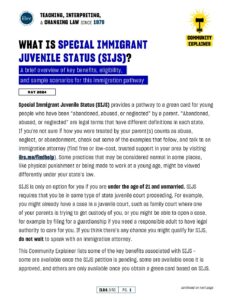
From the introduction: “Special Immigrant Juvenile Status (SIJS) provides a pathway to a green card for young people who have been ‘abandoned, abused, or neglected’ by a parent. ‘Abandoned, abused, or neglected’ are legal terms that have different definitions in each state.”
Read More[Kentucky] Kentucky Department of Juvenile Justice: Notice of Investigation

On May 15, 2024, the DOJ submitted a letter to Kentucky Governor Andy Beshear to notify the state of the commencement of a DOJ investigation into nine juvenile facilities operated by the Kentucky Department of Juvenile Justice (DJJ). The specific issues the DOJ outlined they would investigate include excessive use of chemical force, physical and…
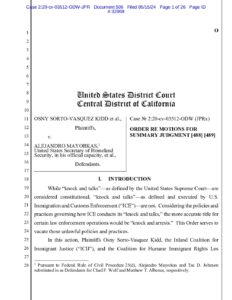
Read MoreKidd v. Mayorkas, 734 F.Supp.3d 967 (C.D. Cal. 2024)
The Anti-Racist Imperative of Infancy

This article calls for the categorical exclusion of young children from juvenile court jurisdiction as a pathway toward the abolition of the juvenile legal system in its current form. This article highlights the landscape of age-based jurisdictional boundaries across the country: 24 states have no minimum age of arrest and prosecution, while 18 states have…
Read MoreJuvenile Life without Parole: Unusual and Unequal.
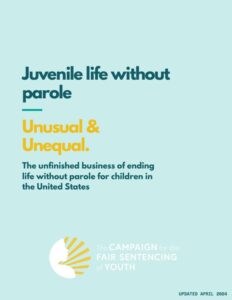
A concentration of a few states has unevenly complied with Miller and the possibility of resentencing provided by Montgomery. Some states have refused to comply at all. This uneven implementation of the Miller decision has a particularly profound impact on racial disparities among those serving JLWOP. An analysis of those deemed worth protecting from JLWOP…
Read MoreFAQs: The Role of Youth Defense Counsel

These FAQs are intended to clarify the role and obligations of the youth defender in juvenile court.
Read MoreCriteria and Procedures for Meaningful Parole Review for People Sentenced as Youth
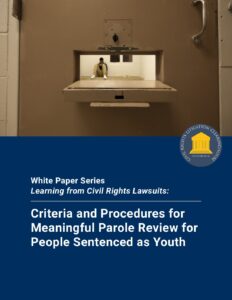
This paper is part of the Series on Learning from Civil Rights Lawsuits from the Civil Rights Litigation Clearinghouse and focuses on parole review procedures for individuals serving long sentences for crimes committed under age 18, discusses constitutional dimensions of parole review for this group, and proposes model policies supporting a meaningful opportunities for release. From the Executive Summary: “In recent years, people serving…
Read MoreSame Crime, Different Time: Sentencing Disparities in the Deep South & A Path Forward Under the Fourteenth Amendment
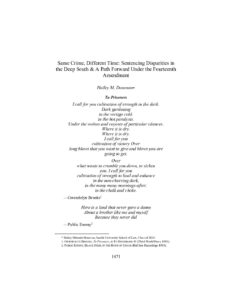
From the introduction: “Although racial discrimination in the Deep South is not the outright focus of this Note—many other scholars have tackled this subject—it remains an underlying ugly truth that is woven into the conversation throughout. Rather than illuminate an already expansive area of jurisprudence, the Author has sought to address racial disparities in sentencing…
Read MoreMathis v. United States Parole Commission – Complaint
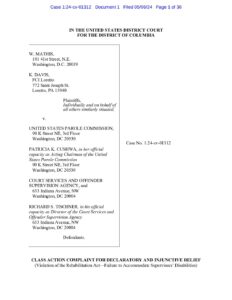
From the preliminary statement: “This case, brought by a class of people who are or will be on parole or supervised release in Washington, D.C., challenges the failure of the federal government’s post-conviction supervision system to accommodate individuals with disabilities as required by federal law.”
Read MoreA Cross-Clinic Collaboration: How an Amicus Brief Helped Create Judicial Recognition of Adultification Bias in Juvenile Sentencing

From the introduction: “In In re Personal Restraint of Asaria Miller, at the urging of merits counsel from the University of Washington’s Race and Justice Clinic, supported by amicus counsel from Seattle University School of Law’s Civil Rights Clinic, the Washington State Court of Appeals took an important step in accounting for the ways that…
Read MoreDangerous Data: What Communities Should Know about Artificial Intelligence, the School-to-Prison Pipeline, and School Surveillance

This report reviews the expanding infrastructure of police surveillance in public schools and highlights the failure of AI technologies and digital surveillance in making schools safer. Further, the report discusses the harms these technologies may cause to Black and Latine youth and youth from other historically vulnerable communities. Calling on youth justice advocates, youth leaders,…
Read MoreA Brief Timeline of States Banning Juvenile Life Without Parole
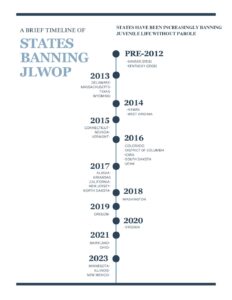
A brief timeline of states banning juvenile life without parole.
Read MoreThe Trevor Project 2024 U.S. National Survey on the Mental Health of LGBTQ Young People
A Path Toward Race-Conscious Standards for Youth: Translating Adultification Bias Theory into Doctrinal Interventions in Criminal Court
Abstract: “This article demonstrates how advocates can leverage empirical literature regarding adultification bias to craft doctrinal interventions that recognize and remedy the disproportionately harsh treatment of Black youth in the juvenile and adult criminal legal system. Through case examples, all of which I litigated in the Civil Rights Clinic at Seattle University School of Law, I demonstrate how adultification…
Read MoreGuidance for SIJS State Court Predicate Orders in California- What You Need to Know in 2024

The Antiracism and Community Lawyering Practicum at Boston University School of Law et al., Amicus Brief, Commonwealth v. Lee
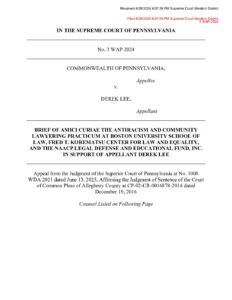
The Antiracism and Community Lawyering Practicum at Boston University School of Law, Fred T. Korematsu Center for Law and Equality, and the NAACP Legal Defense and Educational Fund submitted a brief in support of the appellant, Derek Lee, in a case before the Supreme Court of Pennsylvania regarding the use of mandatory life without parole…
Read More