
Protect and Redirect: Best Practices for Juvenile Diversion
Protect and Redirect: Measuring Equity and Results in Juvenile Diversion

Protect and Redirect: Effective Messaging to Promote Juvenile Diversion Reform
Locked Away for Life: The Case Against Juvenile Life Without Parole for Felony Murder
This article makes the argument against the imposition of life without parole for young people who commit felony murder using an adolescent development framework. The author analyzes existing case law to outline that, just as the U.S. Supreme Court found the death penalty inappropriate for felony murder and relied on adolescent brain development research in…
Read More#AssaultAtSpringValley: 2023 Analysis of Police Violence
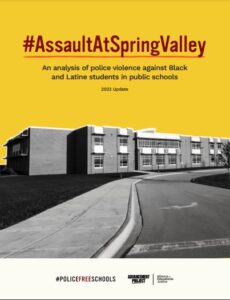
This report is an update to the December 2022 report that analyzed incidents of violence by school police officers against students and the disproportionate impact on Black and Latino/a students attending low-income schools. This update provides additional incidents from the 2022-2023 school year and more context about the reported incidents, such as geographical region and…
Read MoreReimagining Public Safety: Community Listening Sessions with Black Communities and Public Defenders
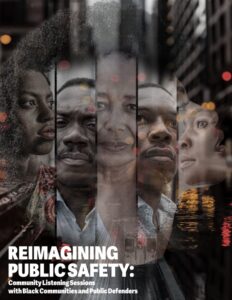
This report is the product of a one-year project to hear directly from Black communities about what safety means to them. The Black Public Defender Association, in partnership with the BlackRoots Alliance, Cook County Public Defender, and Northwestern University, conducted more than 100 interviews of Black residents in Chicago to collect their stories and advice…
Read MoreLatinx Disparities in Youth Incarceration
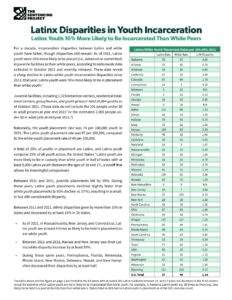
The Sentencing Project released three factsheets highlighting racial disparities in the incarceration of youth: Black Disparities in Youth Incarceration, Disparities in Tribal Youth Incarceration, and Latinx Disparities in Youth Incarceration. These factsheets highlight youth placement rates in 2021 by state and demonstrate that racial disparities persist. Notably, Black youth nationwide are nearly five times more…
Read MoreTribal Disparities in Youth Incarceration
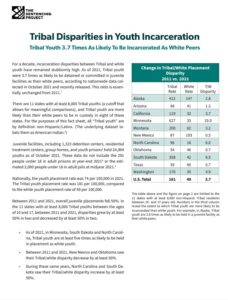
The Sentencing Project released three factsheets highlighting racial disparities in the incarceration of youth: Black Disparities in Youth Incarceration, Disparities in Tribal Youth Incarceration, and Latinx Disparities in Youth Incarceration. These factsheets highlight youth placement rates in 2021 by state and demonstrate that racial disparities persist. Notably, Black youth nationwide are nearly five times more…
Read MoreBlack Disparities in Youth Incarceration

The Sentencing Project released three factsheets highlighting racial disparities in the incarceration of youth: Black Disparities in Youth Incarceration, Disparities in Tribal Youth Incarceration, and Latinx Disparities in Youth Incarceration. These factsheets highlight youth placement rates in 2021 by state and demonstrate that racial disparities persist. Notably, Black youth nationwide are nearly five times more…
Read MoreInternational Independent Expert Mechanism to Advance Racial Justice and Equality in the Context of Law Enforcement: Visit to the United States of America

This report details findings from the International Independent Expert Mechanism to Advance Racial Justice and Equality in Law Enforcement (The Expert Mechanism), who were appointed by the president of the Human Rights Council in 2021 with a mandate to examine the human rights of Black communities in the U.S. as they relate to police interaction…
Read MoreAbolish Gang Statutes with the Power of the Thirteenth Amendment: Reparations for the People

This article calls for the use of the Thirteenth Amendment to abolish federal and state gang statutes. Highlighting the lineage of modern-day gang statutes from Black Codes to vagrancy laws from the Jim Crow era to gang injunctions, this article establishes how current gang statutes remain as “badges and incidents” of slavery. This article walks…
Read MoreSystem Reforms to Reduce Youth Incarceration: Why We Must Explore Every Option Before Removing Any Young Person from Home

This report highlights the importance of reducing the juvenile legal system’s reliance on incarceration by calling for systems reform that centers alternative-to-incarceration programs, adolescent development research, and evidence-based approaches. Highlighting successful state and local laws as well as policies and practices from across the country, the report offers examples of reforms like prohibiting the use…
Read MoreMisdemeanor Enforcement Trends in New York City, 2016–2022: Diminished Caseloads and Persistent Racial Disparities

American Civil Liberties Union Amicus Brief, Ochoa v. State
Listening to Black Women and Girls: Lived Experience of Adultification Bias

Strengthening Indigenous Communities to Eliminate Disparities in the Criminal Justice System Infographic 2024
This infographic details statistics on the overrepresentation of Native and Indigenous communities in the criminal legal system, noting in particular that the incarceration rate of American Indian/Alaska Native communities increased 60 percent from 1990 to 2020. It cautions that current data collection practices on Native and Indigenous communities are often incomplete and inaccurate due to…
Read MoreGirlhood Interrupted: The Erasure of Black Girls’ Childhood

What Goes Up But Never Comes Down? Juvenile Punitive Practice Within the United States
From the Introduction of the Paper: “The U.S.’s failure to implement an internationally abiding federal law regulating juvenile justice has important implications on the treatment of incarcerated adolescent populations while incarcerated, rehabilitated, and reintegrated into society. This article will analyze the harmful and outdated legal frameworks and institutional structures of the U.S. juvenile justice systems.…
Read MoreWhole Youth Initiative Final Report
Equitable Defense: Holistic Defense for Court-Appointed Counsel Cases
This position paper reviews the research on disparities in justice system outcomes based on whether a person is represented by a public defender or by court-appointed private counsel finding that court-appointed counsel achieve less favorable outcomes due largely to differences in compensation and resources available to them. The paper also reviews the literature on the…
Read MoreData, The New Cotton

Black Lives Monitored

Race, Surveillance, Resistance
Virtual Shackles: Electronic Surveillance and the Adultification of Juvenile Courts

Community Responsive Public Defense
From the introduction: “This Essay proceeds in three parts. Part I defines community responsive public defense. Embracing the theme of this colloquium, it situates community responsive defense within the context of increased public awareness of criminal injustice and collective action against mass incarceration. Part II surfaces the work of four public defender organizations that are…
Read More