
Pushing Back on Electronic Monitoring for Young People

This report, written in collaboration with several groups including the East Bay Community Law Center and The Center for Racial and Economic Justice at UC Law SF, provides research, resources and practice suggestions for youth defenders to utilize when arguing against the use of electronic monitoring in juvenile court proceedings. From the introduction: “The use…
Read MoreLitigation Strategies to Curtail the Use of Electronic Monitoring
This page is visible only for registered attendees at our 2026 Youth Defender Leadership Summit who have signed up for access to our Summit portal. You can learn more about our Summit on our Summit Initiative page. If you’ve previously signed up for access to our Summit portal, you can log in below. If you…
Read MoreIn re C.M., 2026 Cal. App. LEXIS 492 (Cal. Ct. App. 2026)
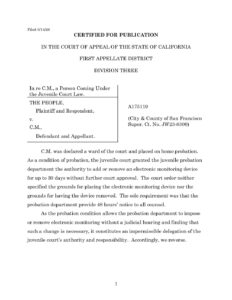
The California 1st District Court of Appeal reversed a probation condition authorizing the probation department to add or remove electronic monitoring without court approval, holding that it is “an impermissible delegation of the juvenile court’s authority and responsibility.” The court stated in relevant part: The “general rule [is] that a court may dictate the basic…
Read MoreSample Motion Challenging Electronic Monitoring
This sample motion from Oregon outlines an argument about the harms of electronic monitoring, especially for youth with disabilities.
Read MoreMemorandum from the American Civil Liberties Union: Problems with Electronic Monitoring for Young People with Disabilities
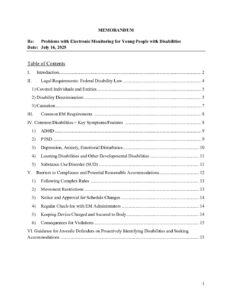
This memorandum from the American Civil Liberties Union provides litigation strategies for defenders challenging electronic monitoring conditions for young people with disabilities. From the Introduction to the memorandum: “Overall, this research project/memo aims to reduce the use of EM for kids with disabilities. Although there is no straightforward disability or accommodations-related argument for ending EM…
Read MoreThe Public Defender Service for the District of Columbia Memorandum on Electronic Monitoring: Compliance with Restrictive Rules, Effects on School, Jobs, Family
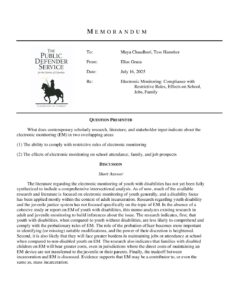
This memorandum from the Public Defender Service for the District of Columbia discusses the contemporary research and literature on electronic monitoring and its impacts on school attendance, family, and employment. The memorandum also discusses the real-world practicalities that make it difficult for youth to comply with the restrictive rules that often accompany electronic monitoring orders. From the memorandum: “The literature regarding the electronic monitoring of youth with disabilities has not yet been fully synthesized to…
Read MoreNo Child Left Confined: Challenging the Digital Convict Lease

This article is a transcript of a lecture given by Professor Chaz P. Arnett at a Symposium hosted by the University of Maryland Francis King Carey School of Law’s Journal of Health Care Law & Policy. Professor Arnett discusses juvenile courts’ increased reliance on electronic monitoring, which he classifies as “e-carceration,” or the “the digital…
Read More

