
4th Amendment
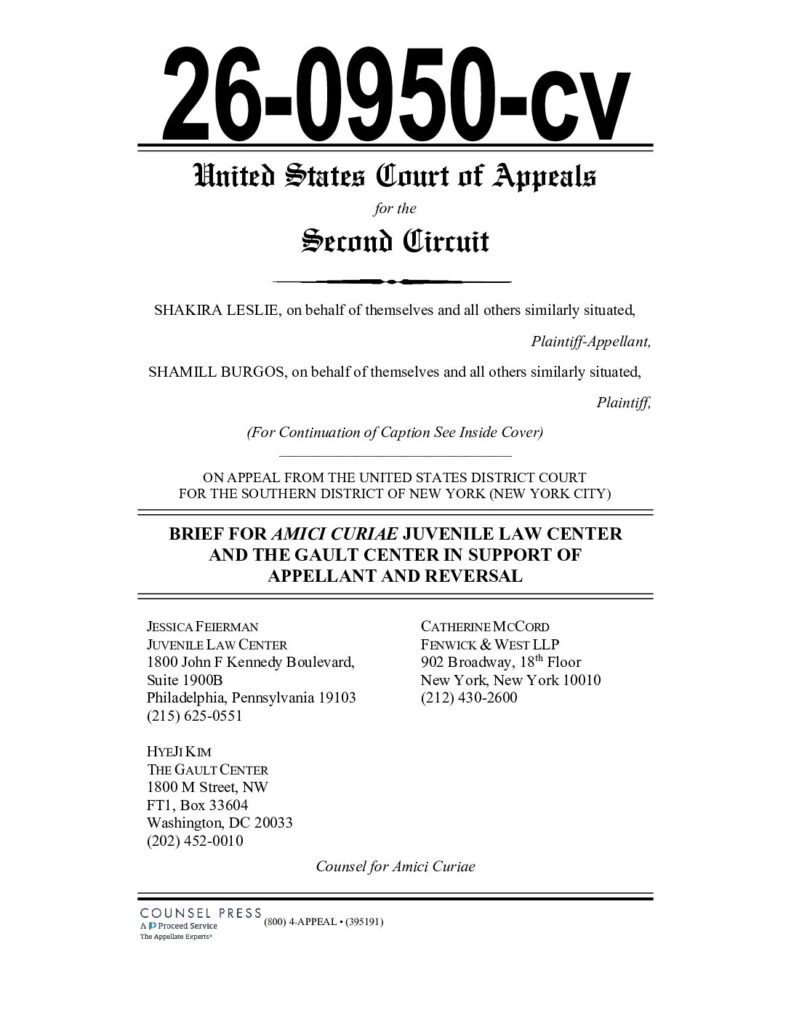
The Gault Center and Juvenile Law Center filed an amicus brief in the Second Circuit Court of Appeals involving New York Police Department’s collection and storage of DNA. From the summary of argument: Amici write in support of Appellant to address the particularly harmful impact that Appellees’ DNA collection and storage practices have on children,…
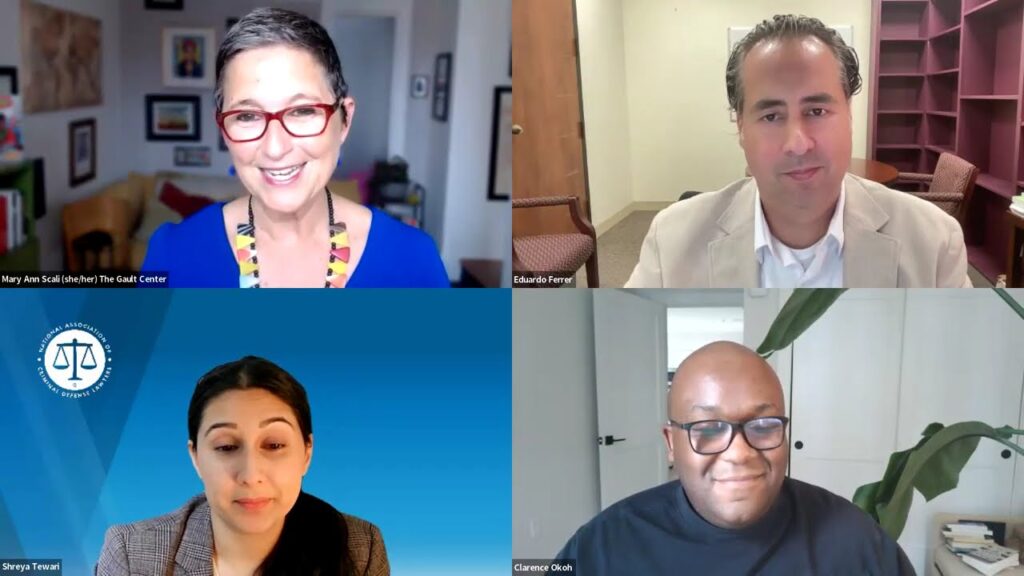
On July 14th, 2026, the Gault Center and the Georgetown Juvenile Justice Clinic & Initiative hosted a webinar on Learning, Litigating, Liberating: Defending Against AI Surveillance of Youth. As AI Surveillance of youth increases in everyday lives from “bullying monitors” to vape detection to facial recognition and so much more, this webinar provides an overview of how and where AI Surveillance is being used and what youth defenders and…
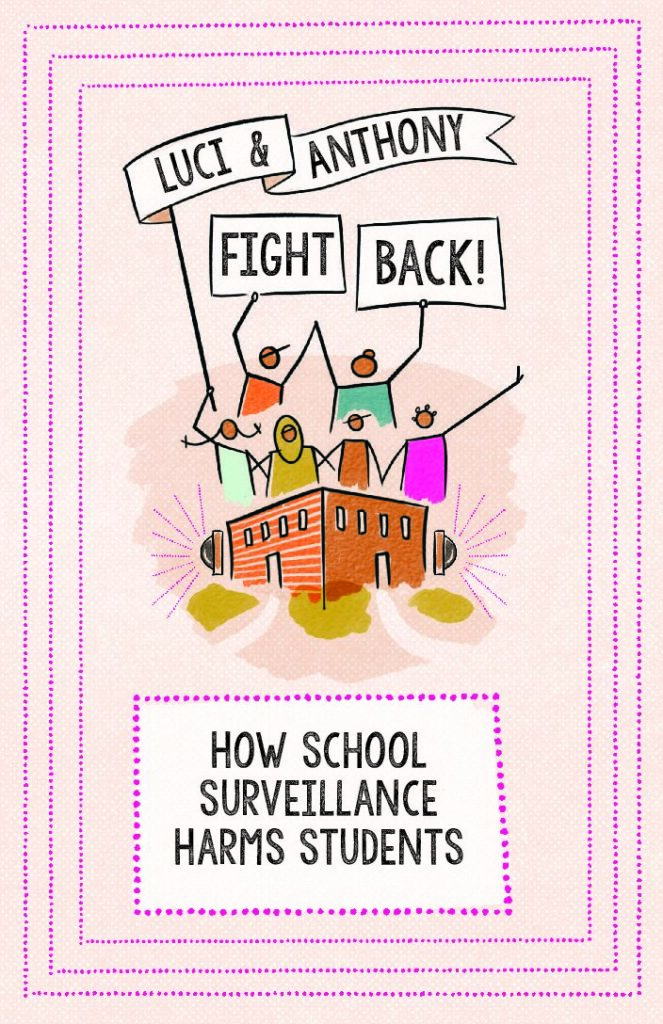
This zine on school surveillance by the National Campaign for Police Free Schools, a campaign that is co-convened by the Advancement Project and the Alliance for Educational Justice, provides know your reality and know your rights information about surveillance technologies used in schools, at home, and in communities. From the introduction: “This zine workbook is…
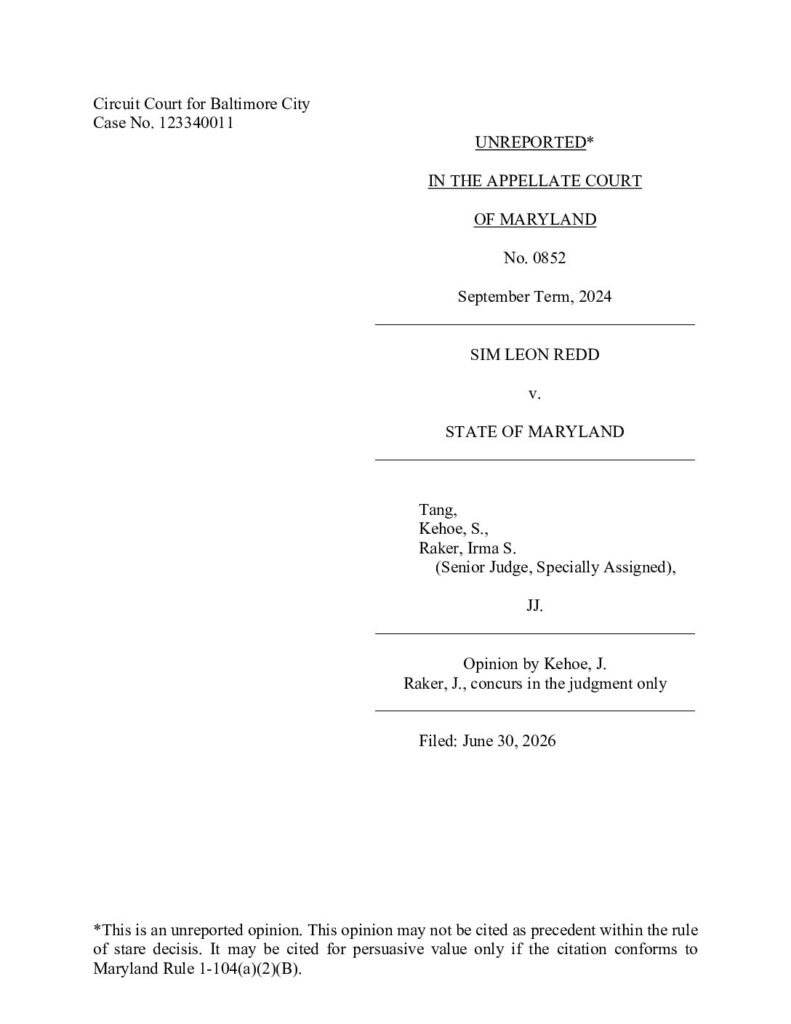
The Maryland Appellate Court reversed the denial of a suppression motion based on an unlawful stop, finding that “sole possession of a firearm, without additional circumstances that indicate illegal possession or other involvement in criminal activity, cannot justify a stop.” The court further stated, “Upon considering decades of case law and federal and state supreme…

The New York Court of Appeals struck a search condition on a probation order, holding that the condition is not reasonably related to the underlying offense. The court stated in relevant part: As we explained in People v Letterlough (86 NY2d 259, 655 N.E.2d 146, 631 N.Y.S.2d 105 [1996]), “[t]he overriding purpose of imposing a sentence…
This article was published by Professor Juan Caballero in the Loyola of Los Angeles Law Review. From the abstract: American history is littered with threats and attempts at mass deportation. The Trump administration’s announced policy of mass deportations is the most recent manifestation of such a policy and one that perhaps poses an unprecedented threat…
From the Abstract: “This article is a practical guide in the fight to abolish the prison-industrial complex as well as institutionalized transphobia and cissexism. Focusing specifically on the practice area of criminal defense, this article proposes a model that must be replicated across jurisdictions wherever transgender people are criminalized. By instituting an interdisciplinary team approach…
This article by Professor Zina Makar was published in the Yale Law Journal. From the abstract: Courts today stand at a doctrinal inflection point: it is unclear whether the spatial logic that has long defined prison law can, or should, govern the digital technologies rapidly evolving behind bars. As tablets and other technologies increasingly structure…
From the abstract: “Among the constellation of actors who appear in courtrooms every day, probation has been largely overlooked in conversations and debates about institutional reform in the criminal legal system. Prior scholarship has focused on probation’s role in administering the sentence of probation. This Article calls for recognizing probation as a key institutional player…
The Alabama Criminal Appeals Court reversed a delinquency adjudication involving possession of a firearm, finding that evidence of the firearm should have been suppressed in light of the illegal stop that took place when the police turned on his vehicle’s emergency lights without reasonable suspicion. The court stated in relevant part: “We hold that Cpl. Seibert lacked…
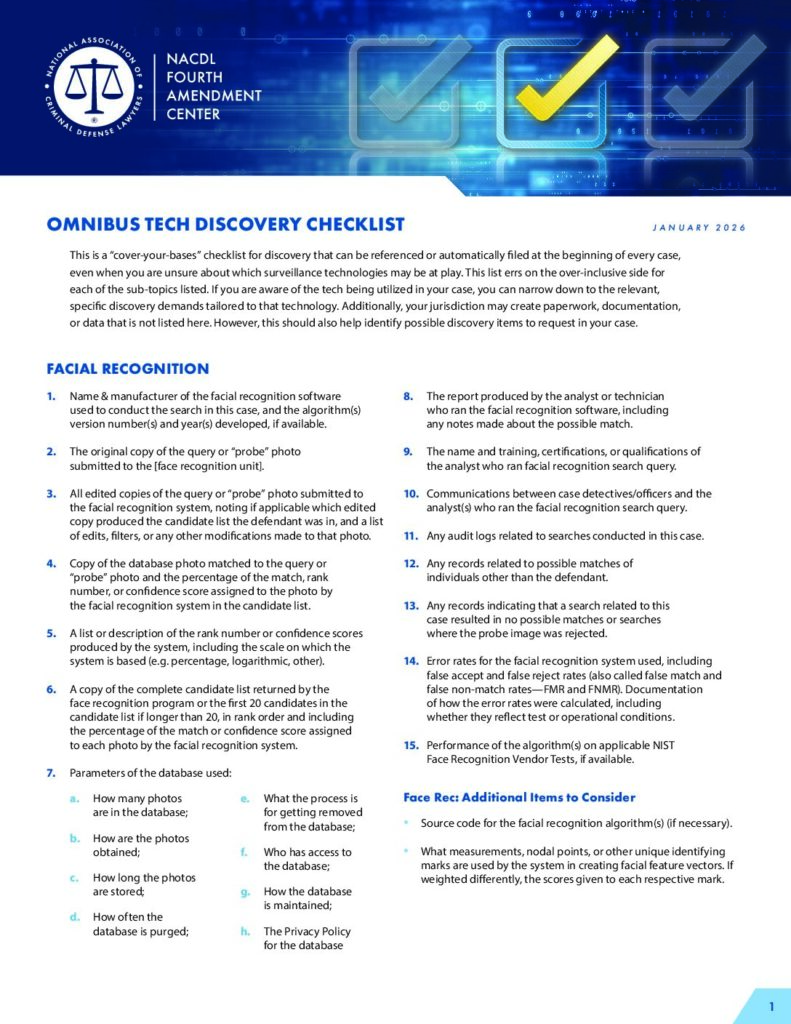
This checklist from the National Association of Criminal Defense Lawyers’ Fourth Amendment Center is a checklist of tech-related items defenders should consider when requesting discovery. Items covered in this checklist include facial recognition software and logs, geofencing warrants and materials, cell-site location information, automatic license plate readers, drone software and licensing, and body worn camera…

The California Supreme Court found that a small amount of loose marijuana scattered on the rear floor of a car does not violate a state statute prohibiting driving while under the impairment of marijuana. The court further held that these circumstances did not create probable cause to conduct a search of the vehicle. The court…
This sample motion argues for special discovery and dismissal and/or suppression based on a claim of selective prosecution in a jaywalking case. Highlighting local police data on racial disparities in jaywalking-related stops, this motion argues that police conduct had a discriminatory effect on Black youth in Cincinnati, in violation of their state and federal equal…

The Delaware Family Court granted a youth’s suppression motion, finding that age and race must be considered when determining whether a seizure has occurred under the Fourth Amendment. The court states in relevant part: “Children are not adults. In J.D.B. v. North Carolina, the Supreme Court decided that children should not be treated like adults for the purposes of…

From the abstract: “This Note provides a general review of the current state of Facial Recognition Technology (FRT), including Illinois state regulation and past federal regulation attempts. This Note asserts that even as datasets become more diverse and “fairer,” FRT may still have discriminatory impacts on minority populations, as evidenced by a few highlighted examples…

From the abstract: This Article employs the Law Review’s Discourse symposium on my book, Unreasonable: Black Lives, Police Power, and the Fourth Amendment, as a starting point to foreground and elaborate on an idea that I reference in that text: police power abolition. The Article begins by describing the central insight that motivates Unreasonable—namely, that…

An appellate court in Washington reversed a trial court’s denial of a young person’s motion to suppress a firearm as a fruit of an unlawful Terry stop. This case involved misidentification by the police officers of three youth of color and the court stated in relevant part: SH-M argues that the trial court erred when…

The Appeals Court of Massachusetts affirmed a defendant’s motion to suppress involving an anonymous tip saying they saw a person who had waved a gun. The court stated in relevant part: “Here, the motion judge found that the anonymous witness’s basis of knowledge was adequately established because the witness saw the person with the firearm…
From the Background of this issue brief by National Immigration Law Center: “This issue brief is designed for individuals or groups advocating for state legislation to protect access to a free public K-12 education for immigrant students and for immigrant students to be safe and protected while in school. The brief outlines some steps that…

The U.S. District Court for the District of New Jersey heard two Motions to Dismiss filed by the Plainfield Public School District, Board of Education, and others, stemming out of a lawsuit filed by fifteen-year-old I.A.’s parents after the detention, search, arrest and prosecution of I.A., by Plainfield school officials and Plainfield Police Officers. In…

Provides tangible opportunities probation officers have to support positive youth development equitably for all youth, regardless of immigration status and circumstances beyond a young person’s control.

The Supreme Court of Maine vacated a conviction, finding that custodial statements should have been suppressed because there was no waiver of the privilege against self-incrimination, and offered the following language in support. “McLain did not clearly waive his privilege against self-incrimination and instead answered that it “depend[ed] on the questions” when asked if he…

Offers an overview of the rights of noncitizen youth and strategies for youth defenders to safeguard these rights and mitigate harm throughout the course of representing youth in juvenile court.


