
Age of Jurisdiction
The Kansas Court of Appeals held that a youth may not be prosecuted as an adult if they were under the age of 13 at the time of the offense based on the court’s statutory interpretation of K.S.A. 38-2347. The court stated in relevant part: “From this review, we do not find that the Legislature…
The Illinois 5th District Court of Appeals found that the juvenile court lacked statutory authority to proceed on a transfer determination once a young person turned 22 years old. This case involved an initial transfer determination followed by a reconsideration request by the defense based on lack of probable cause to justify the initial transfer…
This amicus brief from over 26 juvenile justice amici, including the Gault Center, , argues 1) the spirit and text of New York’s passage of landmark Raise the Age Law rejects the attitudes that underlay the Juvenile Offender Act of 1978, 2) New York’s Raise the Age Law and its legislative history demands a youth subject to adult prosecution only in “extremely rare and exceptional cases”, 3) before courts…

This report highlights D.C. transfer laws and discusses the current U.S. Attorney’s argument that the District of Columbia should amend its law to transfer more young people to to adult court. The report compares D.C.’s transfer law to transfer laws across the country and highlights decades of research that has concluded transfer laws do not…


From the Abstract: In Maine, there is no such thing as a child too young to be prosecuted. Maine’s Juvenile Code grants the juvenile court jurisdiction over a child of any age, even one who would have been considered too young to prosecute in the fifteenth century. As of 2024, just over half of states…

This report challenges the notion that Georgia’s youth legal system is built to rehabilitate and suggests measures that protect the health and humanity of all the state’s children. First, this report will explore the myth of the “superpredator” and its impact on perceived Black youth criminality. Second, it will detail the state’s school-to-prison pipeline and…

This report details the results of the first-ever state-wide Adverse Childhood Experiences (ACEs) survey administered to people currently incarcerated for crimes they committed as children (under eighteen). The trauma measured from ACEs surveys include physical, sexual, and emotional abuse; physical and emotional neglect; separation from parents; mental illness or substance abuse in the home; parent…

The Court of Appeals of Washington remanded a transfer case to the superior court and offered the following language in support. “Our Supreme Court has made clear that trial courts must be vigilant in addressing the threat of explicit or implicit racial bias that affects a defendant’s right to a fair trial. We hold that…
From the abstract: “South Dakota, like many other states, allows young children to be introduced to the criminal justice system at a very young age. Although South Dakota originally focused on managing children’s misbehavior, the law has evolved in a way that punishes kids for being kids. Despite recent reforms to handle juvenile delinquency in…

Florida routinely pushes Black children out of schools and into a legal system with well-documented harms. In recent years, the state has made significant investments in school law enforcement and self-proclaimed “tough love” youth legal system policies, purportedly in the name of public safety. However, these investments have yielded a system that disparately disciplines, arrests,…


On January 30th, 2019, the Players Coalition Charitable Foundation unveiled its 2019 plan to impact racial and social inequality and also announced its 2018-19 support of six national non-profit organizations at a press conference. Players Coalition Co-Founders Anquan Boldin and Malcolm Jenkins presented the Coalition’s direction for the next year. At the press conference, NJDC…

This article calls for the categorical exclusion of young children from juvenile court jurisdiction as a pathway toward the abolition of the juvenile legal system in its current form. This article highlights the landscape of age-based jurisdictional boundaries across the country: 24 states have no minimum age of arrest and prosecution, while 18 states have…

This report details findings from the International Independent Expert Mechanism to Advance Racial Justice and Equality in Law Enforcement (The Expert Mechanism), who were appointed by the president of the Human Rights Council in 2021 with a mandate to examine the human rights of Black communities in the U.S. as they relate to police interaction…


Most states do not set a minimum age of prosecution in juvenile court. And although common sense knowledge of child development1 and international standards2 compel removal of younger children from the juvenile legal system, states have yet to heed the call. Because younger children are inherently more vulnerable,3 they should not be subject to the…

Advocates in Maryland created a series of short policy briefs to educate community members about pressing issues. You can see the others in this series here under “Sample Legislative Advocacy Briefs” on the Policy Page of the Racial Justice Toolkit.

Advocates in Maryland created a series of short policy briefs to educate community members about pressing issues. You can see the others in this series here under “Sample Legislative Advocacy Briefs” on the Policy Page of the Racial Justice Toolkit.

From the introduction: “This report will describe, dissect, and draw lessons from Connecticut’s striking success in juvenile justice reform for other states and communities seeking similar progress. The first section details the timeline and dimensions of change in Connecticut’s juvenile justice system over the past two decades. In 1992, Connecticut routinely locked up hundreds of…
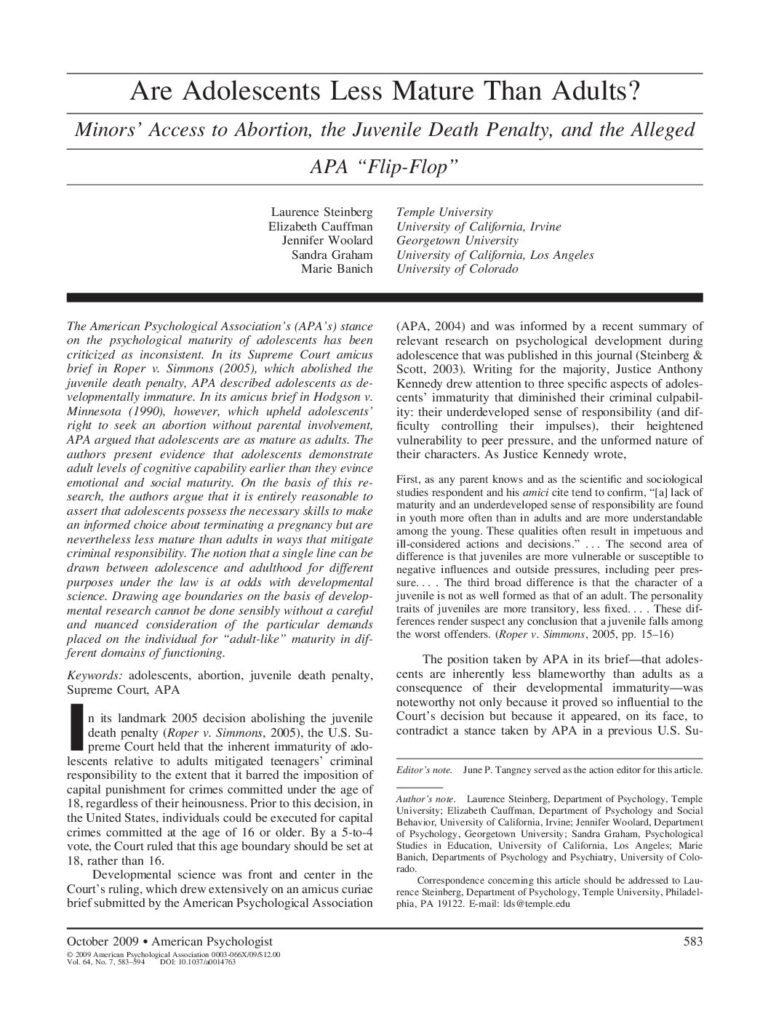
The American Psychological Association’s (APA’s) stance on the psychological maturity of adolescents has been criticized as inconsistent. In its Supreme Court amicus brief in Roper v. Simmons (2005), which abolished the juvenile death penalty, APA described adolescents as developmentally immature. In its amicus brief in Hodgson v. Minnesota (1990), however, which upheld adolescents’ right to…
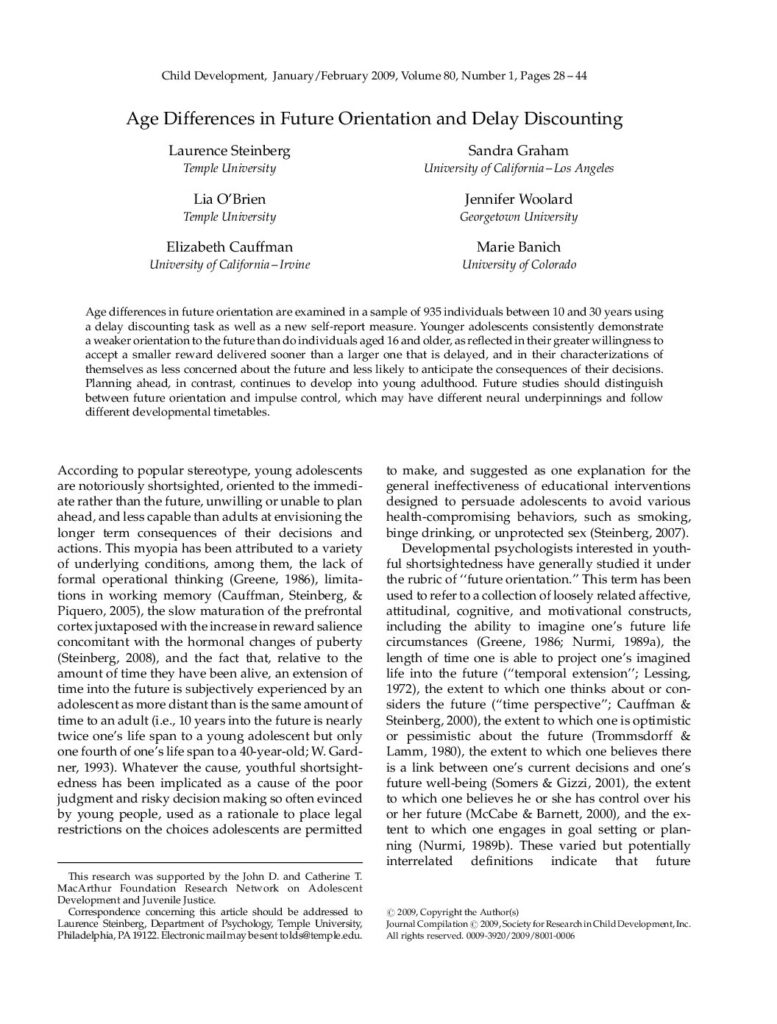
In this research article from Child Development, age differences in future orientation are examined in a sample of 935 individuals between 10 and 30 years using a delay discounting task as well as a new self-report measure. Younger adolescents consistently demonstrate a weaker orientation to the future than do individuals aged 16 and older, as…

From the introduction: “This brief tells the story of how the four Models for Change states—Pennsylvania, Illinois, Louisiana, and Washington—are already moving to reform and reshape their own state juvenile justice systems. These states have demonstrated strong leadership in juvenile justice policy, value collaboration and engagement, and because of their efforts, have changed the political…
