
The Fifth Court of Appeals of Texas reversed a sex offense adjudication finding a violation of due process and the right to confrontation when a state investigator signaled to a child witness during their testimony at trial. The court stated in relevant part: “Rather than being a permissible support person, Dear, looking like Santa, interjected…
The Pennsylvania Superior Court reversed a young person’s probation revocation, finding that the state’s failure to provide defense counsel with notice and discovery violated the young person’s due process rights. The court stated in relevant part: We recognize that “[d]ue process is a flexible concept which ‘varies with the particular situation.’” Bundy v. Wetzel, 646 Pa.…

The Florida Court of Appeals, Second District, found the trial court erred when it decided to make an upward departure from the recommendation of the Department of Juvenile Justice’s recommendation and failed to explain why the departure was most appropriate for T.S.’s individual rehabilitative needs. The court reasoned in part: “Simply listing ‘reasons’ that are…
The Washington Appeals Division 2 reversed a conviction involving allegations of an 11-year-old child charged with attempted rape of a child, finding that the state failed to produce clear and convincing evidence that the child was capable of committing a criminal sexual act. The court stated in relevant part: “A child of at least 8…
The Ohio Court of Appeals, Fourth District, vacated and remanded the trial court’s restitution order, where the trial court allowed unsworn testimony from the victim about restitution and a failed to hold a contested restitution hearing pursuant to state statute. The court reasoned in part: ““‘“[T]he amount of the restitution must be supported by competent,…
The Alabama Criminal Appeals Court reversed an adjudication of making a terrorist threat in the second degree based on insufficient evidence. The court stated in relevant part: “The definition of “threaten” in § 13A-10-242(2) specifically refers to three people. Subsection a. refers to the person who “makes [the] statement.” Subsection b. refers to the person to…
The Minnesota Court of Appeals held that the district court failed to make findings of fact required by statute when ordering restitution and remanded the case for the trial court to make the requisite findings. The court held in relevant part: “Juvenile-delinquency orders require written findings “to show that the district court considered vital standards…
The Nevada Supreme Court reversed an adjudication finding insufficient evidence for possession of a stolen vehicle. The court stated in relevant part: “Viewing the evidence in the light most favorable to the State, we conclude that the evidence presented at the adjudicatory hearing by the State was insufficient to demonstrate that A.W. had possession of…

The New Mexico Court of Appeals held that Malachi D. was reserved his right to appeal despite his plea, and the trial court erred in granting counsel’s request to dismiss the cause as the adjudication hearing was not heard in a timely manner. The court reasoned in part: “We believe that the judgment and disposition…
The North Carolina Court of Appeals reversed an adjudication of disorderly conduct based on insufficient evidence. The court stated in relevant part: “Considering the evidence in the light most favorable to the State and giving the State the benefit of every reasonable inference, Rose, 339 N.C. at 192, 451 S.E.2d at 223 (citation omitted), the evidence is insufficient to…

The California Second District Court of Appeal reversed the juvenile court’s adjudication and disposition orders related to a felony murder charge, finding that the record lacked substantial evidence that the youth acted with reckless indifference to human life. The court stated in relevant part: “Considering the totality of the circumstances, and measured against Emanuel‘s guidance, the…

An Arizona appellate court reversed a youth’s delinquency adjudication, finding that the youth’s statements that he “thinks” or “fantasizes” “about shooting up the school” did not constitute a true threat. The court stated in relevant part: “R.R. argues that his statement was not a true threat because he “specifically said that he would not do…

The Florida 6th District Court of Appeal reversed a youth’s adjudication of grand theft of a motor vehicle based on the State’s failure to prove ownership of the car involved. The Court stated in relevant part: “The delinquency petition charged J.N.S. with stealing Redenti’s “Nissan automobile.” But neither J.N.S.’s confession, witness testimony, nor other evidence established…

The Missouri Eastern District Court of Appeals reversed a juvenile court adjudication of second-degree tampering based on insufficient evidence regarding the youth’s requisite culpable mental state. The Court stated in relevant part: “W.M.H. argues the juvenile court erred in finding he committed second-degree tampering because there was insufficient evidence to prove beyond a reasonable doubt W.M.H.…

This memorandum proposes language for a detention and disposition reform bill in California. The memorandum proposes four areas the detention reform bill aims to change including: 1) clarifying the legal standard for pre-adjudication detention of youth, 2) clarifying the juvenile court’s authority to determine whether pre-adjudication detention is still necessary, 3) clarifying the standard at…

The Third District Court of Appeal in California vacated a felony murder conviction based on insufficient evidence to support the state’s required “reckless indifference” finding, which must also take into consideration youthfulness at the time of the incident. The court stated in relevant part: “Finally, defendant’s youth also cuts against a finding of reckless indifference. In Moore, supra,…

The Pennsylvania Superior Court vacated a conviction for theft by receiving stolen property finding that the evidence was insufficient to establish that the property was stolen. The court stated in relevant part: “Viewing the record, including the habeas corpus testimony about the VIN number check, and drawing all reasonable inferences from that evidence in the light most…

The Georgia Court of Appeals reversed a part of the adjudication and vacated the order of disposition based on insufficient evidence. The court stated in relevant part: “As to the second count of aggravated assault, K. R. argues that there was insufficient evidence to show that the nail clippers were an object that was likely…

The Court of Appeals in North Carolina vacated a judgment adjudicating L.K. delinquent for indecent liberties between minors and imposing a Level 1 disposition upon him, based upon the trial court’s failure to state a standard of proof. The court stated in relevant part: “In the case sub judice, our review of the transcripts and…

The Alabama Supreme Court reversed judgment based on the trial court unnecessarily admitting prior youthful offender adjudications and offered the following language in support. “It is doubtful whether evidence of Walton’s prior crimes was relevant at all, because that evidence did not seem to prove “any fact that is of consequence” to the resolution of the…

The Oregon Court of Appeals reversed a juvenile court’s adjudication of reckless burning, holding that a finding of recklessness requires evidence around a young person’s subjective awareness of risk. This case involved a 13-year-old youth who lit a fire on a grassy hill which spread and ended up damaging several homes. At issue was whether…

The 5th Court of Appeals in Texas reversed a trial court’s judgment based on the state’s constitutional violations of the youth’s right to confrontation and offered the following language in support. “There are specific rules in Texas related to the testimony of a child, including the provision of a support person identified as “any person whose…

The Oregon Court of Appeals reversed a juvenile court adjudication based on insufficient evidence and provided the following language in support below. “Our case law makes clear, however, that [a] youth must have done more to be liable as an accomplice.” Youth did not have a legal obligation to refrain from being present or to discourage the behavior of…
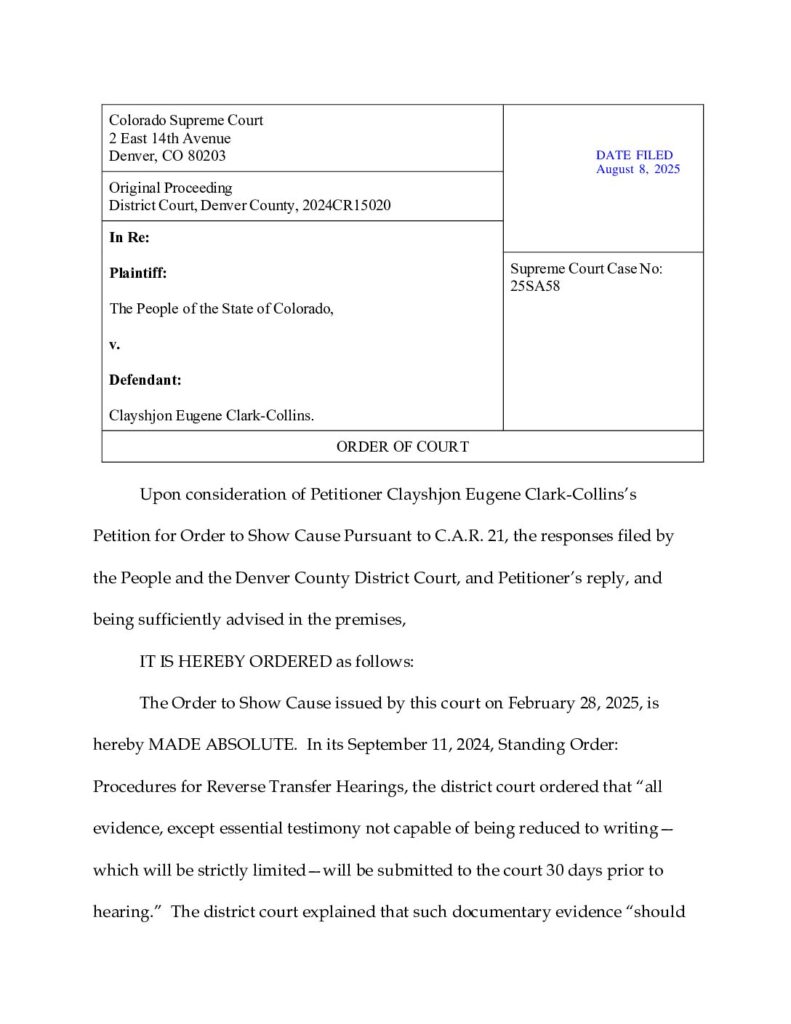
In People v. Clark-Collins, the Supreme Court of Colorado remanded the case ordering the district court to amend its standing order on the presentation and scope of testimony and evidence at a reverse transfer hearing as follows: “While the trial court has significant discretion regarding the presentation of evidence and the application of the rules of evidence, there are limits. In…

