
Lack of Foreseeability

This amicus brief by Juvenile Law Center, Campaign for Youth Justice, and The Gault Center argues the transfer hearing in the state juvenile court deprived the young person of due process when the judge only considered the intentional murder charge, when they were ultimately convicted on the lesser offense of felony murder and second degree…

This amicus brief by The Gault Center, Juvenile Law Center, and National Center for Lesbian Rights argue that strict liability statutes run counter to the principles of adolescent development. Here, amici argue that a 12-year old child who engaged in non-forcible sexual conduct with his peer, who was then prosecuted under a strict liability sex…

The U.S. Supreme Court held juvenile life without parole for non-homicide offenses violates the 8th Amendment and offered the following language in support. “Roper established that because juveniles have lessened culpability they are less deserving of the most severe punishments. 543 U.S., at 569, 125 S. Ct. 1183, 161 L. Ed. 2d 1. As compared…

This amicus brief by The Juvenile Law Center, The Gault Center, and others highlights the unique developmental status of youth, relevant social science research, and Supreme Court Jurisprudence, that make a life without parole sentence for non-homicide crimes unconstitutional in violation of the 8th Amendment of the U.S. Constitution. As stated in their brief: “The…
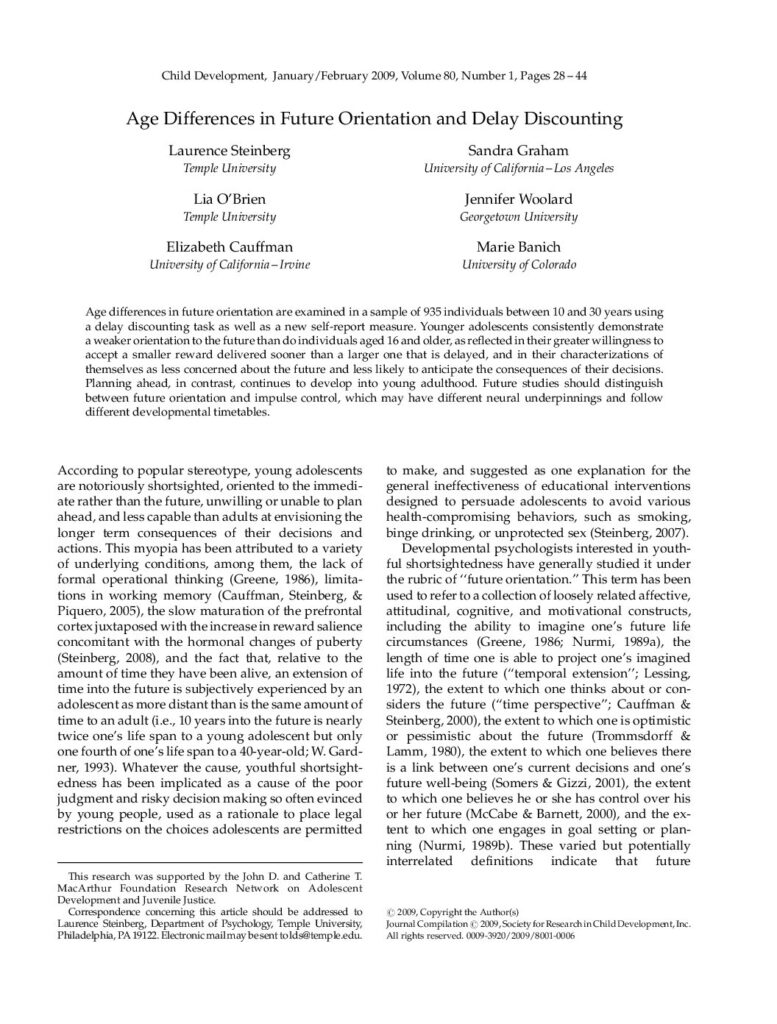
In this research article from Child Development, age differences in future orientation are examined in a sample of 935 individuals between 10 and 30 years using a delay discounting task as well as a new self-report measure. Younger adolescents consistently demonstrate a weaker orientation to the future than do individuals aged 16 and older, as…
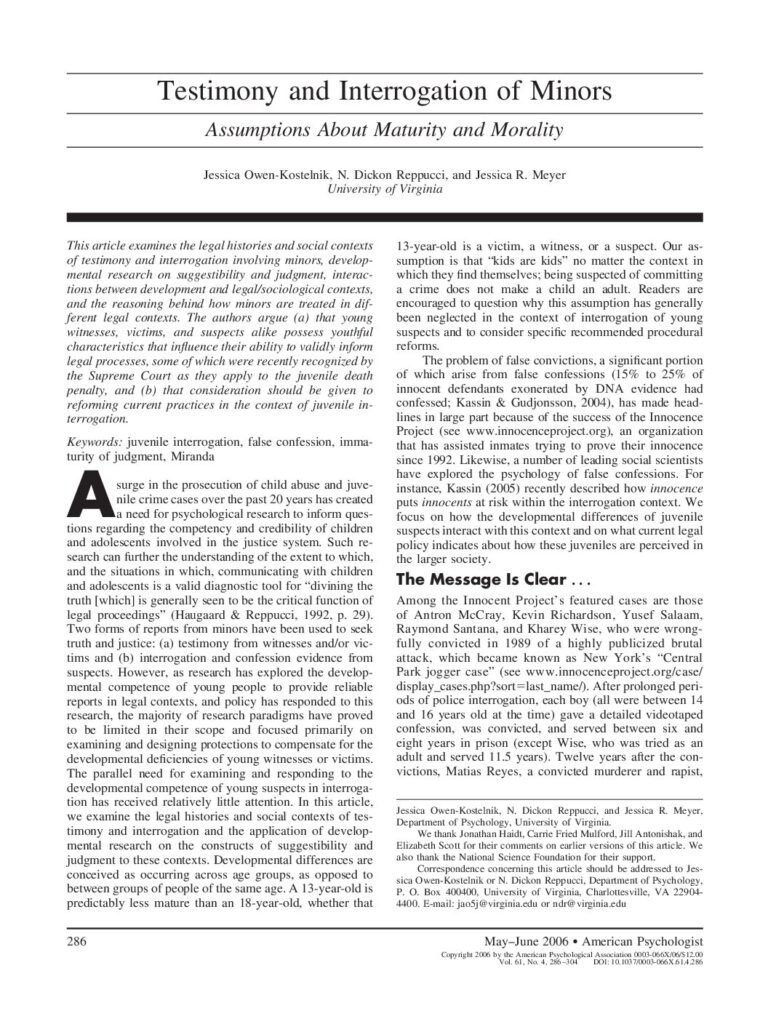
This article examines the legal history and social contexts of testimony and interrogation involving young people, developmental research on suggestibility and judgment, interactions between development and legal/sociological contexts, and the reasoning behind how young people are treated in different legal contexts. The authors argue (a) that young witnesses, victims, and suspects alike possess youthful characteristics…
- « Previous
- 1
- 2
