
Lack of Foreseeability
This infographic series on advancing best practices in youth justice from the RFK Community Alliance’s National Resource Center for the Transformation of Youth Justice provides accessible research on core practices driving change in youth justice and includes research on adolescent development and emerging adulthood, positive youth development and growth-focused case management, the negative effects of…
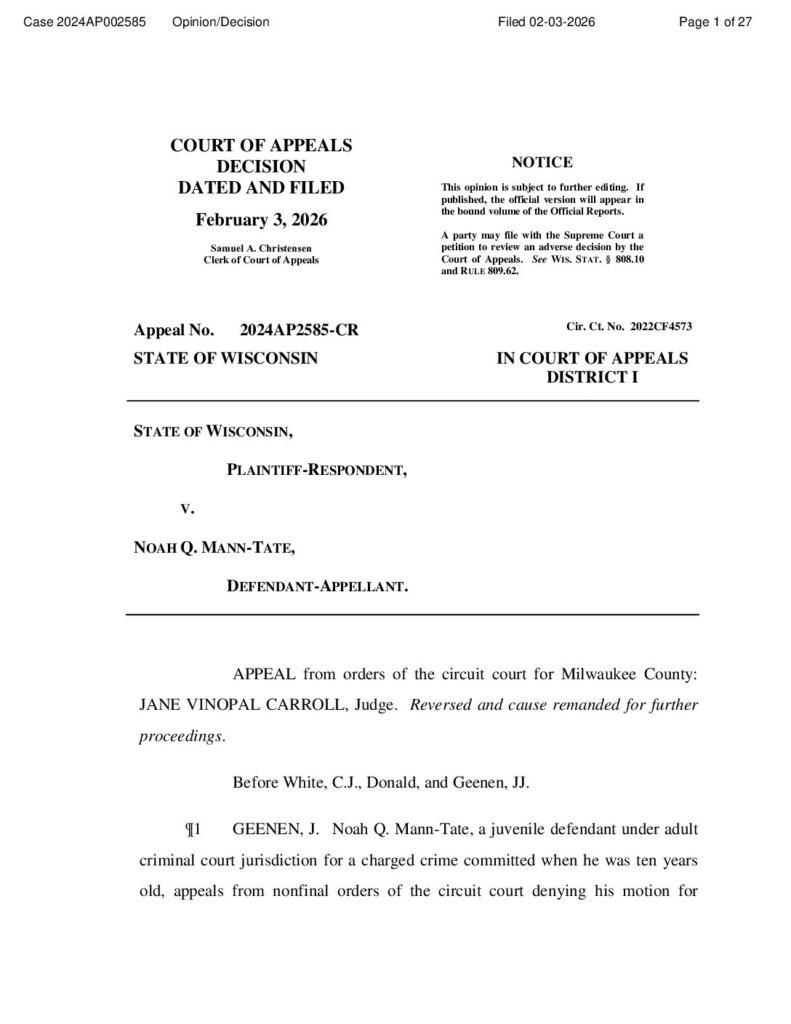
The Court of Appeals of Wisconsin held that the state’s reverse waiver statute was unconstitutional “to the extent it does not require circuit courts to consider the unique attributes of youth identified by the United States Supreme Court.” In Wisconsin, a youth’s case that is directly filed in adult criminal court may be sent to…

The 6th District Court of Appeal in California reversed an order denying a resentencing petition based on trial counsel’s failure to raise the implications of youthfulness and adolescent development in disputing implied malice in a felony murder case. The court stated in relevant part: “Lopez, 20, participated in the attack on Sandoval with two peers.…

The Second District Court of Appeals in Illinois vacated a 66-year sentence finding that the trial court misinterpreted youth-related statutory factors as aggravating instead of mitigating factors. The court stated in relevant part: “Defendant also argues that the trial court incorrectly interpreted the statutory factor of his ability to consider the risks and consequences of…

The Oregon Court of Appeals reversed a juvenile court’s adjudication of reckless burning, holding that a finding of recklessness requires evidence around a young person’s subjective awareness of risk. This case involved a 13-year-old youth who lit a fire on a grassy hill which spread and ended up damaging several homes. At issue was whether…

The Illinois appellate court reversed the trial court’s sentence of 14 years for an aggravated driving under the influence and reckless homicide conviction based on defense counsel’s failure to produce evidence related to youth-based factors in mitigation. The court offered the following language in support. “Because defendant was a minor when the crash occurred, the…
This amicus brief by forty developmental science scholars and nonprofits argues transformative growth during ages 18-20 makes mandatory LWOP for individuals in that age range a disproportionate sentence in violation of Article 1, Section 16 of the Michigan constitution. From the Summary of the Argument: “People v Parks held that Article 1, Section 16…

This amicus brief from American Academy of Pediatric Neuropsychology, the American Civil Liberties Union of New Jersey, the Gault Center, and others argues there is no reasonable, scientific basis for drawing the line for adolescence at age 18, and therefore protections from Comer (including reconsideration of lengthy sentences for homicide offenses committed by individuals under 18) should extend to young people who were 18 to 20 years old. Additionally, the brief…
This amicus brief from the Center for Law, Brain, and Behavior highlights the adolescent capacity for significant growth and social maturation as well as criminological evidence on the unlikelihood of reoffending and responsiveness to evidence-based treatment among youth accused of sex offenses. The brief ultimately calls for the court to find that a de facto life without parole sentence is grossly disproportionate based on developmental science and research. From the Summary of Argument: “Evan McCarrick Jerald is…

Abstract: “While there has been momentum at both the federal and state levels to curtail extreme punishments for justice-involved juveniles (The Campaign for the Fair Sentencing of Youth, 2023), 22 states continue to permit the sentence of juvenile life without parole (JLWOP). Pennsylvania is among them. This essay focuses on judicial rationale in five JLWOP re-sentencing cases in…

This paper is part of the Series on Learning from Civil Rights Lawsuits from the Civil Rights Litigation Clearinghouse and focuses on parole review procedures for individuals serving long sentences for crimes committed under age 18, discusses constitutional dimensions of parole review for this group, and proposes model policies supporting a meaningful opportunities for release. From the Executive Summary: “In recent years, people serving…
This written testimony from Elizabeth Cauffman, Ph.D. and Arielle Baskin-Sommers, Ph.D. discusses what developmental science says about the impact of brain development on adolescent risk taking, decision making, and susceptibility to social and peer influence as it relates to a young person’s culpability. The testimony also provides information on diversion and its impact on lower recidivism and improved public safety. Below is an excerpt from…
From the Introduction: “This Article will focus on the difficulties ex-juvenile offenders face when seeking expungement of their juvenile records to prevent collateral consequences. Specifically, I will argue that a person under the age of eighteen should not be subject to the same statutory expungement bar as adults when seeking an expungement in New Jersey.…
In People v. Stovall, the Michigan Supreme Court vacated Stovall’s sentence of a parolable life sentence for second-degree murder finding it violated Article 1, Section 16 of the Michigan constitution prohibition against cruel and unusual punishment. The court offered the following language in support: “The Michigan Constitution, however, is different. Article 1, § 16 of the Michigan Constitution provides that “[e]xcessive bail shall not be…

From the conclusion: “Washington, DC has severe racial disparities in its justice-involved population. That should alarm local leadership and its residents. These disparities are rooted in policing practices that target communities of color, a lack of investment and opportunity in historically disadvantaged neighborhoods, and an overly punitive sentencing, parole, and corrections system. The current system…

From the Abstract: “Modern doctrine and scholarship largely take it for granted that offenders should be criminally punished for reckless acts. Yet, developments in our understanding of human behavior can shed light on how we define and attribute criminal liability, or at least force us to grapple with the categories that have existed for so…

This article from Dr. Antoinette Kavanaugh and Dr. Thomas Grisso examines the roles experts can play in “Montgomery” resentencing cases. From the article: “In summary, experts can play an important role in the approximately five hundred Miller/ Montgomery cases pending in Pennsylvania’s courts. Experts retained by the defense can serve as educators or evaluators. In…
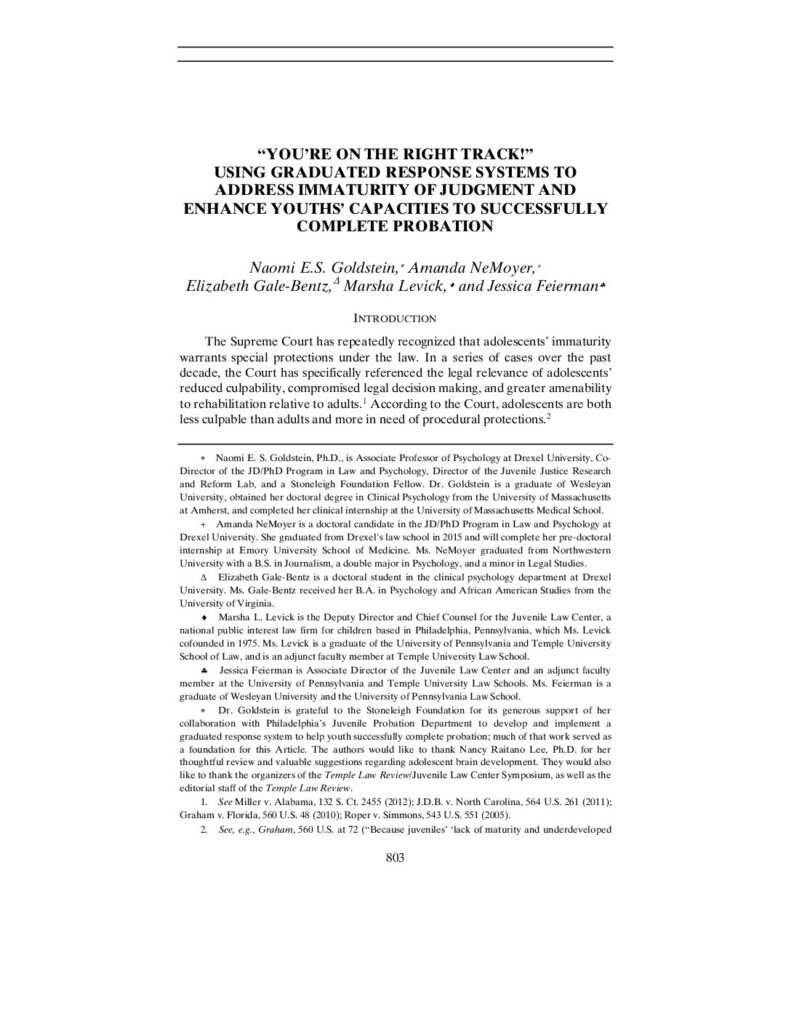
From the Introduction: “The Supreme Court has repeatedly recognized that adolescents’ immaturity warrants special protections under the law. In a series of cases over the past decade, the Court has specifically referenced the legal relevance of adolescents’ reduced culpability, compromised legal decision making, and greater amenability to rehabilitation relative to adults. According to the Court,…

From the introduction: ” Recent Supreme Court cases have recognized the science underlying the common-sense notion that children are not “little adults.” Their brains function in a completely different manner than those of adults. In 2005, the Court abolished the juvenile death penalty and recognized the neuroscience underlying the claim that those under the age…

This amici brief by Juvenile Law Center, Loyola Civitas Childlaw Clinic, and others argues automatic prosecution and mandatory sentencing of young people charged with felony murder is unconstitutional in light of recent Supreme Court case law as Illinois law does not allow for individual sentencing based on maturity and culpability. Furthemore, the brief argues the…
