

The Oregon Court of Appeals vacated and remanded a judgment placing a youth in state custody because of the trial court’s failure to provide adequate written findings as required by state statute. The court stated in relevant part: Finally, the findings taken together are too conclusory to satisfy ORS 9C.478(1). See State v. D. J. P., 342 Ore.…

The Oregon Court of Appeals reversed and remanded a disorderly conduct conviction because of the trial court’s denial of defense counsel’s request to make an offer of proof. The court stated in relevant part: An offer of proof “assure[s] that the trial court can make an informed decision”; “permits the parties to raise additional arguments,…
The Oregon Court of Appeals vacated and remanded a placement order, finding that the order lacked written findings justifying placement based on the best interests of the youth, as required under state statute. The court stated in relevant part: Under ORS 419C.478(1), a juvenile court placing a youth in OYA custody must include in its order…
The Oregon Court of Appeals vacated and remanded an adjudication finding that the trial court erred in failing to provide written findings and consider the youth’s best interest. The court stated in relevant part: Assessment of a youth’s best interest is “a child-focused consideration” and “must be child-centered.” Dept. of Human Services v. T. M. D.,…
The Oregon Court of Appeals held that a trial court must consider mental health attributes at sentencing pursuant to the Eighth Amendment and the Oregon state constitution’s prohibition against cruel and unusual punishment. The court stated in relevant part: “We agree with defendant that ORS 131.295 and ORS 131.300 provide that objective societal standard. Through…

“The Supreme Court upheld the criminalization of public survival by unhoused people in City of Grants Pass v. Johnson in June 2024. This article examines that decision and considers why Grants Pass had not enforced its camping ban against unhoused people when the author visited the city one year later. One important reason is that…

The Oregon Court of Appeals examined a state sentencing statute that prohibits juvenile life without parole sentences (ORS 161.740) and held that it applies when an individual is convicted in adult court and sentenced for an offense committed when they were under the age of 18 if the sentence was imposed on or after January…
The Oregon Court of Appeals held that the trial court erred where it failed to instruct the jury on the “choice-of-evils” defense. The court stated in relevant part: Regarding the first assignment of error, we review a trial court’s refusal to provide a requested jury instruction for legal error. State v. Jackson, 334 Or App…

The Oregon Court of Appeals held that a plea colloquy has to affirmatively demonstrate that a young person understands the “consequences of an admission, including the maximum disposition associated with it”. The court stated in relevant part: “For an admission by a youth to be valid, the youth must be aware, in a manner consistent…

The Oregon Court of Appeals reversed a juvenile court’s adjudication of reckless burning, holding that a finding of recklessness requires evidence around a young person’s subjective awareness of risk. This case involved a 13-year-old youth who lit a fire on a grassy hill which spread and ended up damaging several homes. At issue was whether…

The Oregon Court of Appeals reversed a juvenile court adjudication based on insufficient evidence and provided the following language in support below. “Our case law makes clear, however, that [a] youth must have done more to be liable as an accomplice.” Youth did not have a legal obligation to refrain from being present or to discourage the behavior of…

On April 9, 2025, the Oregon Court of Appeals found that a probation condition ordering a youth “to follow probation conditions as designated by OYA [the Oregon Youth Authority]” was legally insufficient to determine whether a young person violated a term of their probation. The Court explained, “without knowing what probation conditions OYA had actually…


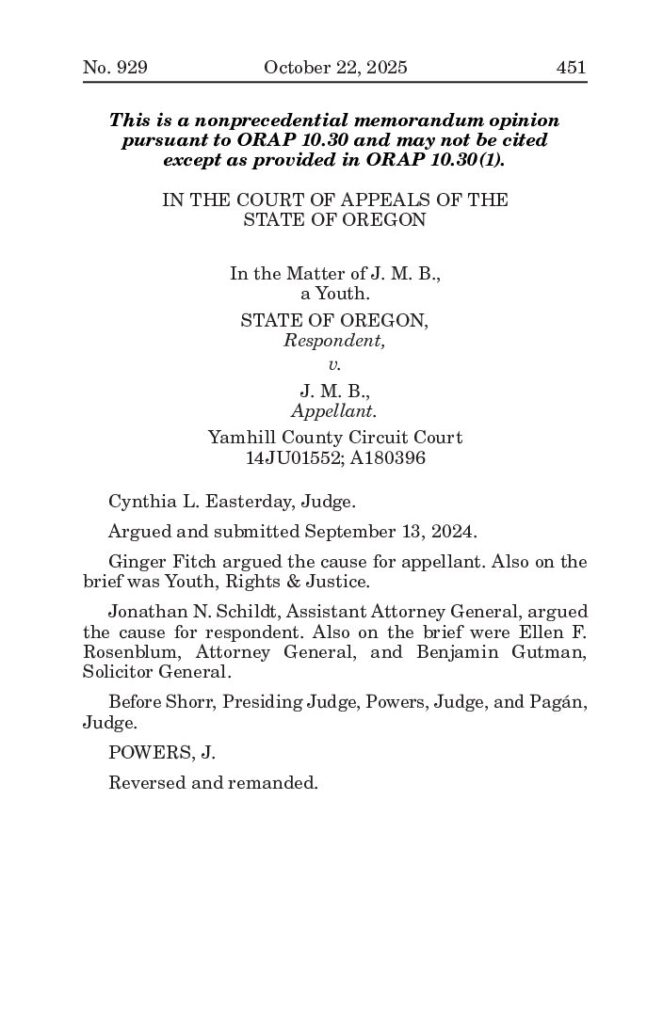
The Oregon Court of Appeals held that the court must provide constitutionally adequate notice to a young person of a requirement to appear in person rather than remotely before making a finding of “failure to appear”. The court stated in relevant part: “Fundamental principles of due process require that an individual be provided with notice…

This guide is meant to help young people in Oregon understand the collateral consequences to juvenile court involvement and adjudications, and what they can do to overcome those consequences. Written in youth-friendly language, this guide walks through how young people should talk about their juvenile court record, the impact of their record on school, jobs,…


To read the opinion in this case, please click here.

To read the Amici Brief submitted by Oregon Criminal Defense Lawyers Association and Oregon Justice Resource Center, please click here.


From the introduction: “In this Pathway we explore why youth of color are overrepresented in the juvenile detention system and review what has been done in some sites to reduce the number of minority youth in detention. Dealing with disparity in the use of detention has been one of the most challenging pieces of the…
