
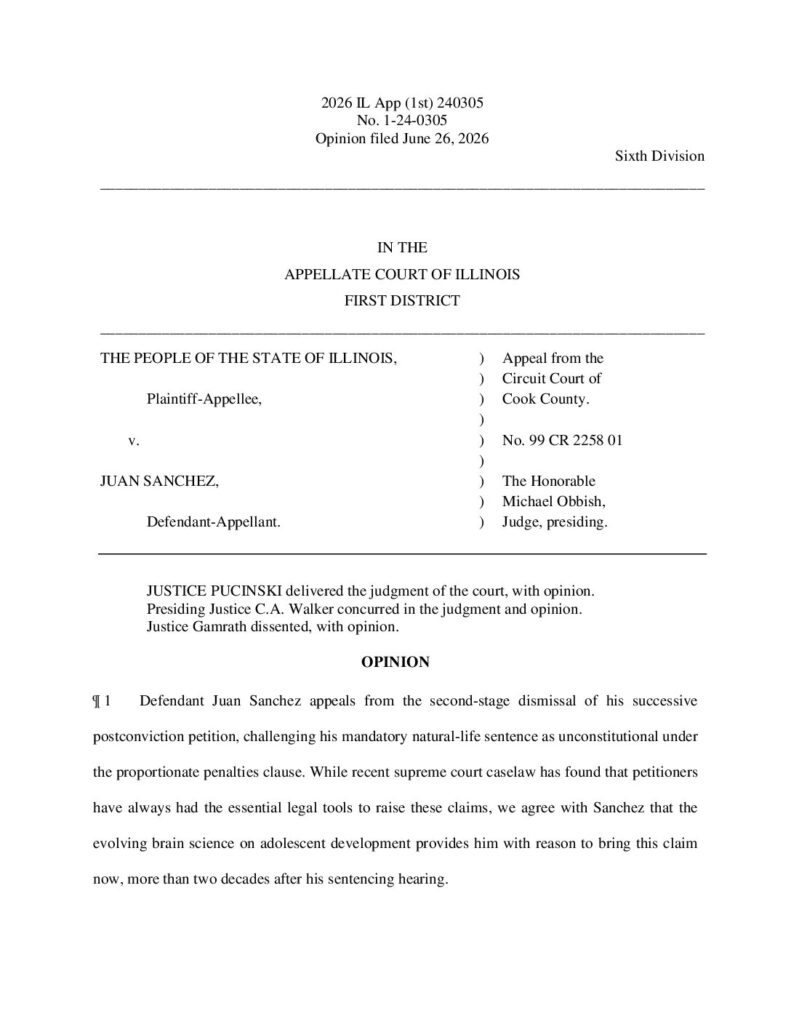
The Illinois First District Court of Appeals granted a full evidentiary hearing on a postconviction petition based on new research on late adolescent brain development that was unavailable at the original sentencing hearing in 2001 and a detailed affidavit connecting that research to the individual’s childhood abuse and trauma. The court stated in relevant part:…
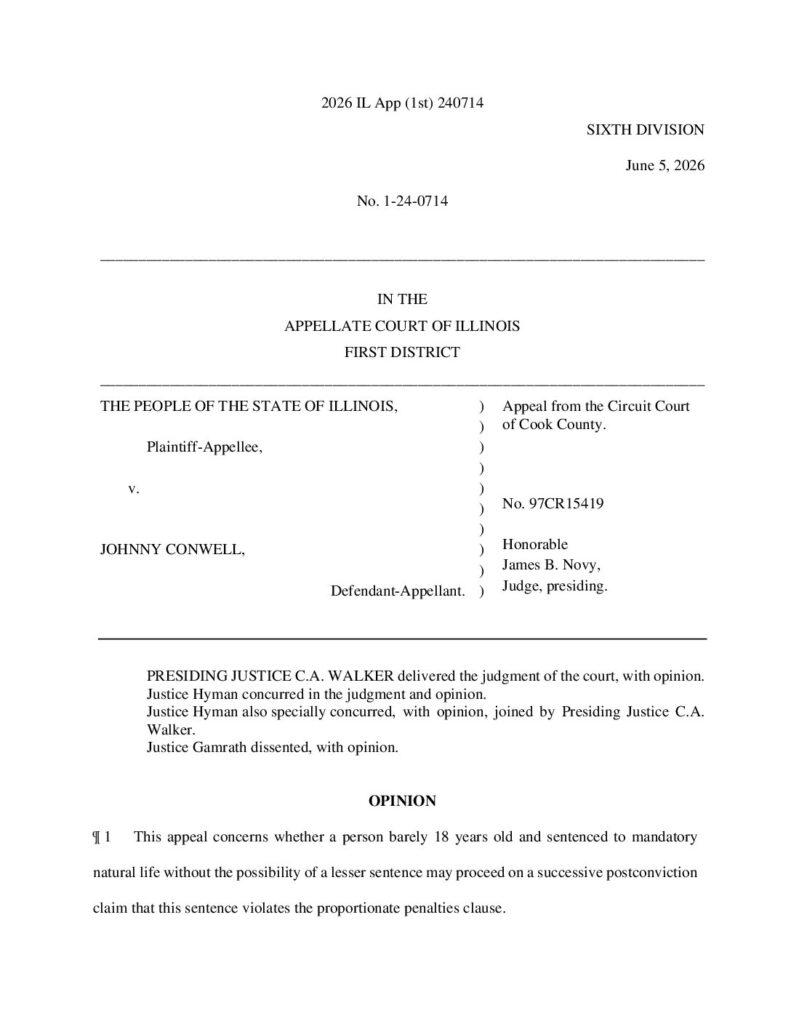
The Illinois 1st District Court of Appeals granted an individual to proceed on a postconviction hearing to challenge his life sentence based on the state’s proportionate penalties clause. The court held that the individual who 18 at the time of the offense was entitled to present mitigating evidence about his age and youthfulness. The court…

The Illinois Court of Appeals found that the trial court erred in applying the statutory framework when resentencing Evans under Miller and that the severity of the offense does not relieve the court of the duty to follow the law. The Court of Appeals remanded the case for a new sentencing hearing. The court reasoned in…
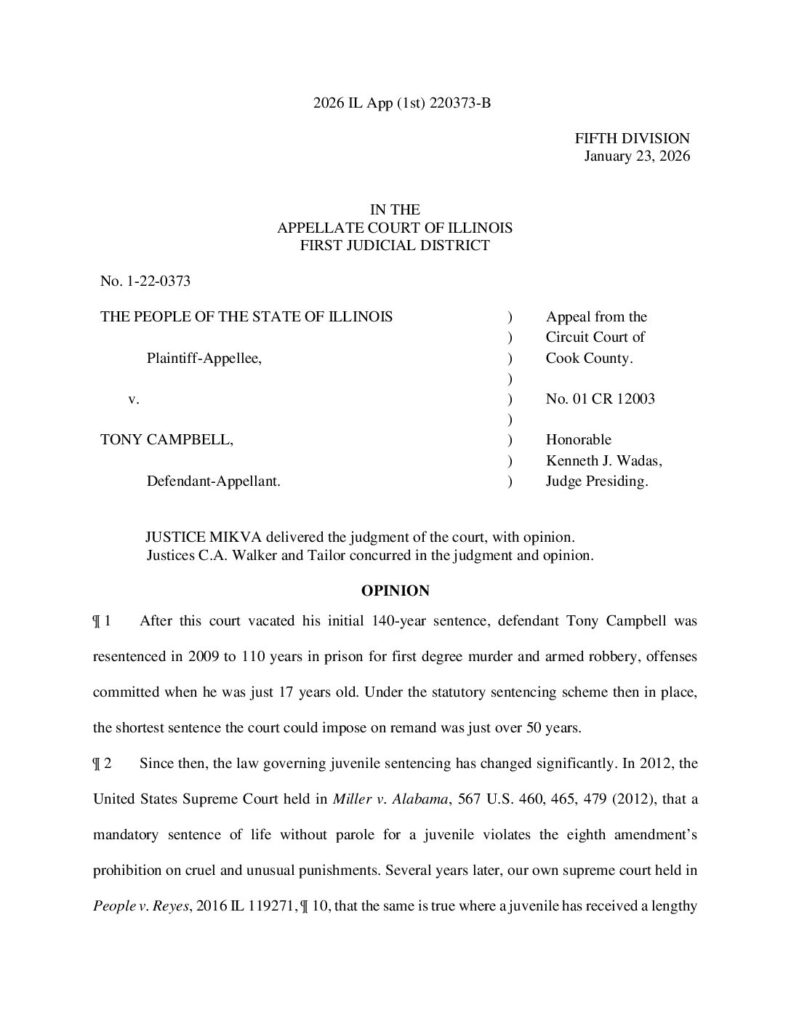
The Illinois 1st District Court of Appeals held that a statutory minimum sentence that effectively amounted to a de facto life sentence as applied to youth violated the Eighth Amendment’s prohibition on cruel and unusual punishment. The court reasoned that the core takeaway of Miller v. Alabama is that “there must be an exercise of…

The 1st District Court of Appeals of Illinois held that an individual is entitled to a new trial due to ineffective assistance of counsel where defense counsel failed to communicate sufficiently with their client and investigate a witness that was flagged by the client. The court stated in relevant part: An attorney’s failure to communicate…
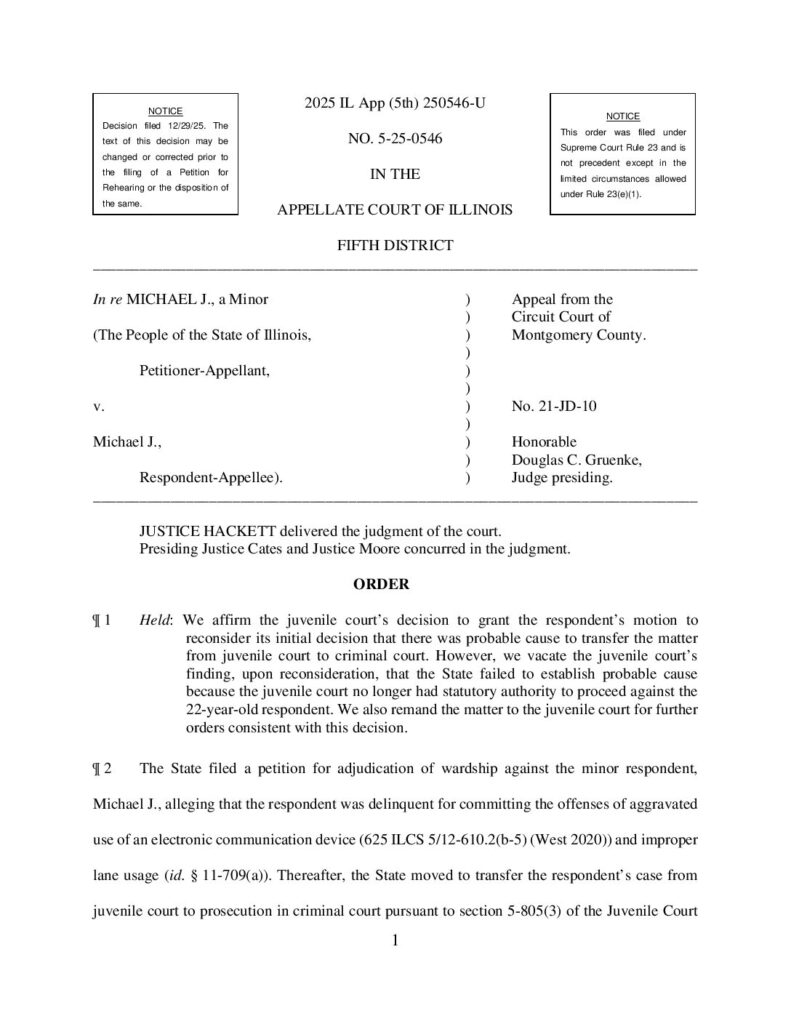
The Illinois 5th District Court of Appeals found that the juvenile court lacked statutory authority to proceed on a transfer determination once a young person turned 22 years old. This case involved an initial transfer determination followed by a reconsideration request by the defense based on lack of probable cause to justify the initial transfer…

The Second District Court of Appeals in Illinois vacated a 66-year sentence finding that the trial court misinterpreted youth-related statutory factors as aggravating instead of mitigating factors. The court stated in relevant part: “Defendant also argues that the trial court incorrectly interpreted the statutory factor of his ability to consider the risks and consequences of…

From the abstract: “This Note provides a general review of the current state of Facial Recognition Technology (FRT), including Illinois state regulation and past federal regulation attempts. This Note asserts that even as datasets become more diverse and “fairer,” FRT may still have discriminatory impacts on minority populations, as evidenced by a few highlighted examples…

“Suspensions, expulsions, and school-based arrests: These exclusionary and overly punitive disciplinary responses disproportionately impact Black students and have become normalized throughout the nation. In reality, school pushout, or the disciplinary sanction of removing students from the classroom, contravenes the very purpose of public education to prepare children to engage as full citizens in our democratic…
You must be logged into your Gault Center account to view this page. Username or E-mail Password Remember Me Forgot Password

This issue brief by the Juvenile Justice Initiative provides an overview of transfer laws in Illinois. Additionally, the brief reviews demographic data on young people who are being tried as adults and identifies the ways that transfer fails children and public safety in the state of Illinois. The brief ends by calling for a return…

The 7th Circuit Court of Appeals found that a liberty interest may exist for short periods of solitary confinement in deplorable conditions and offered the following language in support. “Jackson presented evidence showing that he was subjected to three months in appalling conditions of solitary confinement at Pontiac. Taking that evidence as true, Jackson had…

The Illinois appellate court reversed the trial court’s sentence of 14 years for an aggravated driving under the influence and reckless homicide conviction based on defense counsel’s failure to produce evidence related to youth-based factors in mitigation. The court offered the following language in support. “Because defendant was a minor when the crash occurred, the…


This report is the latest in a series of Juvenile Justice Initiative (JJI) reports on juvenile detention, building on prior research in concluding the time is ripe for a complete overhaul of the juvenile detention system in Illinois.

This report from National Institute for Criminal Justice Reform offers six principles of a positive youth justice system (‘PYJS’) including: 1) Minimize contact with the juvenile justice system, 2) partner with youth and families to develop and share ownership of case plans, 3) community-based organizations should take the lead, 4) build on youth assets and…

On October 24, 2024, the U.S. Department of Justice filed a Statement of Interest in a federal class action lawsuit challenging conditions of confinement at the Mary Davis Detention Home in Galesburg, Illinois. The DOJ asserted, “The federal government, too, has repeatedly recognized that children are developmentally and constitutionally different than adults and that excessive…


From the Executive Summary, developed by Equip for Equality: “The children in the Juvenile Temporary Detention Center (“JTDC”) are some of the most vulnerable youth in Cook County, many having experienced significant trauma and violence as part of their daily existence. The JTDC is the juvenile jail for Cook County, housing youth awaiting adjudication of their cases, as well…

This report from the Urban Institute features results from a survey of young people in four Chicago neighborhoods to “learn from young adults firsthand whether and why they decide to carry guns, how they acquire firearms, how they experience gun violence, and what they view as the best strategies to reduce gun carrying and promote safety in their communities.” From the report: …


This amici brief by Juvenile Law Center, Loyola Civitas Childlaw Clinic, and others argues automatic prosecution and mandatory sentencing of young people charged with felony murder is unconstitutional in light of recent Supreme Court case law as Illinois law does not allow for individual sentencing based on maturity and culpability. Furthemore, the brief argues the…

This amicus brief by Loyola Civitas ChildLaw Center, Juvenile Law Center, The Gault Center, and others argues there is a per se conflict of interest when a child’s defense attorney also acts as their guardian ad litem. The brief argues the guardian ad litem’s ethical and legal obligation to act in the child’s “best interest”…
