
Massachusetts
On June 26, 2026, Joshua Dankoff and Leon Smith from Citizens for Juvenile Justice (CfJJ) offered a training for the Gault Center’s New England Region on mapping and resisting local law enforcement collusion with ICE in Massachusetts and beyond. The training walked through CfJJ’s report that culminated from over 90 public records requests submitted to…
This report by Citizens for Juvenile Justice (CfJJ) investigates the level of information sharing and collusion between police and courthouse staff with federal Immigration and Customs Enforcement (ICE) in Massachusetts. CfJJ filed more than 90 public records requests in the state and found that police and courthouse staff regularly share information with ICE, effectively becoming…
The Supreme Court of Massachusetts held that a transfer hearing is a “critical stage of the criminal process” that requires effective assistance of counsel under the 6th Amendment of the U.S. Constitution. The Court held that defense counsel’s failure to present evidence on youthfulness, developmental maturity, and rehabilitation prevented the judge from considering factors critical…
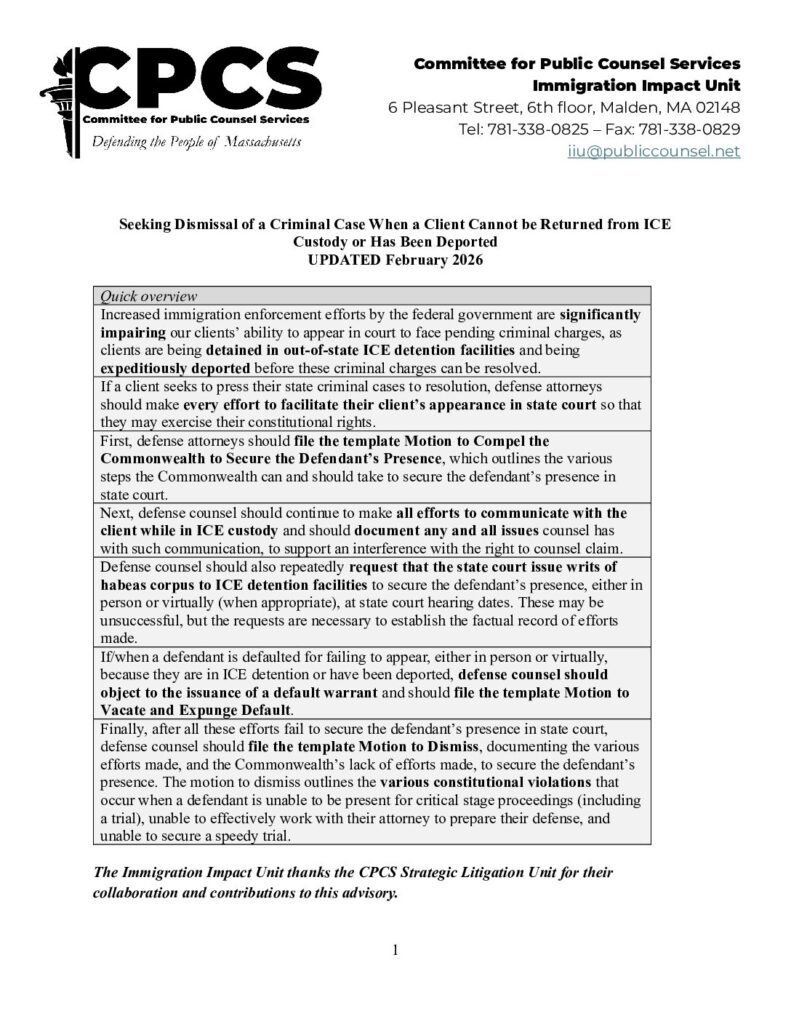
This guide from the Massachusetts Committee for Public Counsel Services, Immigration Impact Unit, offers defense attorneys a step-by-step outline for handling a client’s case when they are detained in ICE detention facilities or have been deported. From the report: “To address the concerns these open cases pose to our clients, this advisory lays out potential…
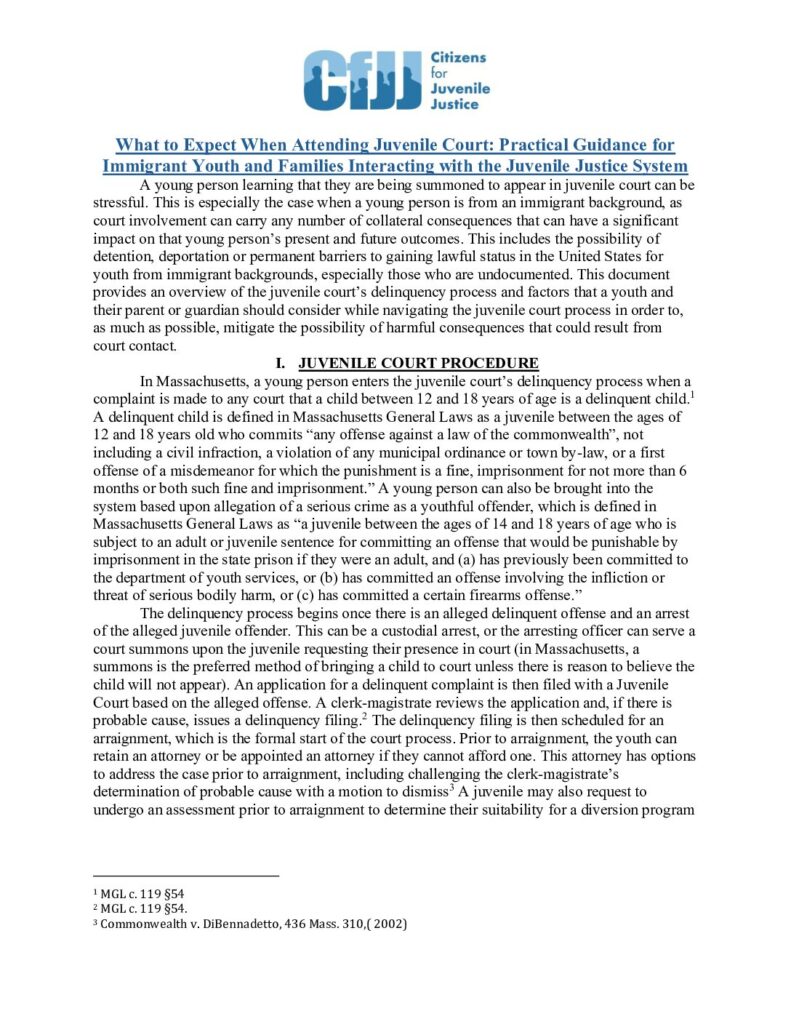
This resource from Citizens for Juvenile Justice offers practical guidance for immigrant youth and families interacting with the juvenile legal system. From the resource: “A young person learning that they are being summoned to appear in juvenile court can be stressful. This is especially the case when a young person is from an immigrant background,…

CfJJ delivered written testimony to the Massachusetts’ Joint Committee on Racial Equity, Civil Rights and Inclusion on information-sharing practices between the juvenile and criminal legal systems and federal immigration authorities. Following a review of public records requests around these practices, CfJJ found a pattern of collaboration between police, prosecutors, probation officers, and Immigration and Customs…

The Appeals Court of Massachusetts affirmed a defendant’s motion to suppress involving an anonymous tip saying they saw a person who had waved a gun. The court stated in relevant part: “Here, the motion judge found that the anonymous witness’s basis of knowledge was adequately established because the witness saw the person with the firearm…

The Health and Reentry Project highlights promising Medicaid policy changes that promote continuity of care for young people returning to their communities following incarceration. The changes will support reentry for young people who are eligible for Medicaid or the Children’s Health Insurance Program by introducing them to services that would start 30 days before release…

This guide was developed by the Gault Center New England Region and offers key insights on sex offense registration requirements for youth based on the practice and experience of youth defense practitioners in New England states.


From the introduction: “This report has been prepared for Health Law Advocates by the Boston University School of Public Health Evaluation Team, and includes qualitative feedback from MHAP for Kids clients. Our team has previously presented information regarding the quantitative impact of the MHAP for Kids program on family outcomes, overtime, highlighting improved measures of…

From the introduction: “This advisory takes you through the various stages of removal proceedings to provide an overview of the process. It also explains key terms that may be relevant to your noncitizen clients.”


This amicus brief by the Massachusetts Committee for Public Counsel Services argues the remedy of considering parole after fifteen years can be extended to late adolescents from 18-20 years old with life without parole sentences while still protecting public safety. Additionally, the brief argues judicial findings regarding the capacity of late adolescents to change are…
This amicus brief from former Massachusetts judges, the Boston Bar Association, and the Massachusetts Bar Association argues life without parole sentences violate the Commonwealth’s prohibition on cruel and unusual punishment for late adolescents between 18-20 years old for the same reasons they did for youth under 18 years old (as articulated in Diatchenko). Additionally, the brief argues late adolescents have a great propensity…
