
Louisiana

In this sample motion to release due to educational deprivation from Louisiana, defense counsel argues for release of their client from detention or secure placement in the juvenile facility due to violation of their educational rights under both state and federal law. This resource is a template with space for defenders to put their individual…
This article was published in the LSU Law Journal for Social Justice & Policy. From the introduction: “Despite having a right to receive an education like every child in Louisiana, incarcerated juveniles in Louisiana juvenile facilities are not receiving the adequate education they need to survive and prosper in a world outside incarceration. The Louisiana…
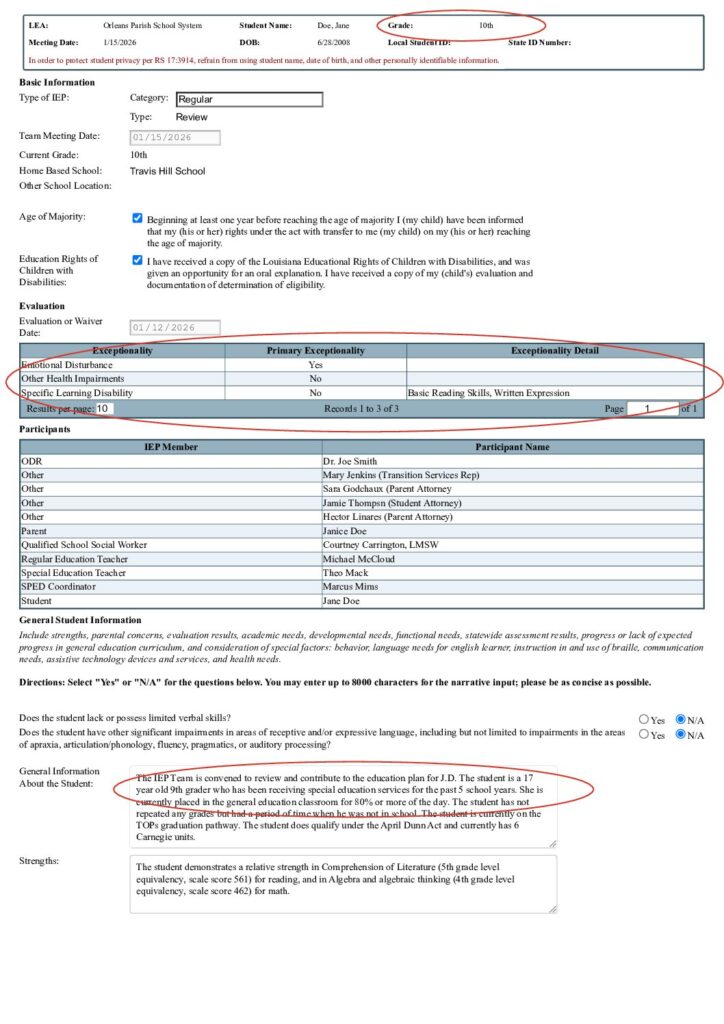
This sample Individualized Education Plan from Louisiana is part of the case scenario for the Decriminalizing Disability – Using Educational Advocacy to Fight the Incarceration of Youth with Disabilities Learning Lab.
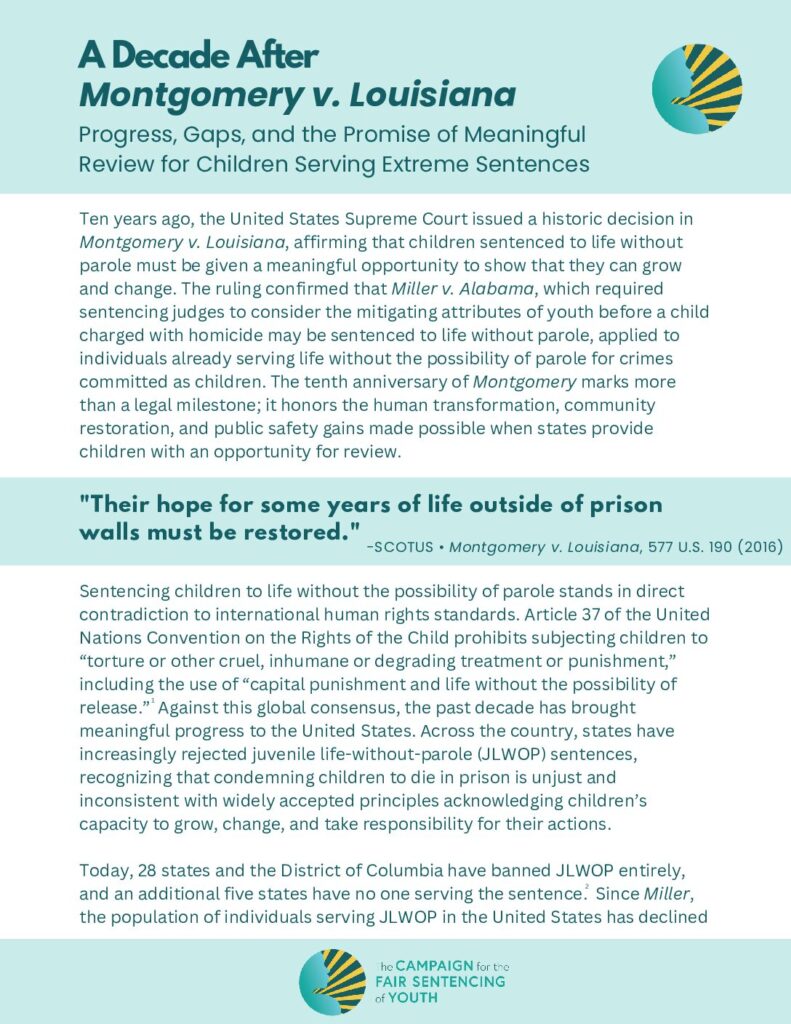
This report from the Campaign for the Fair Sentencing of Youth provides a national overview of the progress states have made post-Montgomery in changing sentencing laws for young people in adult court facing life without parole and other lengthy sentences, and opportunities for continued legislative, legal and policy change. From the resource: Ten years ago, the…
You must be logged into your Gault Center account to view this page. Username or E-mail Password Remember Me Forgot Password

“For decades, in the summertime, America has confined certain of its youth in what are essentially open-air heat camps. In city after city, camp-form is established through the enactment of warm-weather juvenile curfews which keep the youth at home or in state-sponsored centers during summer nights and, increasingly, during days as well. Local governments justify…


No. 3:22-cv-00573 (M.D. La. 2023). The U.S. Department of Justice filed a statement of interest in a civil lawsuit addressing the constitutional rights of youth who had been adjudicated delinquent and transferred to the Louisiana State Penitentiary’s former death row building, known as Angola. In their statement, the United States asserted that youth are particularly…


The U.S. Department of Justice filed a statement of interest in a civil lawsuit addressing the constitutional rights of youth who had been adjudicated delinquent and transferred to the Louisiana State Penitentiary’s former death row building, known as Angola. In their statement, the United States asserted that youth are particularly vulnerable to harmful conditions of…

This report from The Sentencing Project highlights “raise the age” legislative successes across the country, underscoring that the use of youth confinement is not a necessary result of these legislative shifts. For the nine states that implemented raise the age legislation, only New York, North Carolina, and Louisiana added juvenile facilities that are still operating,…

The Louisiana Supreme Court took up defense counsel’s writ following the trial court’s denial of a motion to quash following the State’s dismissal and refiling of charges following two adverse rulings, in effect evading all appellate review of the court’s ruling. The court found the accused, Mr. Reimonenq’s, 14th Amendment right to due process and…

On June 26, 2019, the DOJ closed its investigation of the Leflore County Juvenile Detention Center. In its closing letter, the DOJ stated “[w]e recognize that the state has made many improvements at the Detention Center School over the course of our involvement. . . . Specifically, the Detention Center School has made strides to…
This report from Justice Policy Institute highlights lessons learned from states that have raised the age of juvenile court jurisdiction, including Connecticut, Illinois, Massachusetts, New Hampshire, Louisiana, Mississippi, and South Carolina. The report examines state fiscal data, juvenile legal system data, crime trends, confinement data, recidivism research, and case studies to draw conclusions about the…


This amicus brief prepared by The Gault Center and Juvenile Law Center argues that Louisiana must grant jury trials in juvenile court given the persistent deficiencies in Louisiana’s juvenile legal system including the punitive nature of consequences youth face and the dire and harmful conditions of the state’s jails. Furthermore, amici argue there is a…

From the introduction: “This brief tells the story of how the four Models for Change states—Pennsylvania, Illinois, Louisiana, and Washington—are already moving to reform and reshape their own state juvenile justice systems. These states have demonstrated strong leadership in juvenile justice policy, value collaboration and engagement, and because of their efforts, have changed the political…

