
Washington
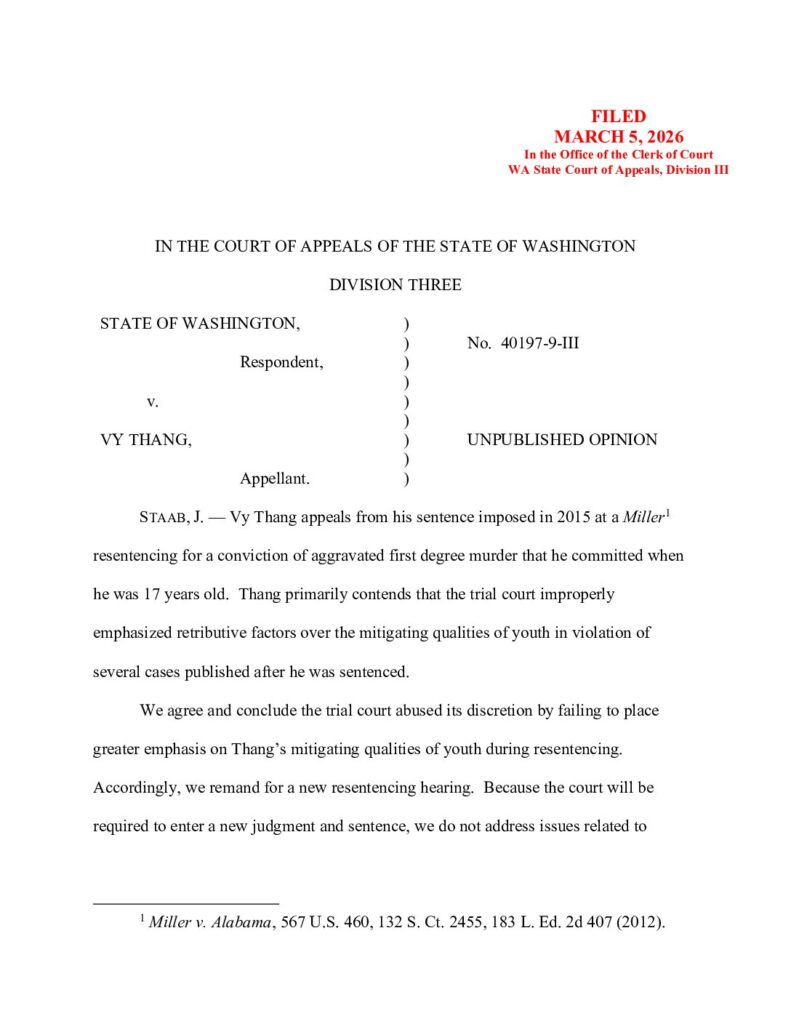
The Court of Appeals of Washington remanded a case for resentencing finding that the trial court abused its discretion by “failing to place greater emphasis on Thang’s mitigating qualities of youth during resentencing,” pursuant to the Miller decision. The court stated in relevant part: “We agree with Thang that this analysis shows that the sentencing…
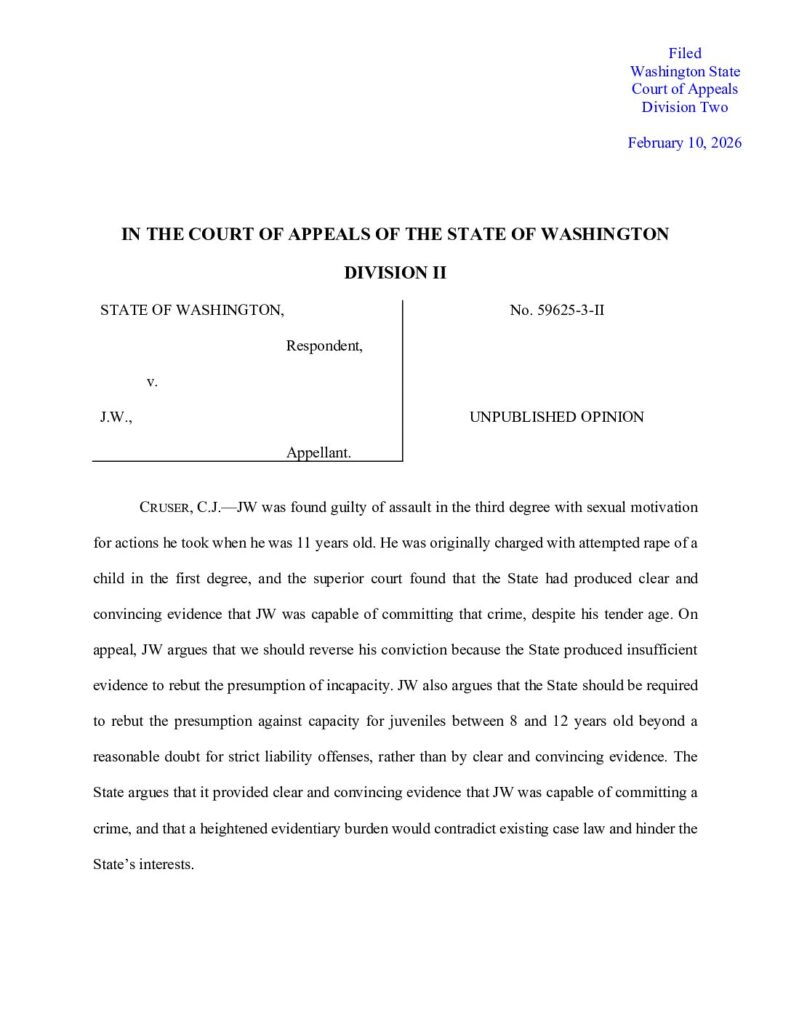
The Washington Appeals Division 2 reversed a conviction involving allegations of an 11-year-old child charged with attempted rape of a child, finding that the state failed to produce clear and convincing evidence that the child was capable of committing a criminal sexual act. The court stated in relevant part: “A child of at least 8…

The Supreme Court of Washington found a Miranda violation based on a totality of the circumstances analysis, which the Court noted must include consideration of race and age. The Court stated in relevant part: “The United States Supreme Court has established that in determining whether a suspect is in custody under Miranda, we must “‘examine…

An appellate court in Washington reversed a trial court’s denial of a young person’s motion to suppress a firearm as a fruit of an unlawful Terry stop. This case involved misidentification by the police officers of three youth of color and the court stated in relevant part: SH-M argues that the trial court erred when…

The Supreme Court of Washington vacated a conviction for second-degree murder, finding that the 16-year-old defendant’s waiver of rights was invalid, considering her age, recent head trauma, and lack of experience with the police. The court stated in relevant part: “Luna challenges several evidentiary rulings and argues that the court should have applied newly enacted…


From the Introduction: “Following a 2024 County Council request, the Pierce County Performance Audit Committee contracted with the CoLab for Community and Behavioral Health Policy at the University of Washington to conduct an audit of the county’s juvenile justice system against national and research best practice. The assessment is intended to guide future county investments…


From the abstract: “This Essay draws on empirical research to compose a sketch of the criminal legal systems of several sparsely populated counties in central and eastern Washington State. The study reveals how, at times, the dearth of attorneys available to do the work of prosecuting and defending criminal cases is subjecting system-involved individuals to…

Abstract: In the wake of Miller v. Alabama and its progeny, there has been a wider acceptance that juvenile’s need more protections in our judicial system. This is a result of a growing body of research stating that young people’s brains do not fully develop until the age of twenty-five. States across the country are…

The Court of Appeals of Washington remanded a transfer case to the superior court and offered the following language in support. “Our Supreme Court has made clear that trial courts must be vigilant in addressing the threat of explicit or implicit racial bias that affects a defendant’s right to a fair trial. We hold that…

From the introduction: “The report begins by examining the racial impact of the Persistent Offender Accountability Act (POAA) through data. The racially disparate application of the Three Strikes Law has been documented since shortly after the law’s passage and has held constant for more than two decades. This report presents the most recent data related…


The Washington Supreme Court ruled the trial court was required to consider an accused person’s race and ethnicity in the totality of the circumstances when determining whether a person was “seized” in Washington state constitution’s prohibition against unlawful seizure. The court offered the following language in support: As noted above, the article I, section 7…

In State v. K.A.B., the Court of Appeals of Washington held that the youth was entitled to a new capacity hearing based on defense counsel’s failure to thoroughly present a diminished capacity defense and the juvenile court’s application of an incorrect standard for capacity to commit a crime. The court offered the following language in support: “We reverse K.A.B.’s conviction because she received ineffective assistance of counsel. We…


